Update on Facebook-in-Egypt

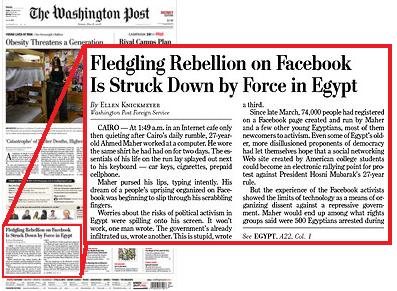
FACT: According to a Sunday Washington Post front-page story today recounting the events leading up to May 4, a “day of strike” called for by social-networkers as a protest against government policies, “By late afternoon, of the 74,000 people who had registered on the Facebook protest page, only 15 – three men and 12 women – were still eager to gather for a protest.”  [Note: the Facebook page had only been launched in late March.]

ANALYSIS: Last week I wrote about media coverage of Egypt’s Facebook affair, and noted that the Post and others had only covered it on media blogs, not in the actual newspaper.

This morning I picked up my Sunday-morning Post and saw the story, “Fledgling Rebellion on Facebook Is Struck Down by Force in Egypt,” right on the front page, which means that across Washington this morning, and other capital cities through clipping services, many in the foreign policy elite and punditocracy may be reading for the first time about the Web 2.0 facet of these events. 

Reporter Ellen Knickmeyer also posted today a related online “Field Notes” column about the challenges of covering the Facebook activists.

AddThis Social Bookmark Button 

Business Executives for National Security, and Dana Carvey?

Went to the big BENS gala last night (Business Executives for National Security) in downtown Washington, along with some Microsoft colleagues – the company was a sponsor – and several guests who fit right in with the rest of the crowd, military brass and IC muckety-mucks.  I first met BENS founder Stanley Weiss back in the late 1980s when he came to Silicon Valley to recruit support for the new group, “a nonpartisan business organization aiming to cut through ideological debates on national security issues.” 

The evening’s billed highlight was the awarding of the annual BENS Eisenhower Award to Sec. of Defense Robert Gates, who gave just a phenomenal speech (see Reuters and AP coverage today, and the full text here). I blogged a couple of days ago about his speech to the Heritage Foundation, which I read the text of, but seeing Gates deliver this speech really impressed me, to be honest. He comes across as sincerely dedicated to fixing some of the fundamental problems of DoD and the intelligence community (his career after all was at CIA and he is obviously a thoughtful critic of the DNI structure and “reforms”).  I sat there wondering whether Gates would be willing to continue at the Pentagon in the next Administration (odds are much higher of that with a McCain victory, obviously, and infinitesimal otherwise).

Brent Scowcroft introduced Gates with a warm and witty tribute, and it was nice to see him in person.  He told several jokes making fun of the Beltway culture, getting big laughs. Gates continued in kind at the beginning of his remarks, before he got serious – keep reading for one of Gates’s best jokes:

Continue reading

Social Networking in Egypt Takes a Political Turn

FACT: In the past two days, reporters for the Los Angeles Times and the Washington Post have each written accounts of the ongoing confrontation in Egypt between the government and online activists – the “Facebook Revolution” as the Post reporter terms it, hyperbolically. One interesting aspect: the two accounts are not carried as actual news stories in the “newspaper” (real or virtual), but as blog posts by the reporters on dedicated foreign-correspondent blogs. The Washington Post account is on the “PostGlobal” uber-blogsite, under Jack Fairweather’s “Islam’s Advance” blog, while the L.A. Times account is on the “Babylon & Beyond” blog, which carries a sub-head of “Observations from Iraq, Iran, Israel, the Arab World and Beyond.”

ANALYSIS: Up to now there’s been little coverage in traditional American media outlets of the emerging political tenor of some social networks in Egypt over the past several months. Major newspapers and the cable-news channels have not explored the topic, but I just returned from some time in Egypt and I learned that of course it is a widely covered and discussed topic there.  One young woman in her 30s, an urban professional, told me “I’m on Facebook all day long!”

Every morning outside my hotel room I would find an English-language newspaper, and for many days in a row it was a different paper – often because they were weekly editions.  That gave me the opportunity to read a variety of opinions from a somewhat broad band, as measured in “distance to/from the government position.”  

Helpfully, on May 6 2008 the Egyptian Mail included a summary of the raging controversy over Facebook, noting that “In Egypt, Facebook is the stage for the latest twist in the generation gap, playing host to politically hungry young Egyptians eager to take on their ageing leader.”  Only at the end of the article did I notice that it was reprinted from a New-York-based Egyptian blogger, the respected Mona Eltahawwy.

Continue reading

Predicting the Future: Bob Gates and IEDs

FACT: There’s been significant media interest in yesterday’s address at a Heritage Foundation conference by Secretary of Defense Bob Gates. Today’s Washington Post story says Gates “implored the U.S. military Tuesday to prepare more for fighting future wars against insurgents and militias such as those in Iraq and Afghanistan, rather than spending so much time and money preparing for conventional conflicts.”

ANALYSIS:The Post story isn’t inaccurate in characterizing Gates as using “unusually strong language” in the speech, but it is still better to go to the original text than to rely on a filtered media account, so here’s the actual transcript of Gates’s remarks.

Vehicle-borne IED photo by Ramzi HashishoOne thing I’ll note about his main point is that he gets right to it: “I have noticed too much of a tendency towards what might be called ‘Next-War-itis’ – the propensity of much of the defense establishment to be in favor of what might be needed in a future conflict,” as opposed to what we need in the here-and-now.  In his eyes, what we need now is counter-insurgency tactics, capabilities, and mindsets. 

He doesn’t argue that other large nation-states will never be our adversaries, or that we’ll only face roving bands of anarchic terrorists.  On the contrary, he argues that “even nation-states will try to exploit our perceived vulnerabilities in an asymmetric way, rather than play to our inherent strengths.” 

Continue reading

IARPA and the Virtual Long Tail

FACT: This week, the Intelligence Advanced Research Projects Activity, an arm of the Director of National Intelligence (DNI), launched its new unclassified website.  What’s there is initially fairly minimal, but they’ll be adding to the public information posted there regularly.

ANALYSIS:  I spent the week in Orlando, as a Keynote speaker at the IARPA “Incisive Analysis Conference.”  I’ll be writing a little more about the conference in the near future, as I saw some great demo’s and spoke to the principal investigators on many excellent and far-sighted advanced research projects sponsored by IARPA.  It was great to be there and to see so many old friends from the intelligence community, the national labs (PNNL, Sandia, Oak Ridge, Livermore), DoD, and innovative commercial R&D outfits.  Also, as the first IARPA conference since the organization’s launch, it was an opportunity to hear new director Lisa Porter communicate her vision and principles, which she did well and I’ll discuss those soon as well.  (She also kidded me about my efforts to make her a cultural phenomenon, but I blamed it on WIRED magazine.)

Continue reading

“Legally Blonde 2.0” – SoCal Spook at Harvard

Shout out to Chris Rasmussen, a former colleague in the intell biz who emails that he’ll be speaking on uses of Web 2.0 approaches in the Intelligence Community at Harvard’s Kennedy School of Government in June…. as he put it in his email, “I’m pretty sure Danish dudes from southern California have been legallyblonde2.jpgblacklisted from Harvard for hundreds of years. Well the times are changing.”

Chris has been involved in social-networking and other 2.0 efforts in the IC, both at the enterprise level and in grass-roots form — accomplishing the latter and encouraging the former (strongly).  The Kennedy School program, “Web 2.0: Taking Action in Government”  is advertised as “examining the lessons learned from first movers in both business and government and distilling what actions government leaders must now take to harness the power of these new tools and business models.”  (more info here

I especially like that the conference is being organized with the help of Don Tapscott, co-author of  an excellent book: Wikinomics: How Mass Collaboration Changes Everything.

Continue reading

SecDef Blasts Air Force on ISR

FACT: U.S. military use of airborne drones (UAVs) dawned at the turn of the millenium, with nearly 100 vehicles in use before the Sept. 11 2001 attacks. By the end of that year the number had doubled, with the majority in use in Afghanistan. Today, according to a speech today by Sec. of Defense Bob Gates, “We now have more than 5,000 UAVs, a 25-fold increase since 2001.”

ANALYSIS: The Gates speech today, to an Air Force audience, is being covered mostly with a focus on his “harsh criticism” of that service. For example, CNN’s headline was “Defense Secretary Scolds Air Force for War Effort,” or Fox News “Gates Says Air Force Must Step Up Efforts in Iraq, Afghanistan.”  And there was plenty of raw material for the tough stories, including CNN’s inclusion of the Gates soundbite that getting the Air Force to send more surveillance and reconnaissance aircraft to Iraq and Afghanistan has been “like pulling teeth.”

Others (like a Reuters story) struck a less frenzied tone, including more depth about his proposals going forward, and the Defense Department’s actual plans for improved acquisition and use of Intelligence, surveillance, and reconnaissance, or ISR. I’d encourage you to read the full transcript (get it here).  (By the way, here’s some background on ISR and its variants.)

Continue reading

Tempted to “Skimp” on IT Security?

FACT: According to a study presented at last week’s annual RSA Conference on cyber security, by Palo Alto Networks CTO Nir Zuk, “Users are routinely, and fairly easily, circumventing corporate security controls. And that is because traditional firewall technology was not meant to grapple with the diversity of Internet applications of recent years.”

ANALYSIS: Security has been an even hotter topic than usual for the past month, what with new national-level attention to cyber security and, for Microsoft, a culmination of sorts of various strands of effort into our new “End to End Trust” initiative.  My boss, Jim Simon, attended the RSA Conference in San Francisco, with his boss, Craig Mundie, Microsoft’s Chief Research and Strategy Officer.  Craig laid out Microsoft’s “End-to-End Trust” vision, designed to provide users more control over online and enterprise systems.  His keynote was widely covered (even by offbeat security blogs, like RiskBloggers.com) so I don’t need to rehash it.

Nir Zuk’s presentation was interesting – and not just because he’s one of the true pioneers of firewall technology.  He really understands secure enterprise environments, something I’m talking about increasingly with government organizations, who are learning the hard way the need to protect their data, apps, and computing platforms.  

Continue reading

Air Wars: the Air Force Takes Heat for its PR

FACT: A heated online debate is erupting about a particular photo posted online, and the brouhaha around it focuses on whether or not classified details are contained therein, thus revealing them. 

ANALYSIS: Given that others are even now writing extensively about this photo and its controversy I thought I would add a couple of thoughts.  Don’t bother blaming me for linking to the photo, by the way; given the attention and reposting/rehosting it has already received, the glare of publicity can only serve to prod better security practices. 

I expect to see parody versions on Flickr soon, with “Area 51” touches.

And so to my related thoughts: recently, an active-duty USAF officer and regular reader emailed me about one of my posts concerning Rod Beckstrom and the new National Cyber Security Center, which he had not previously heard of.  He wrote that in discussing it with a colleague, the response was “I thought the Air Force Cyber Command already had the mission to coordinate all cyber security efforts.”

Continue reading

Friendships and Professional Relationships

FACT: The General Accounting Office has lifted a week-old ban imposed on IBM’s ability to win any new federal contracts (or work on new task orders for existing contracts).  But, according to ComputerWorld, “IBM still faces an investigation by the EPA as well as a federal grand jury probe over a bid for a contract at the agency in 2006.” The ban had been imposed because of significant problems in the process surrounding the $84 million Environmental Protection Agency contract, which the company lost last year. 

ANALYSIS: Now that the ban has been lifted, I am glad to relay the news — not only because I blogged about it when imposed but also because I admire IBM and its work for government. But the circumstances made me think about my own current set of relationships with former colleagues in the federal government.

According to the AP’s account of the agreement struck with IBM leading to the ban’s lifting, which I read in Enterprise Security Today, “Several IBM employees allegedly obtained protected information from an EPA employee, ‘which IBM officials knew was improperly acquired, and used the information during its negotiations to improve its chance of winning a contract,’ according to the agreement. Such an act violated federal procedures… IBM has placed five individuals on administrative leave pending its own internal investigation and any federal probe.”

I don’t have more to say about the issue per se, other than riffing on that human aspect of the affair to make a personal comment about my own experience since leaving the federal government’s payroll last December….

Continue reading