Peering into North Korea’s Future: the Cyber Angle

Looking out over the DMZ into the drab proto-industrial North Korean villages along the border.

With the death of North Korean dictator and “Dear Leader” Kim Jong Il, I join the rest of the world in welcoming this early Christmas gift… at least I hope that it proves to be so.

Egypt’s Mubarak is gone but the country is less stable; post-Qadhafi Libya’s political course is still an open question. So uncertainty is the only safe prediction about North Korea’s near-term political environment. But no nation’s people have endured such unrelenting deprivations (mass starvation, no fuel) for so long in the post-World War II era.

I have no special insight into North Korea’s future. My only DMZ visit on the Peninsula, with a close-up look at Panmunjeom and beyond it “the last Stalinist state on earth,” was in 2006 (see my photos and observations here).

But I have noted the Western-education background (and apparently technologically-intensive current activities) of “The Great Successor,” Kim’s son Kim Jong-Un. One can understand the intense focus which Western governments have trained on the younger Kim’s background and activities, for any clues into his plans – and the plans of those who surround him, or potentially could rival him.

Only a year ago, in October 2010 SCIENCE Magazine published a short but interesting story on Kim Jong-Un, asking “Will Korea’s Computer-Savvy Crown Prince Embrace Reform?”

According to internal North Korean propaganda, informants claim, Kim oversees a cyberwarfare unit that launched a sophisticated denial-of-service attack on South Korean and U.S. government Web sites in July 2009. South Korea’s National Intelligence Service blamed the North, which has not commented publicly on the attack. Kim Jong Un’s involvement cannot be confirmed, says computer scientist Kim Heung-Kwang, founder of North Korea Intellectuals Solidarity, a group of university-educated defectors that raises awareness of conditions in the North… But it’s plausible: Kim claims that Kim Jong Un was tutored privately by a ‘brilliant’ graduate of Universite Paris X who chaired the computer science department at Kim Chaek University of Technology in Pyongyang before disappearing from public view in the early 1980s.” [emphasis added]

To get a feel for how the North’s military has gone about organizing for cyber activities, the best unclassified source I know of remains Christopher Brown’s 2004 Naval Postgraduate School thesis “Developing a Reliable Methodology for Assessing the Computer Network Operations Threat of North Korea.” Brown wrote, by the way, that his thesis was an attempt “to prove that a useful methodology for assessing the CNO capabilities and limitations of North Korea can be developed using only open source information” (emphasis added). Brown also wrote about the early personal role of Kim Jong Il’s eldest son Kim Jong Nam in establishing the priority of computer network operations among military activities (Nam once headed a North Korean intelligence agency, though in recent years he dissipated into a South-Park-like role as a casino-loving playboy).

More recently, there’s information on North Korea’s cyber hacking military units here, where StrategyPage.com concluded (in 2009) that “North Korea is something of a museum of Stalinist techniques. But it’s doubtful that their Internet experts are flexible and innovative enough to be a real threat.”

The contrary view, with a heightened state of alarm about North Korea’s capabilities and intentions, runs through Richard Clarke’s 2010 book Cyber War, where he recounts breathlessly the Soviet-Olympic-style recruitment of “elite students at the elementary-school level to be groomed as future hackers.” In a publicity interview for the book, Clarke told Forbes magazine: “if you ask who’s the biggest threat in the sense that they might use their abilities, it might be North Korea. First, they’re crazy, and second, they have nothing to lose.”  Even China’s People’s Daily English-language version carried a dire summary in December 2010 of North Korea’s aggressive cyber intentions, “Cyber Attack from Pyongyang: South Korea’s Nightmare?”

I hope and expect that cyber activities will not be the immediate focus of the new post-Kim Jong Il leader. Certainly regime transition and  consolidation of authority is the first priority. So far, two days after the actual death, we’re seeing a mannered roll-out of news and propaganda consistent with the clockwork transition from “Great Leader” Kim Il-Sung to his own son in 1994.

Everyone’s watching….
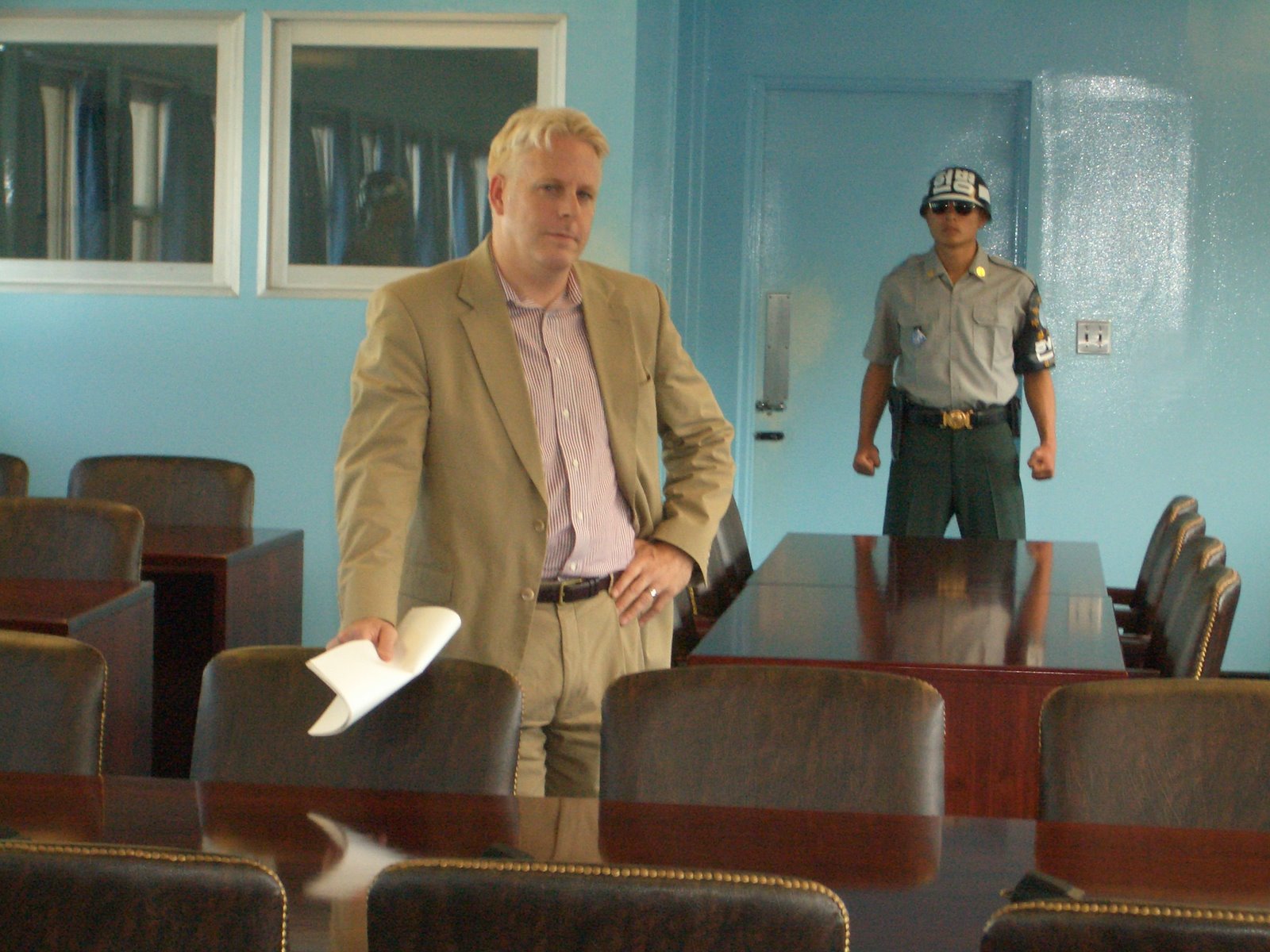
My stroll over to the far side of the famous Demilitarized Zone (DMZ) table, where I was testing the patience of the MP breathing down my neck.

Tech Trip to Argentina

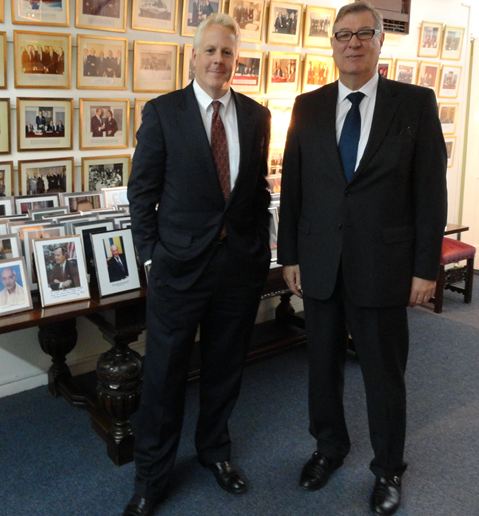
With Luis Ruvira, President of the Argentine American Dialogue Foundation, after my speech at the Argentine Council on International Relations

I’m traveling in Argentina this week, on a trip sponsored by the U.S. Department of State in their official Speaker’s Program. The U.S. Embassy in Buenos Aires had requested of DoS an American technology speaker “who can talk about technology innovation and bleeding edge kinds of things.  The goal is to highlight the role that innovation and technology plays in creating a better society.” I was delighted to accept the invitation when asked by my friend Lovisa Williams of the State Department’s Internet Steering Committee.

Most of the trip is being spent in Buenos Aires, second largest city in South America – so large it is constitutionally recognized as an autonomous federal entity alongside the 23 Argentinian provinces, with its own government ministers and municipal administration. I am also enjoying side visits to Rosario and La Plata, large cities and provincial capitals. I’ll write about several aspects of the trip separately.

Working together to cram in a series of whirlwind meetings have been my excellent co-hosts, the U.S. Embassy and the respected Argentine American Dialogue Foundation. Below are the highlights of the visit, plucked from my official agenda:

Monday 9/19: Meeting with the Minister of Education for Buenos Aires city and visit to the Escuela Gauchos de Guemes school which is studying the social and educational benefits of having given each child their own netbook. Tour of the Universidad Abierta Interamericana (UAI) (the Open InterAmerican University), visiting their robotics labs, meetings with engineering students, and a separate meeting with authorities from the university and national civil servants. Meeting with Pedro Janices, National Director at the National Office for Information Technologies (executive-branch component of the President’s Office; Pedro has been called “the Argentine CIO,” and has worked with the first U.S. CIO Vivek Kundra.)

Tuesday 9/20: Public speech at the Argentina Council for International Relations (CARI, one of the most important think tanks in Latin America), topic: “Governments 2.0 and the impact of new technologies.” Lecture at the American Club of Buenos Aires, with participating companies from the American Chamber of Commerce of Argentina, members from the academic sector and public servants (including the Head of International Relations of the National Ministry in Science and Technology). Tour of the Supreme Court of Argentina, meeting with Deputy Chief Justice Highton, who was the first woman appointed to the Court (under a democratic government).  Videoconference lecture on “Innovation and Government” at the National Technological University (UTN), transmitted live to 13 campuses of the University in the interior of the country.

Wednesday 9/21: Trip to Rosario, second largest city in Argentina and capital of Santa Fe Province. Visit and tour of largest tech firm in Rosario, Neoris; lunch with Neoris Latin American President Martin Mendez.  Meeting with the Secretary of Production and Local Development for the city of Rosario, subject “Creating conditions for local technology-industry growth.” Meeting with Rocio Rius of the Fundacion Nueva Generación Argentina (Argentina New Generation Foundation). Lecture at the Universidad Abierto Interamericana (UAI) campus in Rosario on new technologies and their impact on government; audience of authorities and students from UAI and other universities, faculty from the Engineering School, and also local public servants.

Thursday 9/22: Trip to La Plata, capital city of Buenos Aires Province.  Meeting with Governor Daniel Scioli (Vice President of Argentina 2003-2007) and other provincial civil servants, including Undersecretary of Institutional Relations, Director of Interministerial Relations, and Chief of Cabinet.  Public Lecture at the National University of La Plata, guest of Dean of the Informatics Faculty.

Friday 9/23: Participate in opening ceremonies in Buenos Aires of the IX Congreso Internacional en Innovación Tecnológica Informática (CIITI, Ninth International Congress on IT Innovation). Visit to Universidad Argentina de la Empresa, (UADE, Argentine University of Enterprise), meetings with faculty/students from Government, Law, and Engineering departments, and tours of laboratories. Lecture at the American Club of Buenos Aires. Meeting with Director of the Business School at Argentine Catholic University, and Dean of the Faculty of Economic Sciences. Private meeting at Embassy with U.S. Ambassador Vilma Martinez. Panel speaker on “Ciberculture Y Gobierno” (Cyber-culture and Government) at the IX Congreso CIITI with international panel.

I’ve been on several other State Department-sponsored trips before (to Mexico and, many years ago near the end of the Cold War, to the Soviet Union), but I must say that this frenetically busy jaunt through lovely Argentina may be my favorite. I’ll write more over the next few days.

Share this post on Twitter

Email this post to a friend

Virtual recipe stirs in Apple iPad, Microsoft Kinect

Who says Apple and Microsoft can’t work together?  They certainly do, at least when it involves the ingenuity of their users, the more inventive of whom use technologies from both companies (and others).

Here’s a neat example, “a just-for-fun experiment from the guys at Laan Labs” where they whip up a neat Augmented Reality recipe: take one iPad, one Kinect, and stir:

Some technical detail from the Brothers Laan, the engineers who did the work:

We used the String Augmented Reality SDK to display real-time 3d video+audio recorded from the Kinect. Libfreenect from http://openkinect.org/ project was used for recording the data coming from the Kinect. A textured mesh was created from the calibrated depth+rgb data for each frame and played back in real-time. A simple depth cutoff allowed us isolate the person in the video from the walls and other objects. Using the String SDK, we projected it back onto a printed image marker in the real world.” – source, Laan Labs blog.

As always, check out http://www.kinecthacks.com/ for the latest and greatest Kinect hacks – or more accurately now, the latest cool uses of the openly released free Kinect SDK, available here.

There are several quiet projects underway around the DC Beltway to make use of the SDK, testing non-commercial but government-relevant deployments – more detail and examples at the appropriate time. We will eventually release a commercial SDK with even more functionality and higher-level programming controls, which will directly benefit government early adopters.

In the meantime, I may report on some of the new advances being made by our research group on Computational User Experiences, who “apply expertise in machine learning, visualization, mobile computing, sensors and devices, and quantitative and qualitative evaluation techniques to improve the state of the art in physiological computing, healthcare, home technologies, computer-assisted creativity, and entertainment.” That’s a rich agenda, and the group is in the very forefront of defining how Natural User Interaction (NUI) will enhance our personal and professional lives….

Share this post on Twitter

Email this post to a friend

Through the Afghan Looking Glass

The news today that the United States government will be paying $367 million dollars to Russia, for 21 Russian Mi-17 “Hip” helicopters for use by Afghanistan’s military, for some reason made me recall something I heard Monday.  I was talking about the Libya crisis to an E-Ring friend and former colleague in the Pentagon who told me, “the difficulty in Libya is that this is all new territory for us, new because it’s more complex, and so we have to figure it out as each new complication comes along.”

That’s one way of looking at modern life, as if drowning in too much data. Perhaps there’s another, driven more by longer memory, and analysis “à la recherche du temps perdu.”  Let’s set down some facts, past and present, and see if any lessons emerge. With apologies to Mark Twain whose forward to Adventures of Huckleberry Finn reads:

“Persons attempting to find a motive in this narrative will be prosecuted; persons attempting to find a moral in it will be banished; persons attempting to find a plot in it will be shot. By Order of the Author”

Once upon a time, not so long ago (the 1980s), the United States armed Afghan “rebels” against an oppressive central government and its foreign puppetmaster patron, the Soviet Union. The rebels pre-existed the foreign involvment; in fact there is difficulty finding a historical point in the region’s history when there weren’t “rebels” against anyone claiming to be “the government.” (If it’s easier for you, imagine the residents of the hills of Kentucky and West Virginia.)

Continue reading

Air Everything

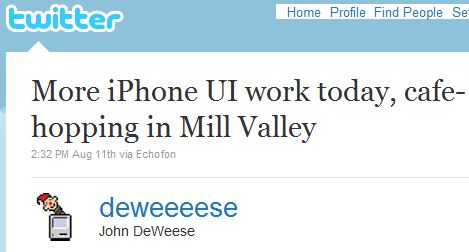
Like many people, I was very impressed by a video over the weekend of the Word Lens real-time translation app for iPhone.  It struck with a viral bang, and within a few days racked up over 2 million YouTube views. What particularly made me smile was digging backwards through the twitter stream of a key Word Lens developer whom I follow, John DeWeese, and finding this pearl of a tweet (right) from several months ago, as he was banging out the app out in my old stomping grounds of the San Francisco Bay Area. That’s a hacker mentality for you 🙂

But one thought I had in watching the video was, why do I need to be holding the little device in front of me, to get the benefit of its computational resources and display? I’ve seen the studies and predictions that “everything’s going mobile,” but I believe that’s taking too literally the device itself, the form-factor of a little handheld box of magic.

Continue reading

The wikileaks label ticks off Wikipedia cofounder

Note from Lewis: I have commented on the latest Wikileaks outrage elsewhere (Facebook, Twitter), making clear my thoughts for what they’re worth.  Briefly, they summarize in pointing out that the U.S. Government has now allowed a dynamic to emerge without challenge: an “acceptable” intermediary between Traitor and Public. The original insider-threat individual who ripped the 251,000 cables and all the other previously leaked Iraq war data would likely not have been able to simply provide that to the New York Times personally and have it immediately published; they might have turned him in themselves. But the miraculous creation of a self-appointed, self-sanctified group like Wikileaks has allowed motivated groups like the Times & the UK’s Guardian to proclaim that their hands are clean. I find it outrageous. But the government did not press the point after the first major release (Iraq war data) with any forceful intent, so now we’re simply going to see this continue – until an Administration gets serious with criminal charges including treason for anyone involved, right up the chain of those stealing/mediating/publishing classified information.

 An online friend, Larry Sanger, today posted some very thoughtful remarks from a unique perspective – as a cofounder of Wikipedia who obviously is offended among other things by the misleading use of “Wiki-” in the Wikileaks name.  But he makes some other profound points as well. He offered to have them reposted, which I have done below. Reader comments are welcome, either below or as always by email.

 Continue reading

Increasing Jointness and Reducing Duplication in DoD Intelligence

Today I’m publishing an important guest-essay, with a brief introduction.  Last month the Wall Street Journal published a 12-part online series about college graduates and their paths to success, featuring surveys and input from job recruiters. One thing caught my eye, at least when blogged by an acquaintance, Prof. Kristan Wheaton of the Mercyhurst College Institute Of Intelligence Studies. The WSJ’s study included a look at recent graduates’ job satisfaction in their new careers, and as Prof. Wheaton strikingly put it in his own blogpost:

Intelligence Analysts are Insanely Happy.” 

I’m pretty sure that’s not really true by and large; Prof. Wheaton seems slightly dubious as well. Many readers of this blog are intelligence analysts themselves, so I’d love to hear from you (in comments or email) about your degree of giddyness….

We all know that the intelligence-analysis field as currently practiced in U.S. agencies bears many burdens weighing heavily on job satisfaction, and unfortunately weighing on successful performance.  Our youngest and our most experienced intelligence analysts have been battling those burdens. 

One analyst has now put constructive thoughts on paper, most immediately in response to a call by Defense Secretary Bob Gates asking DoD military and civilian employees to submit their ideas to save money, avoid cost, reduce cycle time and increase the agility of the department (see more about the challenge here).  

Continue reading

Contributing to Intelligence Innovation

Below are two ways to contribute to innovation in government, and specifically in intelligence matters. One is for you to consider, the other is a fun new path for me.

Continue reading

Mix, Rip, Burn Your Research

You’ve done research; you’ve collected and sifted through mounds of links, papers, articles, notes and raw data. Shouldn’t there be a way to manage all that material that’s as easy and intuitive as, say, iTunes or Zune – helping you manage and share your snippets and research the way you share and enjoy your music?

Continue reading

Your choice, Dataviz as event or book

A friend wrote asking if I could make it to an event happening this week near DC. I can’t make it, but fortunately he also mentioned as consolation that he has a cool new book on the cusp of release – and I’ve now ordered my copy.

The Friend: legendary visualization and HCI guru Ben Shneiderman (Wikipedia entry). Ben is a computer-science professor at the University of Maryland and the founder of its well-known Human-Computer Interaction Laboratory (HCIL), as well as an ACM Fellow and AAAS Fellow.  He has done government a million favors over the years, consulting for agencies, including his recent work on the Recovery.gov site to help that platform of data – from hundreds of thousands of sources – organize, host, and visualize the data for millions of visitors.  I first got to know Ben through his support for better intelligence analysis – he helped invent a longtime intelligence analytics tool, Spotfire (see his article “Dynamic queries, starfield displays, and the path to Spotfire“).  Ben’s also well-known for his award-winning 2002 book Leonardo’s Laptop: Human Needs and the New Computing Technologies, which I enjoyed and still think about when brainstorming new techie toys.

Continue reading