Microsoft and Google Look at the World Differently

I didn’t think I would have to write this same kind of observation twice within a year. But today, on D-Day, I notice yet again a striking difference between Google and Microsoft.  And in this case, one can almost read the evidence as a snub from Google to the United States, to the nations who united in sacrifice during World War II, and to President Obama on a day of his personal leadership in commemorating international war and peace.

I made a similar observation on Columbus Day, when Microsoft chose to honor Christopher Columbus and his explorations’ significance to American history and the world, while Google chose to honor – wait for it – Paddington Bear’s “birthday.” (See my post from then here.)

Today is of course D-Day, the 65th anniversary of a day in which over 2,000 American soldiers lost their lives, leading the way in the greatest military operation in the history of the world, as the initial landing to liberate Europe and the beginning of the end of the Nazi empire.

Google and Microsoft are two great American companies, which operate globally. Each has a public face to the world through signature online properties – their search engines. In Google’s case, that page at Google.com is their ne plus ultra public face, since they are at core a mighty search engine.

Take a look at the two pages today. Microsoft’s Bing search-engine uses its home page to commemorate D-Day, with a dramatic photograph of Normandy Beach today, and mouse-over popups providing historical highlights and links to more information on the battle’s signficance to World War II and to world history.
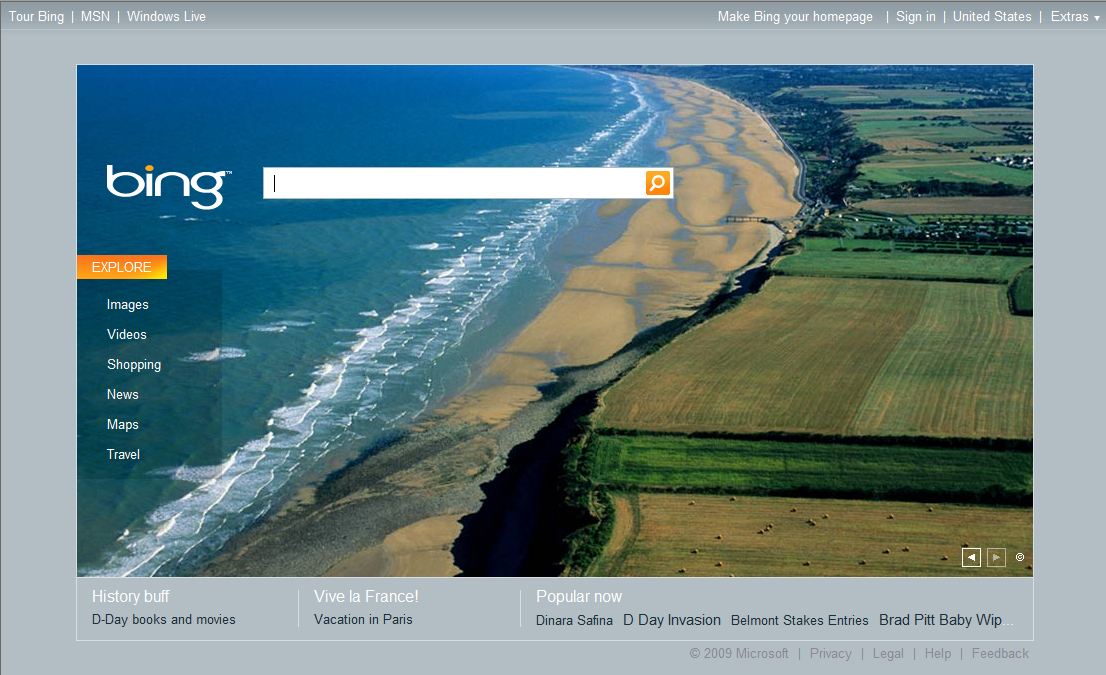
Bing D-Day

Google uses its home page to commemorate the 25th anniversary of the invention of the computer game Tetris.
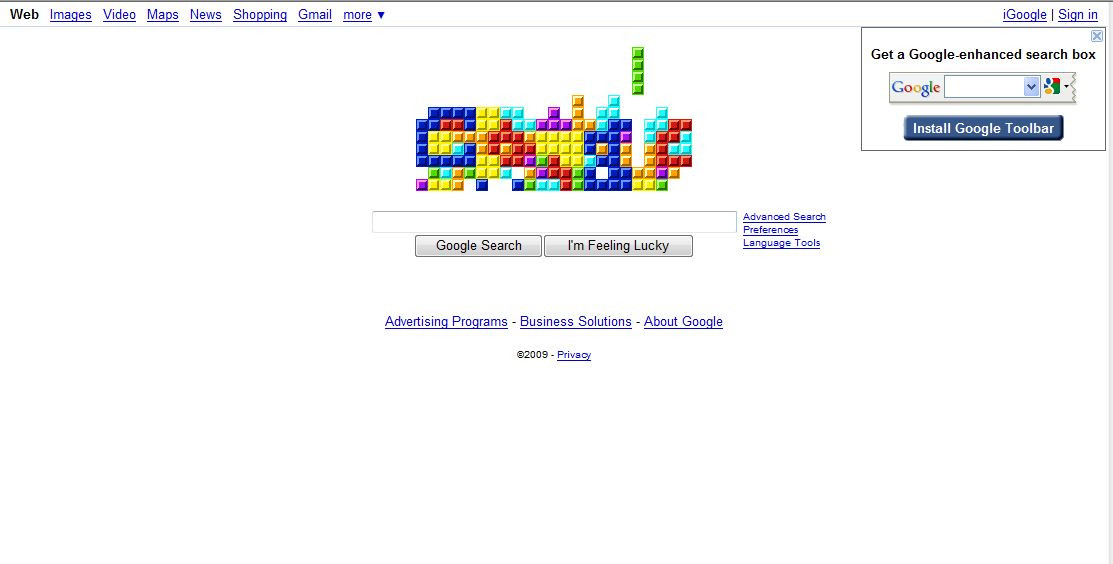
Google Tetris

The mouse-over popup on the cutesy Google logo reads, “Celebrating 25 years of the Tetris effect – courtesy of Tetris LLC.”  (I suppose one could read that as, predictably, a coporate ad, right there on Google’s home page.)

Just as I noted on Columbus Day, this doesn’t appear to be a localization issue, or an issue of appealing to a global audience – both Microsoft and Google know my location, and in fact each is serving up a page targeted for me in the United States.

Don’t get me wrong: Tetris was an amusing and absorbing game. As a young guy I spent hours dropping the bars and shapes to fit into the rising pile below.

But at certain moments in life, you put aside childish things. Unless you’re trying to make some other kind of statement.

Note: I am a Microsoft employee. But this is not a Microsoft corporate blog, it’s my personal blog – and I’ve been known to tweak Microsoft here frequently as well.  This is my personal observation space.

I have to admit I am puzzled – and personally appalled – by the decision-making over at the Googleplex, and the statement they choose to send to the world.

President Obama is leading our delegation himself at Normandy Beach today, for the international event with other world leaders remembering a moment of global importance.  Self-evidently Eric Schmidt and the Google gang weren’t on board with that, and by their way of thinking saw something more significant to mark. 

Email this post to a friend


Obama Team Infighting on Intelligence

The easiest prediction in Washington is this one: “bureaucratic turf war.” The Obama Administration isn’t immune. Several months ago when the president-elect announced his names for DNI and CIA director, I put forth this idea:  “Swap Blair and Panetta: A Modest Proposal.”  In it I wondered, between the two of them, “Who gets the top bunk?”

Well, they still haven’t figured that out yet. 

Continue reading

A few words about a few great Pentagon leaders

I was thinking about the Pentagon over the long weekend – appropos, given the Memorial Day celebration. But my thoughts were also sparked by viewing a 9/11 documentary, reviving all the memories of that dark day’s attacks on New York and Washington – which ultimately led to my joining the ranks of defense intelligence for a while.

Continue reading

The Spy Chief and Bohemian Rhapsody

Very often, complaints about the stasis of the reform-resistant Intelligence Community recount the same old complaints, about how little the bureaucratic and stovepiped mentality has changed inside its oh-so-thick walls.

Yet I find some encouraging signs, and this week featured another one: the ceremony for this year’s winning entries in the IC’s “Galileo Awards” program, designed to reward innovative ideas and proposals for new thinking and positive change. More than 50 entries came from 14 separate agencies across the community, and this week marked the public crowning (at least, publicly to an intell audience) of the three winning papers.

Just in case you weren't sure - that's DNI Blair on the left, I believe, Freddie Mercury on right

Just in case you weren't sure - that's DNI Blair on the left, I believe, Freddie Mercury on right

And oh, how far we’ve come from the days of DNI Mike McConnell, not to say gray-faced shadowy DCI’s like Dulles and Colby, when we see a DNI rock the stage as Dennis Blair did in Wednesday’s ceremony.

Rock the stage? Well, I take it as a real sign of progressive change in the IC that we now have a Director of National Intelligence who can easily and with familiarity quote from an iconic rock song of the 1970s to make his point:

Everyone knows something about Galileo – if nothing else, as a lyric in the Queen song, “Bohemian Rhapsody.” You head-bangers in the audience, if you know what I’m talking about, bob your heads up and down.

For the rest of you who are a little less contemporary, Galileo was the Renaissance scientist who proved empirically that the Sun – not the Earth – was the center of the known universe.  It’s too bad he’s still not around in some modern version to prove Washington is not the center of the universe.

Blair did have a more serious point to make: “We have to work to create an integrated global enterprise that can anticipate and respond to rapidly changing threats. Innovation has never been more important. And keeping the Intelligence Community on the cutting edge of innovation is a critical priority for all of us.”

Unfortunately for those of you without security clearances, the submissions – the “innovative ideas” on how to improve intelligence collection, analysis, and operations – are often classified. So you won’t be able to read them in the open.  Nor should you 🙂

But it is at least worth mentioning, as Blair did, that for the first time in the often CIA-dominated awards, a paper submitted by two FBI officers (often considered the red-haired stepchildren of the IC) received honorable mentions. As Freddie Mercury – oh, sorry, as Denny Blair said: ” That’s an important trend toward participation and collaborative thinking, from all corners of our Intelligence Community.”

My congratulations to the winners – and a tip of the hat to all those who submitted.

Email this post to a friend

AddThis Social Bookmark Button

Immersed in Augmented Reality

Here’s a quick post, about a talk I gave this week – but as an excuse to link to a much more compelling presentation given at the TED Talks recently. Yesterday I had the good fortune to deliver the “Technology Keynote” address at the annual International Field Directors and Technology Conference, in Delray Beach, Florida. The IFD&TC is a well-known group in its field – no pun – of the world’s leading academic and government researchers, conducting large-scale and longitudinal social-scientific research studies.

As an example, think of the U.S. Census – and indeed I had the opportunity to spend some time with Cheryl Landman, Chief of the U.S. Census Bureau’s Demographic Surveys Division. You know those large studies drawn from every decade’s data? She runs them. That division’s work should feature prominently (I hope) in the forthcoming U.S. government’s “Data.gov” set of services.

Continue reading

Social Media goes hyper local for emergencies

For the past year, whenever my group has had government visitors to Microsoft labs in Redmond to see advanced technologies, we’ve considered whether or not to show them a demo of a particular “secret project” being developed, now called Microsoft Vine.

vineIf the group was with local or state government, or related to homeland security, or emergency responders and the like, the answer was easier, because that’s the sweet spot it’s designed for.

But I was always tempted to show it even to my federal government friends – and anyone else – just because it’s so impressive!

Continue reading

Year of Data brings together Apple iPhone, Microsoft Surface, Google Android


Neat video below (Stimulant’s “XRay” project), but first, why I think it’s neat:

Every year is the year of data, I believe.

Continue reading

DNI Flags at Half-Mast

Only the second-ever Director of National Intelligence, Mike McConnell, resigned today effective immediately. As the Associated Press reported this afternoon in the wake of the announcement, “Lt. Gen. Ronald L. Burgess, Jr. is temporarily serving as acting national intelligence director… McConnell’s letter did not explain why he resigned before the Senate’s confirmation of his replacement. President Barack Obama has nominated retired Adm. Dennis Blair to be the next national intelligence director.” 
Analysis:  Given the impending Senate hearings on Denny Blair’s confirmation and the expected smooth sailing, most people I know were mildly surprised that McConnell jumped ship today, rather than waiting for a formal turnover to a confirmed Blair. McConnell has had a solid, successful track record of leading the IC in an era of long-needed reform, while contributing to a track record in his tenure of zero terrorist attacks on American soil.

odni-red-flagsBut then my inbox pinged with another notice from the Office of the DNI: release of “The 500-Day-Plan Update at Day 400” (download the PDF version here).  It contained a graphic depiction of the troubling challenges remaining – actually using graphic “red flags” to mark areas at risk.  More on the flags below.
Those who work in and with the intelligence community have been intimately familiar with the DNI’s 500-Day Plan.  When it was first drafted I was still in government and had my tiny slice of input into its composition through the interagency review process. Its release was hailed by some (“ODNI Earns Kudos for 500-Day Plan,” in Federal Computer Week) and greeted with a yawn in some sectors of the community itself. “Another reform plan? I’ll make room on the shelf.” Continue reading

Way Ahead and Far Behind

Today’s Washington Post has a story on its front page: “Staff Finds White House in the Technological Dark Ages.”

Two years after launching the most technologically savvy presidential campaign in history, Obama officials ran smack into the constraints of the federal bureaucracy yesterday, encountering a jumble of disconnected phone lines, old computer software, and security regulations forbidding outside e-mail accounts.”

“What does that mean in 21st-century terms? No Facebook to communicate with supporters. No outside e-mail log-ins. No instant messaging. Hard adjustments for a staff that helped sweep Obama to power through, among other things, relentless online social networking.”  -Washington Post

Some say that whoever has been responsible for information technology in the White House itself should be fired — but then perhaps the change of Administration just took care of that  🙂 

Overall, this situation is familiar to anyone who has worked in what I call “Big-G  IT” or the information technology of a federal government agency. I’ve argued about its challenges and sub-optimality before: see my previous pieces on “Roadmap for Innovation: From the Center to the Edge,” and more specifically “Puncturing Circles of Bureaucracy.”  In that latter piece back in March of 2008, I wrote about the “the defensive perimeters of overwhelming bureaucratic torpor,” and the frustrating reality within much of Big Government: “Federal employees have an entire complex of bizarrely-incented practices and career motivations, which make progress on technology innovation very difficult, not to mention general business-practice transformation as a whole.”

Here’s the truly frustrating, mind-bending part: it isn’t always true!  Other elements of the White House have cutting-edge, world-class technologies operating day in, day out.

Continue reading

2.0 View of President Obama’s Inaugural Speech

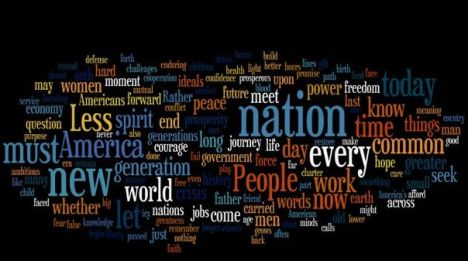
obama-inaugural-word-cloud

A word-cloud produced (quickly) by the Los Angeles Times.  Befiitting the social-media aspect, the paper published it on Twitter immediately; don’t know if it will even be published as a graphic in the day-old “newspaper” printed and distributed tomorrow.  The New York Times, meanwhile, has the same for every previous presidential inaugural address as well – interesting to scroll back and forth to notice trends in presidential intentions.

Which lines was I most struck by? Because of my national-security interests, I was taken by the strong, even muscular statement to terrorist foes: “You cannot outlast us and we will defeat you.”  That followed on his opening with a declarative statement that ““Our nation is at war against a far-reaching network of violence and hatred.”

Information Week has already this afternoon called it the “First Web 2.0 Inauguration,” arguing that “Web 2.0technologies offered plenty of new experiences and communications tools for those witnessing the historic event.”

Some of the best set of mashups using cutting-edge technology, to my mind, are the photographs from media and members of the crowd on the Mall, being synthed into 3D Photosynth virtual models. Really cool!inaugural-photosynth


Twitter and other social-media services and channels appeared to hold up well under the crush of traffic. I was pleasantly surprised with the performance of Microsoft’s official streaming of the entire ceremony for the Presidential Inaugural Committee, using Silverlight (same technology was used really nicely for global streaming of the Summer Olympics last year).  In fact, the online streaming was markedly smoother than the ability of the TV networks to speak to reporters reliably down on the Mall – it appeared that network and cellular traffic was constantly cutting out on remote video and microphones.

A moving day, brought to more people than ever before through technology.

 Email this post to a friend

AddThis Social Bookmark Button