A New Prototype: Research Desktop

Fact: The international conference on Advances in Social Network Analysis and Mining (ASONAM 2009, next July in Athens, Greece) today issued its call for papers on “experimental and theoretical works on social network analysis and mining,” particularly relating to online social Web sites, email logs, phone logs and instant messaging systems “which are widely analyzed using graph theory and machine learning techniques.”  Interested authors are encouraged to submit abstracts of up to 300 words by December 10, 2008; the full papers aren’t due until January 31, 2009.  More info at www.asonam.org.

Analysis: Several Microsoft Research people are preparing papers based on their current research, and I’m considering attending myself (I’ve written before about MSR’s work in analyzing large social networks). There are three Microsoft scientists on the Committee (Dou Shen, Haizheng Zhang, and Rina Panigrahy – check out Rina’s publications on hashing and sketching algorithms).  It should be a top-notch conference, co-hosted by ACM and IEEE.

But that’s way off in the future – what if you want to look at some research stuff right now? Well, I’ve been going through the related “Socio-Digital Systems” work of MSR Cambridge (UK), and they’ve just added more information to their section here of the main MSR site.  That’s some neat stuff, more on the side of the actual social uses of digital data and the effects on our (still-human?) everyday lives.

Continue reading

Click on My Head and You’re Classified 2.0

Fact: According to the latest McKinsey Global Survey report, “Building the Web 2.0 Enterprise,” many companies find themselves actually changing organizationally, both internally and externally, as a result of adopting Web 2.0 tools and practices. 

Continue reading

Using Web 2.0 to Track a Political Crisis

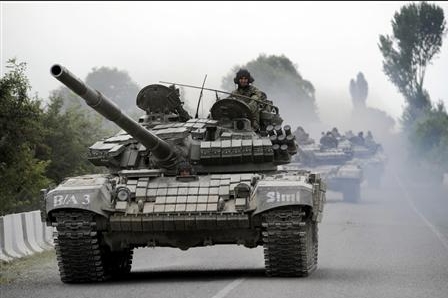
My gut tells me that the latest round in the Georgian-Russian crisis is going to get ugly.

CNN’s “Russian Tanks Rolling into Georgian Breakaway” shows one thing: our old friend Vladimir Putin feels free to call the shots.

Twitter alerts can only get you so far, in following a crisis.  Check out these first attempts: this Twitter search or this one, or this Live News feed.  You can RSS any of these by the way.

I’m working on several Popfly-designed orchestrations of alerts and newsfeeds to keep me updated on the latest news from South Ossetia, incorporating crowd-sourced information as much as I can. 

Continue reading

CIA 2.0: The Agency’s CIO and Change

Fact: CIO magazine is running a big story on the CIA’s Chief Information Officer Al Tarasiuk and his IT operation, and their online site is breaking it up into a four-part series running this week.  Below I analyze the series.

Analysis: By the halfway mark in the series, the magazine’s reporter Thomas Wailgum had only accomplished a fairly rote recounting of what CIA is, what its CIO does, and how both those factors have changed since the good ol’ spy days amid the challenges of a post-9/11 world.

Part Onedescribed “a business-IT alignment project like few others,” although it mainly served to introduce CIO magazine’s broad readership to the unfamiliar world of a walled-off intelligence agency, waxing on about the hyper-security at Langley.  Part Two similarly was background on the bureaucratic culture of the agency and its relegation of IT to backwater status – until 9/11 came along.

Continue reading

Three Key Promotions in U.S. Intelligence

In the old days of Kremlinology, our side’s “Soviet analysts” (I was one as a kid, back in 1985-86) would pore over personnel lists and announcements of Politburo or Central Committee appointments, seeking clues to the direction of Party doctrine and intent. Military personnel promotions and reassignments were also studied closely to divine any insight into Soviet military policy.

There’s not a direct analogy to American military leadership promotions, but those lists are also studied intently, by peers and colleagues within the military branches, and also by experts throughout defense industry circles who can often decode Pentagon politics by watching who gets an extra star and who gets passed over.

Friday the U.S. Senate confirmed several key Army promotions, including three which I consider to be the most critical military intelligence positions in the nation. 

Continue reading

Research and Intelligence … Research for Intelligence

I’ll be at Penn State University for the next couple of days, at the Research in American conference.  This particular conference, with the theme “Connecting Technology Thought Leaders with Government Officials,” is sponsored by the Office of the Director of National Intelligence, focusing on their Science and Technology area. 

Here’s the agenda for the conference, which has an excellent lineup of technologists presenting their approaches and progress. 

ODNI turned to the Intelligence and National Security Alliance (INSA) to host and run the conference.  Someone, somewhere in the chain, slipped up and invited me as the Keynote speaker for Tuesday – I’m planning to do the thing with no slides and to speak (in part) about the emerging possibilities of revolutionary research in a post Web 2.0 world.

For some sobering background information,  check out a recent tour of the research-funding horizon by Amy Ellis Nutt in the New Jersey Star-Ledger (“As research funds stagnate, science in state of crisis“).  Here’s a taste:

Once the world’s gold standard, American scientific enterprise is in free fall. Short of government funds and strapped for cash, researchers across the country are abandoning promising avenues of scientific investigation and, increasingly, the profession of science itself.” – Amy Ellis Nutt, The Star-Ledger

Do you share that pessimism?  Think it’s overstated?

I’ll give an update about the conference tomorrow.

Email this post to a friend

AddThis Social Bookmark Button

Test for Prediction Markets: They Say Obama, but Polls Say It’s Tied

Fact: According to the latest Rasmussen poll released Saturday July 12, and promptly headlined by the Drudge Report, “The race for the White House is tied. The Rasmussen Reports daily Presidential Tracking Poll for Saturday shows Barack Obama and John McCain each attract 43% of the vote.” Newsweek is reporting a similar result in its own poll, with Obama moving down and McCain up (“Obama, McCain in Statistical Dead Heat“), and other polls increasingly show a similarly close race.

Analysis: I’ve been tracking the growing divide between two quite different methods purporting to offer statistical predictive analysis for the November presidential election. Polls are saying one thing, but Prediction Markets are saying another. 

Continue reading

A-SpaceX, Google, and Virtual Tuesday

Yesterday I had a “virtual world vibe” going.  At 5:30 a.m. when my dog Jack woke me up offering to take me for a walk, the first thing I noticed on my mobile was a series of tweets from Chris Rasmussen, NGA’s social software guru, posted the night before.  Twitter is interesting for a lot of reasons, but one is the ability to snatch asynchronous stream-of-consciousness statements, from strangers and friends alike, as they pass by in the microblogosphere conversation.

Chris went on a tear about Second Life, with several hilarious observations and comments within the space of an hour, so here are several from his public Twitter feed:

Continue reading

Healthcare: It’s the Data, Stupid

Fact: Today’s L.A. Times has a startling report: “A stunning number of people who work in healthcare settings lack paid sick time — as many as 75% of all home health aides, for example… Federal data indicate that as many as 29% of all workers in the ‘healthcare and social assistance’ job sector lack paid sick days. Healthcare employees who work while ill may end up hurting the people they are hired to help….”

Analysis: Mark Twain said the only two sure things in life were death and taxes.  So it’s no surprise that the two presidential campaigns are focusing on healthcare and the economy, since people are universally affected in personal ways.  Forget taxes for today, I’m interested in technology’s role in healthcare, which is growing, and there’s no more potentially game-changing facet of that than the role of data. 

Continue reading

So Long, Long Tail?

I’ve been known to disagree with Harvard eggheads before 🙂 


Chris Anderson's Long TailAnd now, perhaps, another opportunity. A new Harvard Business Review article (“Should You Invest in the Long Tail?” by HBS Professor Anita Elberse) throws water on Chris Anderson’s paradigm, arguing that “hit products” are still more valuable than the conglomerated also-rans in the tail; her research is mostly in retail products. Chris has responded on his blog, sparking many comments and debate, and today the Wall Street Journal covered the back-and-forth debate.

I’m interested in the debate mostly because of the interest in the Long Tail way of thinking in some circles of the intelligence community.  I’ve written about the approach and its relevance to some intelligence issues (see “Tradecraft in the Long Tail” and “IARPA and the Virtual Long Tail“).

I’m just not certain that even a total debunking of the retail-oriented paradigm would undercut its value as applied to intelligence analysis. 

For intelligence analysts, obscure “facts” and patterns hidden snugly within the low-scale noise are all important – whether or not they gain numerative bulk in any accumulative way.  The paradoxical “unknown unknowns” are what’s being sought by dogged collection and analysis, and I’m not sure that’s analogous to Elberse’s acknowledged findings. 

Your thoughts welcome, here or by email back to me.

 
Email this post to a friend

AddThis Social Bookmark Button