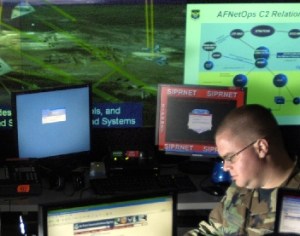
SecDef Blasts Air Force on ISR

FACT: U.S. military use of airborne drones (UAVs) dawned at the turn of the millenium, with nearly 100 vehicles in use before the Sept. 11 2001 attacks. By the end of that year the number had doubled, with the majority in use in Afghanistan. Today, according to a speech today by Sec. of Defense Bob Gates, “We now have more than 5,000 UAVs, a 25-fold increase since 2001.”

ANALYSIS: The Gates speech today, to an Air Force audience, is being covered mostly with a focus on his “harsh criticism” of that service. For example, CNN’s headline was “Defense Secretary Scolds Air Force for War Effort,” or Fox News “Gates Says Air Force Must Step Up Efforts in Iraq, Afghanistan.”  And there was plenty of raw material for the tough stories, including CNN’s inclusion of the Gates soundbite that getting the Air Force to send more surveillance and reconnaissance aircraft to Iraq and Afghanistan has been “like pulling teeth.”

Others (like a Reuters story) struck a less frenzied tone, including more depth about his proposals going forward, and the Defense Department’s actual plans for improved acquisition and use of Intelligence, surveillance, and reconnaissance, or ISR. I’d encourage you to read the full transcript (get it here).  (By the way, here’s some background on ISR and its variants.)

Continue reading

Air Wars: the Air Force Takes Heat for its PR

FACT: A heated online debate is erupting about a particular photo posted online, and the brouhaha around it focuses on whether or not classified details are contained therein, thus revealing them. 

ANALYSIS: Given that others are even now writing extensively about this photo and its controversy I thought I would add a couple of thoughts.  Don’t bother blaming me for linking to the photo, by the way; given the attention and reposting/rehosting it has already received, the glare of publicity can only serve to prod better security practices. 

I expect to see parody versions on Flickr soon, with “Area 51” touches.

And so to my related thoughts: recently, an active-duty USAF officer and regular reader emailed me about one of my posts concerning Rod Beckstrom and the new National Cyber Security Center, which he had not previously heard of.  He wrote that in discussing it with a colleague, the response was “I thought the Air Force Cyber Command already had the mission to coordinate all cyber security efforts.”

Continue reading

Google’s Argument to Enterprise IT: “Trust Us”

FACT:  Yesterday, Google’s Dave Girouard, VP of enterprise sales, gave a keynote speech on “The Evolution of Cloud Computing” at FOSE, a Washington trade-show focusing on federal government and military IT customers.  According to a Washington Post reporter’s blog account afterwards:

[Girouard said] “Google will have to do things differently” to work with defense and intelligence agencies, where data security and privacy are held to the tightest standards. But he argued that having information spread across hundreds of different servers is actually more secure than housing data on a few servers at a specific location. “Security is now more virtual than physical,” he said.

ANALYSIS:  The Google salesman (Girouard is VP of enterprise sales) was speaking at FOSE on the same day I made an April Fools blogpost featuring a lame “Cloud Computing” joke (see it here, come back when you stop laughing).  

This year I’m at FOSE as neither buyer nor speaker; the past couple of years I spoke at FOSE, as a DIA official, and I always enjoy walking the exhibit floor, plus I was curious about Girouard’s take on Google’s current move into the federal space.

To be honest I’ve met him before when he was with Virage and he’s a fine fellow, a good salesman.

The rhetoric of his main pitch, though, seems to be battling uphill, and I’m not sure he gets a nuanced distinction.

Continue reading

From Microsoft’s Cloud – PopFly

I mentioned PopFly in my last post – many Web users are now beginning to appreciate how it enables the fun and ease of innovation for non-technical people. Go to www.popfly.com/ and set up your own account (free of course), and you’ll be able to create usable, powerful “tools” out of the Cloud, or with your own data. 

Continue reading

A Roadmap for Innovation – from Center or the Edge?

Fact:   In marking its five-year anniversary earlier this month, the Department of Homeland Security released a fact sheet touting the department’s accomplishments in that time, including “establish[ing] the Computer Emergency Readiness Team (US-CERT) to provide a 24-hour watch, warning, and response operations center, which in 2007 issued over 200 actionable alerts on cyber security vulnerabilities or incidents. US-CERT developed the EINSTEIN intrusion detection program, which collects, analyzes, and shares computer security information across the federal civilian government. EINSTEIN is currently deployed at 15 federal agencies, including DHS, and plans are in place to expand the program to all federal departments and agencies.”

Analysis:  I’m not going to write, in this post at least, about US-CERT and EINSTEIN in particular. I will point out that some writers have been skeptical of “Big DHS” progress on cyber security up to now, and the anniversary was an occasion for much cynical commentary. 

cnet-news.jpgCharles Cooper in his popular Coop’s Corner blog on CNet wrote that “when it comes to network security, DHS appears to be more of a wet noodle than even its sharpest critics assumed… Talk with security consultants and former government officials involved with DHS and you come away wondering what these folks do all day.”

Continue reading

The Future of Enterprise Computing – and Social Computing

I wrote the other day about how highly ranked the University of Virginia’s undergrad business school is (a close second in BusinessWeek’s annual ranking), and mentioned that one reason is the creative research and programs they sponsor.

In fact, thanks to UVA’s McIntire School of Commerce, I enjoyed a great day recently exploring some of my favorite topics with leading experts.  I was an invited speaker at their one-day conference on The Future of Enterprise Computing on March 14th, presented by McIntire’s Center for the Management of Information Technology (CMIT).  It was a fascinating day….

Continue reading

The IC’s Own Geek Superheroine

FACT: According to the law establishing the new position, the Director of National Intelligence is charged with “the recruitment and training of women, minorities, and individuals with diverse ethnic, cultural, and linguistic backgrounds,” as a way of broadening the personnel base on which the nation relies for intelligence analysis.

ANALYSIS: I’ve noticed that one of the single-most-viewed posts in this six-month-old blog has been my early profile of Dr. Lisa Porter, when she was appointed the first director of IARPA, the advanced-tech crowd for the intelligence community.

I can tell that the large volume of hits isn’t from my normal reader crowd, but comes in from search results. There was another uptick of hits on that old post this week, driven by searchers using Google and Live Search, and I believe it’s because WIRED magazine has its own profile of Porter in its new edition, the one with “Apple: Evil/Genius” on the cover.

The new profile, while short, doesn’t mind taking advantage of her apparently unexpected good looks; it begins, “Picture Q as a tall blonde woman with an American accent, and you’ve got Porter. Lisa Porter.”

Continue reading

Expect Some “New Thinking” on Cyber Security…

FACT: Department of Homeland Security head Michael Chertoff last week: “I am pleased to announce my appointment of Rod Beckstrom as the first Director of the National Cyber Security Center. Rod will serve the department by coordinating cyber security efforts and improving situational awareness and information sharing across the federal government.”

ANALYSIS: There are people who think inside the box, those who think outside the box, and those who ask: What box?

Then there are “the anti-box people.”  They see the box, shove it on its side, stomp on it to squeeze it flat, and consign it to recycling where it belongs.

One of those kind of people is Rod Beckstrom, a well-known Silicon Valley successful entrepreneur and author. I knew him at Stanford, aeons ago, and like others recognized his leadership drive when he ran successfully for student body president, and he left with both a BA and MBA on the way to forming his first successful software startup.

I was surprised when I read last week that Rod is moving to Washington to take a high-level government job.

Continue reading

Puncturing Circles of Bureaucracy

In my airplane reading this week was the February issue of Defense Systems magazine, with an interesting article on the Department of Defense’s “Rapid Reaction Technology Office,”  or RRTO.

(Also in my reading stack was a hilariously disturbing article in WIRED about the merry pranksters of Second Life, but it has nothing to do with my topic right now.)

RRTO is facing great challenges inherent in trying to innovate DoD practices, and I’d argue some of the problem is evident right there in its title: there’s rarely anything truly “rapid” about a reactive approach to technology innovation.

After I joined DIA in 2003, leading that agency’s efforts at “innovation” in information technologies, I began to structure my thoughts about the impediments to change and improvement.

Continue reading

Silverlight 2.0: It’s “1 better than 1.0”

Last week I was visiting an intelligence community facility which has been known for several years for housing some of the brightest and most innovative adopters of Web 2.0 approaches for classified systems. I could say who and where, but then I’d have to… well, not kill anyone, just apologize to all my other friends at other agencies who think they’re the cat’s meow on classified Web 2.0. (With any luck this anonymity now makes each of them think, “Wait, who’s more advanced than we are?  How can we catch up??!”)Well, it turns out they’re excited about something new & cool they would like to use.

Continue reading