Mix, Rip, Burn Your Research

You’ve done research; you’ve collected and sifted through mounds of links, papers, articles, notes and raw data. Shouldn’t there be a way to manage all that material that’s as easy and intuitive as, say, iTunes or Zune – helping you manage and share your snippets and research the way you share and enjoy your music?

Continue reading

Free Tools for the New Scientific Revolution

Blogs are great for supplementing real-life events, by giving space and time for specific examples and links which can’t be referenced at the time. I was invited to give a talk last week at the first-ever NASA Information Technology Summit in Washington DC, and the topic I chose was “Government and the Revolution in Scientific Computing.” That’s an area that Microsoft Research has been focusing on quite a bit lately, so below I’ll give some examples I didn’t use at my talk.

One groundrule was that invited private-sector speakers were not allowed to give anything resembling a “sales pitch” of their company’s wares. Fair enough – I’m no salesman.  The person who immediately preceded me, keynoter Vint Cerf, slightly bent the rules and talked a bit about his employer Google’s products, but gee whiz, that’s the prerogative of someone who is in large part responsible for the Internet we all use and love today.

I described in my talk the radical new class of super-powerful technologies enabling large-data research and computing on platforms of real-time and archival government data. That revolution is happening now, and I believe government could and should be playing a different and less passive role. I advocated for increased attention to the ongoing predicament of U.S. research and development funding.

Alex Howard at O’Reilly Radar covered the NASA Summit and today published a nice review of both Vint’s talk and mine.  Some excerpts: Continue reading

Pre-release hands-on look at WP7

I try to avoid straight-up promotion for my employer on my blog too often (if you didn’t know, it’s that scrappy West-Coast-based startup Microsoft). I like sharing R&D projects, but for consumer products I leave that stuff to others or third-parties.

But with the Apple iPhone 4 controversy going on, and Google’s Droid platform chugging away, frankly I was surprised to see a long story on übergeek tech blog Engadget today about our Windows Phone 7, with a great video of a hands-on demo:

I’m sharing it because I eagerly await the launch for my own use. The review itself is worth a read – it has in-depth looks at the UI and UX, social-networking aspects, music integration (full-on Zune experience), app marketplace, search, maps, innovative photos, wireless cloud syncing, high-def video, elegant online/offline email innovation, Office integration, Xbox Live, and other facets. Some features are good, some missing, some are awesome. Launch coming this fall…

Share this post on Twitter

Email this post to a friend

AddThis Social Bookmark Button

DARPA crowd guru gets a new lab

It’s been a little over two years since I came back to the tech private sector from my government service, and it’s great when we have other folks take the same path, for it improves the knowledge of each side about the other. Today we’re announcing that Peter Lee, currently the leader of the Defense Advanced Research Projects Activity’s innovative Transformational Convergence Technology Office (TCTO), is joining Microsoft to run the mighty flagship Redmond labs of Microsoft Research.

Continue reading

Using the body in new virtual ways

This is CHI 2010 week, the Association for Computing Machinery’s Conference on Human Factors in Computing Systems in Atlanta. Top researchers in human-computer-interaction (HCI) are together April 10-15 for presentations, panels, exhibits, and discussions. Partly because of our intense interest in using new levels of computational power to develop great new Natural User Interfaces (NUI), Microsoft Research is well represented at CHI 2010 as pointed out in an MSR note on the conference:

This year, 38 technical papers submitted by Microsoft Research were accepted by the conference, representing 10 percent of the papers accepted. Three of the Microsoft Research papers, covering vastly different topics, won Best Paper awards, and seven others received Best Paper nominations.

Continue reading

Enabling Eureka via Citeability

The story of Archimedes resonates with everyone, because we all regularly feel that rush of excitement that he famously felt when discovering the principle of water displacement: “Eureka!” he shouted, “I have found it!”

Whether it’s car keys or the perfect birthday present for a loved one, we know that feeling. But how often do you feel like shouting “Eureka” when you’re surfing the web looking for a particular piece of government information?

Continue reading

Simon Moves On

Jim Simon at the Library of Alexandria, Egypt

One indulgent use of a personal blog is to drop a nod in the direction of a salutary individual, and I’d like to do so for my departing boss, Jim Simon.

Jim has been the founding Director of the Microsoft Institute since 2004, when Bill Gates and Craig Mundie personally decided to establish a small outfit to use the benefits of Microsoft’s advanced research and development activities against intractable problems for the global public sector. They had been talking with Jim for several years, back when he was a senior executive at the Central Intelligence Agency and after, to understand how to improve government’s adoption of modern technologies.

Continue reading

Slate of the Union Day

Today is “Slate of the Union” day, when the two most charismatic individuals in recent American history go on stage and attempt to reclaim mantles as innovators. I’ll leave aside the fellow with lower poll numbers for now (President Obama). More eyes in the tech world will be watching as Steve Jobs makes his newest product announcement, the Apple tablet/Tabloid/iSlate thing iPad (it’s official).

Back in the late 1980s I worked for the legendary “Mayor of Silicon Valley” Tom McEnery (he was actually the mayor of San Jose), and we did many joint projects with Apple, particularly with CEO John Sculley, a great guy.

Continue reading

Total Recall for Public Servants

MyLifeBits is a Microsoft Research project led by the legendary Gordon Bell, designed to put “all of his atom- and electron-based bits in his local Cyberspace….MyLifeBits includes everything he has accumulated, written, photographed, presented, and owns (e.g. CDs).” 

SenseCam - Click to enlarge

Among other technical means, Bell uses the SenseCam, a remarkable prototype from Microsoft Research.  It’s a nifty little wearable device that combines high-capacity memory, a fisheye lens passively capturing 3,000 images a day, along with an infrared sensor, temperature sensor, light sensor, accelerometer, and USB interface. My group has played with SenseCam a bit, and shared it with quite a few interested government parties and partners. More info on SenseCam here, and more on its parent Sensors and Devices Group in MSR.  

Continue reading

Gunning the Microsoft Semantic Engine

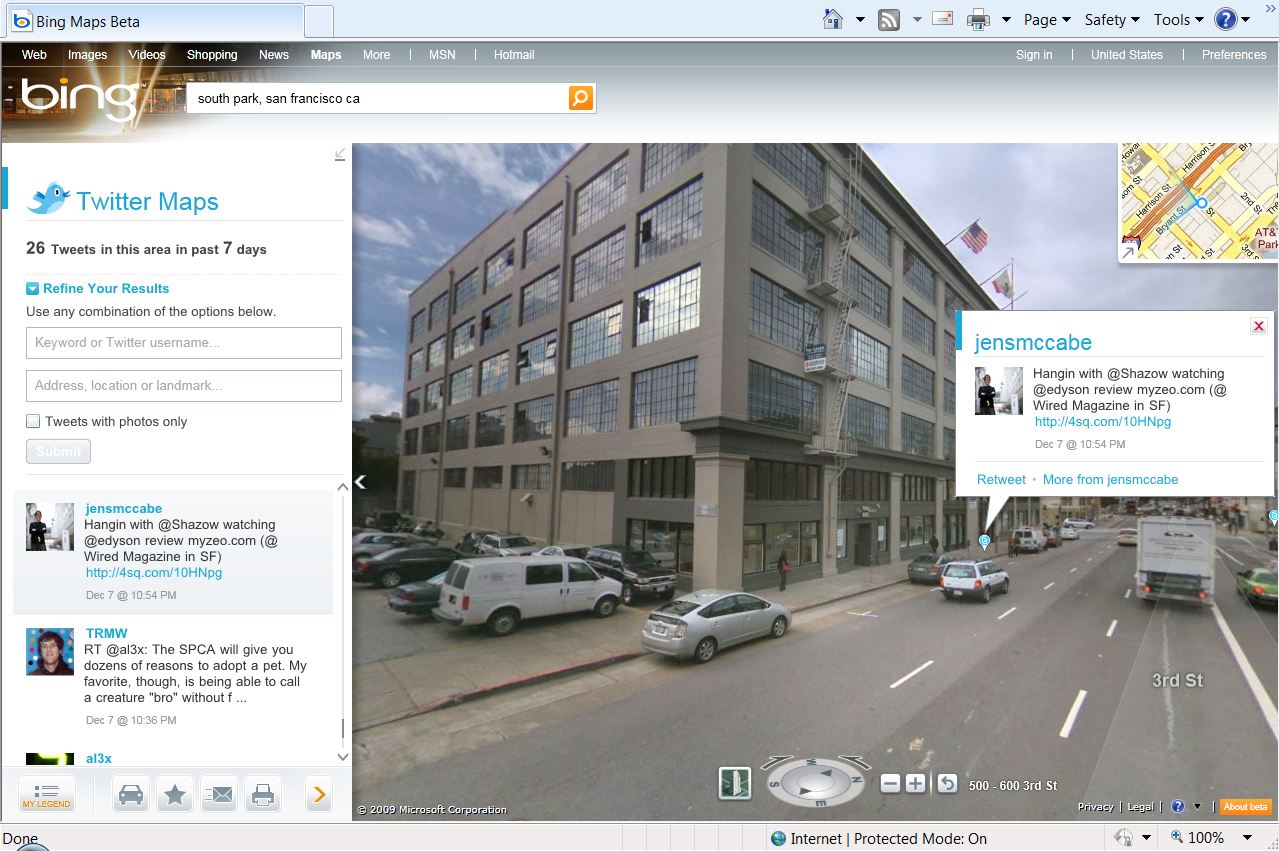
New Bing Maps Beta with embedded data layers from Twitter and other social feeds, click to enlarge screenshot

There’s a lot of information on the Internet already. Every day, more is added – a lot more. And while there are a concomitant number of new analytic or sense-making tools on the web, they butt up against the fact that the data – the all-important data – is held in multiple places, formats, and platforms.

How are we going to deal with all this? One approach is almost mechanical: ensuring that datasets can be accessed commonly, as in our new Microsoft Dallas platform associated with the Windows Azure cloud platform.  In the government realm, the anticipated reliance on “government-as-a-platform” (a meme popularized by Tim O’Reilly) holds promise in allowing somewhat aggregated datasets, openly accessible.

Continue reading