Why a Cloudlet Beats the Cloud for Mobile Apps

Sure, you know cloud computing. You also know a bit about so-called “private clouds,” which enterprises and government agencies are exploring as an option to combine the power and scale of virtualized cloud architectures with security and control over data.

But what do you know of Cloudlets? They may just be a key to the future of mobile computing.

That’s a possible conclusion from the results so far of a Microsoft Research family of projects called MAUI, short for Mobile Assistance Using Infrastructure. The MAUI approach is to enable a new class of CPU-intensive, and data-intensive, applications for mobile devices – but enable them in a new way.  Today’s mobile devices can’t run such apps, at least not well. And if they stick to the cloud they may never do so.

I’ve just read a fundamental MAUI paper published last month in the IEEE’s Pervasive Computing journal: “The Case for VM-based Cloudlets in Mobile Computing” (November 2009, co-authored by MSR’s Paramvir Bahl along with colleagues from Carnegie Mellon University, AT&T Research, and Lancaster University).

Continue reading

Data in the Cloud from Dallas to Mars

There’s a lot going on at this week’s Microsoft Professional Developers Conference (PDC 09); it’s a traditional launchpad for cool new stuff. I thought I’d point out several of the government-relevant announcements and technology roll-outs.

I specifically want to spotlight something called Codename Dallas, and how NASA and others have begun using it. In the keynote this morning Microsoft’s Chief Software Architect Ray Ozzie told PDC attendees (and his streaming-video audience) that a landslide of new sensors and observational systems are changing the world by recording “unimaginable volumes of data… But this data does no good unless we turn the potential into the kenetic, unless we unlock it and innovate in the realm of applications and solutions that’s wrapped around that data.”

Here’s how we’re addressing that, with a bit of step-by-step context on the overall cloud-computing platform enabling it.  The steps are: 1. Azure, 2. Pinpoint, and 3. Dallas.

Continue reading

Para Bellum Web

Tim O'Reilly, Ray Ozzie

Tim O’Reilly created a bit of a stir last night in the tech world by writing a thoughtful essay entitled “The War for the Web.” He’ll be expanding on his thoughts in his keynote address today at the Web 2.0 Expo in New York. From the essay, here’s the core argument:

“[W]e’ve grown used to a world with one dominant search engine, one dominant online encyclopedia, one dominant online retailer, one dominant auction site, one dominant online classified site, and we’ve been readying ourselves for one dominant social network. But what happens when a company with one of these natural monopolies uses it to gain dominance in other, adjacent areas? I’ve been watching with a mixture of admiration and alarm as Google has taken their dominance in search and used it to take control of other, adjacent data-driven applications.

It could be that everyone will figure out how to play nicely with each other, and we’ll see a continuation of the interoperable web model we’ve enjoyed for the past two decades. But I’m betting that things are going to get ugly. We’re heading into a war for control of the web. And in the end, it’s more than that, it’s a war against the web as an interoperable platform. [emphasis added] Instead, we’re facing the prospect of Facebook as the platform, Apple as the platform, Google as the platform, Amazon as the platform, where big companies slug it out until one is king of the hill.

… P.S. One prediction: Microsoft will emerge as a champion of the open web platform, supporting interoperable web services from many independent players, much as IBM emerged as the leading enterprise backer of Linux.

Continue reading

Once you get past Filter Failure

How do intelligence analysts handle the long-discussed problem of information overload? (The same question goes for information workers and government data of any kind.)

Continue reading

The promise of mobile augmented reality

Robotvision appMy intention with this blog is always to write medium-length “think-pieces,” about technology, government, or preferably both. I’m working on several (the Jefferson Gov 2.0 piece, the Evil Twin 2.0 piece, and one on “whither the multilingual web”), but they do truly require thought and some free time, so they percolate a bit.

In the meantime, readers like the latest cool demo videos, so for Friday fun here’s another one (watch below or on youTube), which was featured on TechCrunch last night (“Bing comes to the iPhone via Robotvision”), with an augmented reality app for the iPhone which uses Bing Maps and Bing’s real-time data (website here). The company describes itself this way:

Continue reading

The So-Called Secret Courier Video

What is the “user interface of tomorrow”? In the past I have chronicled some cool Microsoft Research prototypes of flexible touchscreen interfaces – and even touchless interfaces!  And now this month one of my friends in MSR, Mary Czerwinski, has written in Venture Beat that “those types of interfaces could be the tip of the iceberg”:

A whole new set of interfaces are in the works at various stages of research and development… I have colleagues working on tongue-based interaction, bionic contacts lenses, a muscle-computer interface, and brain-computer interaction.” – Mary Czerwinski

Not bad! But working devices along those lines are several years away, so for now we’re stuck with the tablet form-factor as the primary basis for natural input. I’ve used a tablet PC on and off for the past five years, happily. My wife now uses an HP tablet.

So I’ve been eagerly following the blogosphere’s hyperventilation about the much-rumored, still-unseen Apple tablet computer, which has been variously described as being close to launch, far from launch, and non-existent.

  Continue reading

Webcast interview from the Government 2.0 Summit

I’ve been attending the Government 2.0 Summit in Washington this week, along with a lot of friends and colleagues from various spots in Silicon Valley, the international tech world, and federal, state, or local government agencies. If you want to follow along on Twitter, there’s a great number of attendees posting real-time notes and comments throughout the sessions.

Over the past couple of months I’ve participated with many colleagues planning the kick-off Gov 2.0 Expo Showcase, which highlighted fantastic new-technology projects from government agencies across the country. One of the great projects showcased is www.NeighborsforNeighbors.org, a collaborative website of rich services run by Joseph Porcelli (on Twitter he’s @josephporcelli). Among the other services on the site is a webcast series of great interviewst all levels, from across the country. , and this afternoon I sat down for a chat.

You can watch it below, on their site, or over on the archived kyte.tv site  – lots of laughs as we talk about my varied experiences in government, and why Microsoft is focusing intently on enabling enterprise Government 2.0 capabilities.  Fun stuff!

[kyte.tv appKey=MarbachViewerEmbedded&uri=channels/202174/553690&tbid=k_168&p=p/s&height=436&width=416]

Email this post to a friend

AddThis Social Bookmark Button

Navigating Indoors Without GPS

Here’s a nifty demo of a very small piece of software, that could find daily use for large numbers of people in any large enterprise, or any shopper in a mall – anywhere someone’s wandering in a large building or complex looking for a specific office, conference room, storefront, or location – especially indoors where GPS is of no use.

It’s called GoMap, and I think it could have great applicability for government complexes, which have lots of rabbit-warren hallways, lots of constantly-reassigned workers, and lots of visitors.

I missed GoMap’s first public unveiling today because I’m on the east coast this week, mostly for the Cybersecurity “Leap Ahead” conference in Arlington Virginia which wrapped up today; I will write about the conference separately.

But that meant I had to miss the bar-camp-style WinMoDevCamp today on the Microsoft campus in Redmond. There was a lot of buzz around this DevCamp, and there’ll be others in 6 more cities soon (Austin, London, New York, San Francisco, Singapore, and Toronto) as developers gear up for the upcoming release of the Windows Mobile 6.5 operating system.  You can get registration information about the future events at the main WinMoDevCamp site (props to Todd Bishop on his TechFlash blog for highlighting the series).

The GoMap prototype makes innovative location-aware use of Microsoft Tag and TagReader (the high-capacity color barcodes developed by Microsoft Research), to solve the problem of having no GPS capability indoors  – check out the short video.

WinMoDevCamp is an indication that there’s a real explosion of app development going on in the Windows Mobile world, to match the equally exciting iPhone app and Android app activity. There’s been a feeling in Microsoft that our best advantages are the large installed base through third-party WinMo phone manufacturers, plus Microsoft’s long experience nurturing app developers on other platforms (.Net as a good example).  But I personally think that superior innovation is going to be the battleground, and we’re well positioned for that as well, with a lot of exciting things emerging from Microsoft Research and different advanced development labs in product groups. GoMap’s one example.

Not sure of the timeline for GoMap, but you can use TagReader right now, without the GoMap piece. It’s a free download on the Tag webpage, or you can get it on any mobile phone (yes, even the exploding iPhone) at http://gettag.mobi.

Email this post to a friend

AddThis Social Bookmark Button

Microsoft and Google Look at the World Differently

I didn’t think I would have to write this same kind of observation twice within a year. But today, on D-Day, I notice yet again a striking difference between Google and Microsoft.  And in this case, one can almost read the evidence as a snub from Google to the United States, to the nations who united in sacrifice during World War II, and to President Obama on a day of his personal leadership in commemorating international war and peace.

I made a similar observation on Columbus Day, when Microsoft chose to honor Christopher Columbus and his explorations’ significance to American history and the world, while Google chose to honor – wait for it – Paddington Bear’s “birthday.” (See my post from then here.)

Today is of course D-Day, the 65th anniversary of a day in which over 2,000 American soldiers lost their lives, leading the way in the greatest military operation in the history of the world, as the initial landing to liberate Europe and the beginning of the end of the Nazi empire.

Google and Microsoft are two great American companies, which operate globally. Each has a public face to the world through signature online properties – their search engines. In Google’s case, that page at Google.com is their ne plus ultra public face, since they are at core a mighty search engine.

Take a look at the two pages today. Microsoft’s Bing search-engine uses its home page to commemorate D-Day, with a dramatic photograph of Normandy Beach today, and mouse-over popups providing historical highlights and links to more information on the battle’s signficance to World War II and to world history.
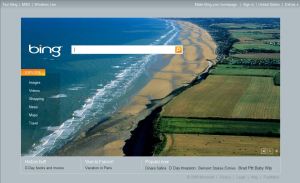
Bing D-Day

Google uses its home page to commemorate the 25th anniversary of the invention of the computer game Tetris.
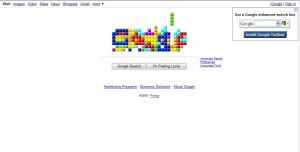
Google Tetris

The mouse-over popup on the cutesy Google logo reads, “Celebrating 25 years of the Tetris effect – courtesy of Tetris LLC.”  (I suppose one could read that as, predictably, a coporate ad, right there on Google’s home page.)

Just as I noted on Columbus Day, this doesn’t appear to be a localization issue, or an issue of appealing to a global audience – both Microsoft and Google know my location, and in fact each is serving up a page targeted for me in the United States.

Don’t get me wrong: Tetris was an amusing and absorbing game. As a young guy I spent hours dropping the bars and shapes to fit into the rising pile below.

But at certain moments in life, you put aside childish things. Unless you’re trying to make some other kind of statement.

Note: I am a Microsoft employee. But this is not a Microsoft corporate blog, it’s my personal blog – and I’ve been known to tweak Microsoft here frequently as well.  This is my personal observation space.

I have to admit I am puzzled – and personally appalled – by the decision-making over at the Googleplex, and the statement they choose to send to the world.

President Obama is leading our delegation himself at Normandy Beach today, for the international event with other world leaders remembering a moment of global importance.  Self-evidently Eric Schmidt and the Google gang weren’t on board with that, and by their way of thinking saw something more significant to mark. 

Email this post to a friend


Immersed in Augmented Reality

Here’s a quick post, about a talk I gave this week – but as an excuse to link to a much more compelling presentation given at the TED Talks recently. Yesterday I had the good fortune to deliver the “Technology Keynote” address at the annual International Field Directors and Technology Conference, in Delray Beach, Florida. The IFD&TC is a well-known group in its field – no pun – of the world’s leading academic and government researchers, conducting large-scale and longitudinal social-scientific research studies.

As an example, think of the U.S. Census – and indeed I had the opportunity to spend some time with Cheryl Landman, Chief of the U.S. Census Bureau’s Demographic Surveys Division. You know those large studies drawn from every decade’s data? She runs them. That division’s work should feature prominently (I hope) in the forthcoming U.S. government’s “Data.gov” set of services.

Continue reading