My bold decision to withdraw from consideration as Obama’s CTO

To: President-Elect Barack Obama

From: Lewis Shepherd

RE: My Imminent Selection as Chief Technology Officer for the United States

Mr. President-Elect, I am hereby reluctantly but insistently withdrawing my name from consideration as your appointment to the newly created position of Chief Technology Officer for our nation.

No, no, please don’t try to persuade me otherwise. My decision is final.

Analysis: My earlier post about John Brennan being President-elect Obama’s “imminent” selection as CIA director is now a curio, given Brennan’s decision yesterday to withdraw from consideration. 

Like any good intelligence analyst writing a balanced assessment, I had included the caveat that the only thing standing between Brennan and the appointment was the likelihood of a last-minute political squabble or contretemps.

This being Washington we’re talking about, that is precisely what happened. 

Continue reading

Superpowers battle, in computing.

Fact: According to a WIRED report earlier this week, “A new crop of supercomputers is breaking down the petaflop speed barrier, pushing high-performance computing into a new realm that could change science more profoundly than at any time since Galileo.”

Continue reading

MS Office Wired, OpenOffice Tired, Google Docs Expired?

google-newsFact: “Google Docs Struggles to Gain Foothold.” “Google Docs Use: Just a Blip.” “Study: Office Fights Off Google Docs Threat.” “OpenOffice Five Times More Popular than Google Docs.”  These are news articles covering the release of a new ClickStream study of typical use of “productivity software” like the Microsoft Office suite (Word, Excel), Google Docs, Google Spreadsheets, OpenOffice, etc. The study “among adult U.S. internet users showed that use of free productivity applications such as Google Docs and OpenOffice remains low, while Microsoft Office is in use by over 50% of adult U.S. internet users and shows no signs of declining popularity.”

Analysis: Well, yesterday I gave Google some nice words because of our joint work with DoD on improving military health IT. So I’m itching to tweak the Big G now, and we have some numbers to examine.  And I wasn’t cherry-picking the titles above either, they were the “most relevant” results on a Google News query this morning for <“Google Docs” OpenOffice Microsoft>.

Continue reading

Google and Microsoft sign up for military duty

Fact: A September 2008 article in the Michigan Business Review holds that “An estimated 70 million people do have access to basic personal health records through their health insurers, with millions more scheduled to receive the service this year, according to health care benefit company Aetna.”  But that doesn’t mean they’re using a PHR.  Aetna also did a study just last year (2007) with the Financial Planning Association, according to the same article and found that “64 percent of respondents said they didn’t know what a personal health record was and of those who did, only 11 percent said they were currently using one.”

Analysis: In the battle to expand access to and use of PHRs, there’s great news on the way for a significant portion of the country: our millions of men and women in the military.

Continue reading

My other computer is a Cray

Fact: The annual ACM Gordon Bell Prize is about to be awarded at “SuperComputing 08” (or SC08) which takes place November 15-21 at the Austin Convention Center in Texas. The convention is “the” international conference for high-performance computing, networking, storage, and analysis. The Association for Computing Machinery makes the Bell award “to recognize outstanding achievement in high-performance computing,” in honor of Microsoft’s legendary Gordon Bell, one of the pioneers of supercomputing.

Continue reading

Comparing Apple and Microsoft as Platforms for Developers

I missed October’s Professional Developers Conference (PDC) in Los Angeles this year because of a couple of other conferences and meetings in other cities. But of course I was happy to see the coverage in the technology press and blogs, so much of it positive about our announcement on Windows Azure and the Azure Services Platform.

Then I read Joe Wilcox over on his “Apple Watch” blog at eWeek, on “What Apple Needs to Know about Azure, Windows 7.” It’s striking in its conclusions, particularly coming from a longtime Apple watcher:

Continue reading

Stop being so touchy

Remember Tom Cruise’s virtual 3D in Minority Report? Wouldn’t it be cool if, instead of an iPhone-like touch screen, we could manipulate data and 3D images on screens by simply moving our hands – interacting virtually without touching a keyboard or screen?

Continue reading

Google and Microsoft on Columbus Day

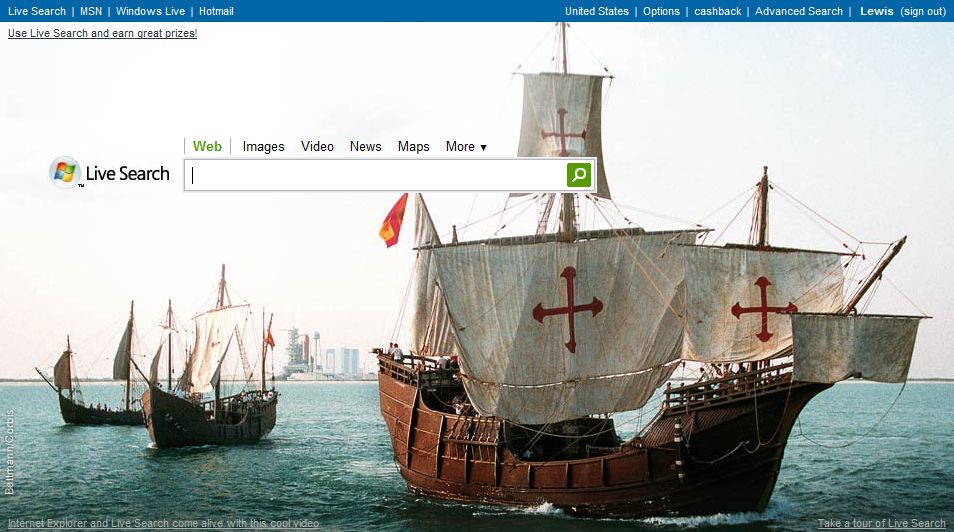
Click to enlargeToday is celebrated in the United States as Columbus Day. I happened to notice that my search engine of choice, at www.Live.com [ed. note: relaunched Bing as of Spring 2009], has a striking image (courtesy of Bettman Corbis archives), as you can see to the left.

As always with the new (improved!) Live Search, there are several hover spots on the page, with pop-up queries about the holiday, “sailing lessons,” Columbus’s trip to the Bahamas, and “the caravel,’ which turns out to be “a small, highly maneuverable, two- or three-masted lateen-rigged ship, created by the Portuguese and used also by them and by the Spanish for long voyages of exploration.”

  Continue reading

Inventing the Software that Invents the Future

Worried about today’s stock market activity? Retreat with me into the security of the bright future that awaits.

Microsoft’s Craig Mundie (pater familias of the Institute for Advanced Technology in Governments), is on a college tour across the nation.  The trip is something of a reprise of jaunts Bill Gates famously made over the years, when he would string together visits to campuses partly to evangelize, partly to recruit, and mostly to get new ideas from bright young (and contrarian) minds.  The Seattle paper today labels these tours as filling the role of Microsoft’s “chief inspiration officer” (“Mundie gives campuses peek at tech’s future”).

Continue reading

Lucky 7, as in Windows 7

When there’s neat stuff nearing release, it’s both professionally fulfilling but also no fun being a Microsoft employee, because you’re (rightly) constrained from blogging about some of the cool technology being cooked up in MSR or in advanced development labs among the product groups.

It means that I wind up passing along links to open stories in the media written by outsiders who wind up getting an early story (mostly) right, through good solid reporting and insightful addition skills, i.e. 2+2=4.

I faced that several months ago when Live Mesh was in the batter’s circle, before its public announcement; I wrote what I could because I was so impressed with the technology and approach, as were the reviews after its unveiling.  Before, I wrote this post among others; and after the announcement I wrote this one

Same scenario now, with “Windows 7.”  You don’t have long to wait (October 27) for the public announcement, but if you’re curious about some of the technical approaches, there are several generally reliable bloggers already writing about “technical details” of the multi-touch, parallel-processing, and cloud-services S+S integration points in the new release. A couple of good quick examples are Mary Jo Foley, “Windows 7 to Get Parallel Processing Tweaks” (she’s not as snarky as usual) and TechRadar’s “Seven Things You Need to Know about Windows 7“).

Email this post to a friend

AddThis Social Bookmark Button