
The IC’s Own Geek Superheroine

FACT: According to the law establishing the new position, the Director of National Intelligence is charged with “the recruitment and training of women, minorities, and individuals with diverse ethnic, cultural, and linguistic backgrounds,” as a way of broadening the personnel base on which the nation relies for intelligence analysis.
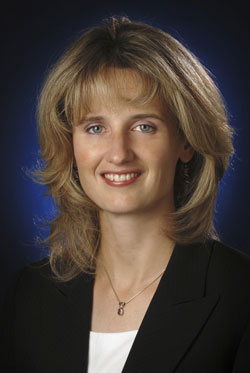
ANALYSIS: I’ve noticed that one of the single-most-viewed posts in this six-month-old blog has been my early profile of Dr. Lisa Porter, when she was appointed the first director of IARPA, the advanced-tech crowd for the intelligence community.

I can tell that the large volume of hits isn’t from my normal reader crowd, but comes in from search results. There was another uptick of hits on that old post this week, driven by searchers using Google and Live Search, and I believe it’s because WIRED magazine has its own profile of Porter in its new edition, the one with “Apple: Evil/Genius” on the cover.

The new profile, while short, doesn’t mind taking advantage of her apparently unexpected good looks; it begins, “Picture Q as a tall blonde woman with an American accent, and you’ve got Porter. Lisa Porter.”

Continue reading

Expect Some “New Thinking” on Cyber Security…

FACT: Department of Homeland Security head Michael Chertoff last week: “I am pleased to announce my appointment of Rod Beckstrom as the first Director of the National Cyber Security Center. Rod will serve the department by coordinating cyber security efforts and improving situational awareness and information sharing across the federal government.”

ANALYSIS: There are people who think inside the box, those who think outside the box, and those who ask: What box?

Then there are “the anti-box people.”  They see the box, shove it on its side, stomp on it to squeeze it flat, and consign it to recycling where it belongs.

One of those kind of people is Rod Beckstrom, a well-known Silicon Valley successful entrepreneur and author. I knew him at Stanford, aeons ago, and like others recognized his leadership drive when he ran successfully for student body president, and he left with both a BA and MBA on the way to forming his first successful software startup.

I was surprised when I read last week that Rod is moving to Washington to take a high-level government job.

Continue reading

Puncturing Circles of Bureaucracy

In my airplane reading this week was the February issue of Defense Systems magazine, with an interesting article on the Department of Defense’s “Rapid Reaction Technology Office,”  or RRTO.

(Also in my reading stack was a hilariously disturbing article in WIRED about the merry pranksters of Second Life, but it has nothing to do with my topic right now.)

RRTO is facing great challenges inherent in trying to innovate DoD practices, and I’d argue some of the problem is evident right there in its title: there’s rarely anything truly “rapid” about a reactive approach to technology innovation.

After I joined DIA in 2003, leading that agency’s efforts at “innovation” in information technologies, I began to structure my thoughts about the impediments to change and improvement.

Continue reading

Massive Data Centers, Right in your Cellphone

I try to keep my cellphone on “vibrate” during meetings; no one needs to know my taste in ringtones. But more importantly, I keep it on so that I can use the browser and web search ability, which I wind up doing almost as often as I check my email.

Yesterday was a good example of the utility of ever-handy web search. My group and I had brought together an international group of government officials to visit Microsoft Research’s annual TechFest.  Tuesday was the “Public Day” with the media and outsiders allowed, so we spent that day at the Microsoft Convention Center with Craig Mundie, Rick Rashid, and a hundred others, but Wednesday morning we offered a series of side briefings for the group at Microsoft’s Executive Briefing Center, on topics of interest to large government and defense agencies.  Topic one was data centers.

Continue reading

TechFest and its Value

I am spending much of the week at Microsoft Research’s annual TechFest, which is proving to be an absolutely mind-blowing experience.  So much, so cool, so out there….

There’s been some good press about the show already (ComputerWorld, and ITWorld for example), and the official Microsoft TechFest site has a wealth of material.  The media were allowed in on the “Public Day” to report on a carefully selected subset of the projects being displayed. But I think the coverage has missed an important difference between this show and something like COMDEX or CeBIT.

Continue reading

Manferdelli Had a Salad, I Had Meatloaf

I had a very pleasant lunch today in Reston with John Manferdelli, one of the engineering legends with whom I’m privileged to work at Microsoft.  (Check out this list, kind of my own corporate “bucket list” of people to meet and listen to).

John arrived in DC a couple of days ago; unlike mere mortals, he decided to spend a weekend day off visiting the University of Maryland Engineering  Library in the Math Building, and told me he’d found a fascinating book on random numbers….

Continue reading

Silverlight 2.0: It’s “1 better than 1.0”

Last week I was visiting an intelligence community facility which has been known for several years for housing some of the brightest and most innovative adopters of Web 2.0 approaches for classified systems. I could say who and where, but then I’d have to… well, not kill anyone, just apologize to all my other friends at other agencies who think they’re the cat’s meow on classified Web 2.0. (With any luck this anonymity now makes each of them think, “Wait, who’s more advanced than we are?  How can we catch up??!”)Well, it turns out they’re excited about something new & cool they would like to use.

Continue reading

Opening Doors to Interoperability

I had to write a freshman term paper on Immanuel Kant, and chose as a topic his role in sparking the German Enlightenment, from which I at least learned the word Aufklarung … which surprisingly doesn’t come up much in normal conversation, even when I’m in Germany. But I’ve been thinking about that movement and its ramifications quite a bit, because of the ongoing technology enlightenment driven by “open-source” approaches.

When I announced I was joining Microsoft, several of my friends in the open-source-software “movement” raised their eyebrows and ribbed me for joining the dark side… although the brighter ones also pointed out several important trends and markers through 2006 and 2007, changes in Microsoft behavior and approach which appeared to signal that the company was tacking in a much more open direction. Ray Ozzie’s joining of the company, and his announced projects, were taken as significant, along with several software launches (both in the Live world and elsewhere) with fundamentally open foundations.

Today the company is making public what Steve Ballmer and Ray Ozzie are calling “important changes to our technology and business practices that will enhance the interoperability of our products and expand the technical information we share with developers, partners, customers, and competitors.” All to the good, including more comprehensive information about the new “Interoperability by Design” approach.

Continue reading

Social (Network) Science

Fact: The social-networking site LinkedIn claims as users “17,000,000+ Professionals, 500,000+ Senior Executives, Executives from 498 Fortune 500 companies, [and] 65,000 new Professionals every week.”

Analysis: Since I hold the title of “chief technology officer” for my group at Microsoft, I regularly check the widely-read blog CTOvision, written by Bob Gourley, CTO of Crucial Point.

CollaborationlogosYesterday he posted a very solid summary of several social networking tools, including my preferred LinkedIn.  If you’re not up to speed on the genre it is a helpful cheatsheet and “buyer’s guide.”

The technology area deserves the attention. There are a dozen or more such sites for each that Gourley covers, and he chooses the ones that have shown growth and potential longevity; why invest any time adding personal data to a site just to watch it disappear? We’ve all had that happen. And yet hockey-stick growth has to be managed – LinkedIn for example has come in for some critical attention for some snafus along the way.

Let’s look at some efforts to understand more about the science behind the software….

Continue reading

New Report on Homeland Security’s S&T Directorate

Fact: “The Directorate of Science and Technology is the primary organization for research and development (R&D) in the Department of Homeland Security. With a budget of $830.3 million in FY2008, it conducts R&D in several laboratories of its own [and] funds R&D conducted by industry, the Department of Energy national laboratories, other government agencies, and universities.”

Analysis: The quote above comes from my hot-off-the-press copy of the new Congressional Research Service report (a pdf version here) on the Department of Homeland Security’s Science and Technology Directorate. Bottom line: CRS notes that “Congress and others have been highly critical of the directorate’s performance. Although recent management changes have somewhat muted this criticism, fundamental issues remain.” 

By the way, you’ll get a special bonus for reading to the end of this post, derived from an obscure footnote in the report.

The report is being reported in short-hand in the Beltway technology media, as criticizing DHS S&T for not being receptive to industry.  “DHS Directorate Elusive, CRS Report States,” is the headline in Federal Computer Week. The sister pub WashingtonTechnology has the same story with a different head: “CRS: DHS Directorate Lacks Collaborative Spirit.”  And yes, the report does detail the poor job DHS does at providing an open door to new ideas and technologies from the private sector.

But there’s a lot more in the report and it deserves more thoughtful reading & reporting, as it goes into some detail into the difficulties in bringing powerful and effective new technical and scientific approaches to bear for homeland defense and the war on terror.

Continue reading