
Mashup Markoff

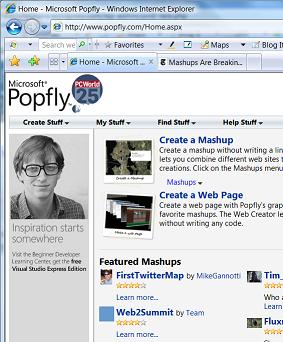
popfly.jpgJohn Markoff has a great story (that phrase belongs on a cut-n-paste clipboard) in today’s NY Times about PopFly, one of my favorite new Microsoft programs because it is so darned fun, and easy, and flexible – and potentially revolutionary.

I’m both a friend and fan of Markoff, but read his piece and you’ll see what I mean, as the examples he cites are pretty cool – or jump to the site itself.

PopFly is getting a lot of attention and coverage, landing on PCWorld’s list in December of “25 Most Innovative Products of the Year.”

Continue reading

Seeking Business Intelligence

I had breakfast this morning with Gartner’s Lisa Gross and we were able to talk about her continuing work in support of my old haunts – the agencies of the Intelligence Community. She’s first-rate at understanding the IT needs of large-scale government enterprises, and has always been known as a trusted adviser for CIOs, CTOs, and senior IT executives across many federal agencies.

I was recounting to her that when I first started at Microsoft (oh these many weeks), I was ecstatic at finding on our corporate intranet seemingly total unfettered access to Gartner research reports and white papers (along with similar access to Forrester research and reports).  The mother lode! 

Continue reading

Ominous Look at Second Life

Robert O’Harrow Jr. of the Washington Post has a solid story today on the IC’s attitude towards Second Life and similar virtual worlds.  I myself would say “attitudes” because there is a broader and more creative range of thinking than is reflected in the story.  There’s a mention of HiPiHi, a new Chinese virtual world, which I’m sure is a land free of any sort of espionage potential whatsoever. </sarcasm>

O’Harrow (whose overwriting skills I’ve noted before) cites ominously an anonymous source with this line:

“Virtual worlds are ready-made havens,” said a senior intelligence official who declined to be identified because of the nature of his work. “There’s no way to monitor it.”

Well, in fact of course there are ways to monitor it, they’re just hard, time-intensive, and require careful thought and imagination, mindful of legal restrictions and appropriateness.  Hmm… that makes it a lot like intelligence work in the real world.  Or police work or government work or simple everyday life, for that matter.


AddThis Social Bookmark Button

Punk Rock & Moore’s Law

Fact: Intel’s CEO says “We have new processors that have 250 million more transistors, and yet are 25 percent smaller than today’s version and don’t require more electricity to run.” (Interview published 2/1/2008 )

Analysis: Moore’s Law: immortal, or destined to be broken?  Punk Rock: dead, or in revival?  And why were Johnny Rotten and one of the legendary Traitorous Eight in the Fairmont Hotel in San Jose on the same night back in 1989?

Once-and-future Sex Pistol John Lydon (Rotten) was there after playing a gig up the road, and I happened upon him in the bar, where he proceeded to buy round after round of Heinekens for me, him, and his roadies. He latched onto me because he wanted to talk about American politics, and to his delight I reminded him of some caustic things (surprise) he had had to say over the years about politicians like Reagan and Carter. That just got him started, and we wound up laughing pretty drunkenly into the night in the Fairmont’s swanky lobby bar.

But earlier that evening, I had shown up at the hotel with friends to attend the Silicon Valley Business Hall of Fame dinner, where Bob Noyce, co-founder of Intel, was being honored along with others….

Continue reading

Wall Street Journal – Peering into the Future, Dimly

The Wall Street Journal ran a collection of think-pieces today on “Thinking About Tomorrow: How will technology change the way we shop, learn and entertain ourselves? How will it change the way we get news, protect our privacy, connect with friends? We look ahead 10 years, and imagine a whole different world.”

My take on the story, though, was “ho-hum.” Looking ahead 10 years should get the mind a little further than easily predictable stuff such as this: “Mobile devices will get smaller and more powerful, and will connect to the Internet through high-speed links. The result: People will be able to do anything on a hand-held that they can now do on a desktop computer. In fact, they’ll be able to do even more, as mobile gadgets increasingly come equipped with global-positioning-system gear that can track your every move. As you drive around, for instance, you might get reviews of nearby restaurants automatically delivered to a screen in your car — maybe even projected onto the windshield.”

Aside from the safety aspect of that type of projection, this scenario surely is only a year or so away – not 10.

Continue reading

Patents, Microsoft, and the Future

Fact: According to the latest annual report on patents released this month, the number of patents awarded in 2007 by the U.S. Patent and Trademark Office was down a full 9.5 percent from 2006’s all-time high. In addition, some 80 percent of the companies on the list of top recipients (including IBM, repeating for its 14th straight year at the top of the list) received fewer patents than they had the year before.  Only one American company in the top 25 earned more patents in 2007 than it had the year before: Microsoft.

Analysis:  One of my minor hobbies is reading patents, for example in the field of information retrieval, and I got the bug as an undergrad from my idol Thomas Jefferson, founder of both my alma mater and the U.S. Patent Office and the first patent examiner himself.  Patents are a great indicator of the future – the future of an idea, a technology, a company, a nation.  I enjoyed a great visit to IBM’s Thomas J. Watson Research Center last year, and was enthralled by one design element in the hallways: the wallpaper in the tech demo area was actually small-type listings, floor to ceiling, of the previous year’s patents.  Amazing!  And plenty of fun to read. But in 2007 IBM Corp. received 3,148 patents, down more than 500 grants from the previous year. By contrast, as Network World reported “Microsoft charged into the top 10 with 1,637 patents [and] ranked No. 6 on the annual list after failing to crack the top 10 the previous two years,” with an increase of nearly 12 percent in its patents from the year before.

Continue reading

The Future of Army’s “Future Combat Systems”

Fact:  The U.S. Army is currently in the midst of a multi-year, $6 billion software development program which it says “dwarfs Microsoft Windows.”

Analysis: The Washington Post did a long piece on the U.S. Army’s gargantuan Future Combat Systems program today, not overly critical but quite skeptical. 

Some highlights of the program itself, which has its own comprehensive site maintained by the Army: 

  • FCS is the “Big Kahuna” of Army modernization, full-on system-of-systems;
  • It’s a $200 billion program, called the most thorough modernization of the Army since WWII;
  • All depends on a massive software development effort led by Boeing; 
  • The S/W development cost alone is around $6 billion (H/W costs are much larger, for the actual weapons, tanks, etc.).

When I was serving at the Defense Intelligence Agency, I was aware that (a) everyone associated with FCS had their fingers crossed and eyes closed when talking about it; (b) everyone not associated with it used the same tone of voice about FCS as they used about FBI’s Virtual Case File and NSA’s Trailblazer – two well-known large-scale failed technology programs.  Many people who know more about FCS than I do consider it a pipe-dream (here’s a good Heritage Foundation backgrounder on the program).  Yet the program continues to spend billions and the Army is slogging on with it.

So here’s what I really think about it: Continue reading

Another Microsoft key hire

Fact: In 2007, Walt Disney shot up the ranks in two separate “Most Innovative Companies” lists. On Business Week’s annual list of “The World’s 50 Most Innovative Companies,” Disney zoomed from #43 in 2006, to #8.  Similarly, “The WIRED 40,” WIRED Magazine’s “tenth annual list of the most innovative companies in the world,” saw Disney come from nowhere – not even on the list in 2006 – to rank at #29.  

Analysis: Microsoft again made both lists, including a stellar #5 in Business Week, but rivals Apple and Google held down the top two spots on each list (trading positions).  Not to rest on its laurels, and to gain leverage against such innovative engines, Microsoft today announced it has lured away Disney’s CIO Tony Scott to come to Redmond and bring some of the Mouse’s magic way of supporting innovative spark with a robust and cutting-edge internal IT environment.

Continue reading

Live may get (even more) personal

A welcome bit of news: Greg Linden, a very very smart pioneer in the personalization of information flow, has announced he is joining Microsoft, specifically Live Labs, the increasingly energetic dynamo at the heart of the company’s future online plans.  Gary Flake, who leads Live Labs, was one of the key people to convince me late last year to join Microsoft, and now Gary has convinced Linden to work on the Live team.  Linden was of course the founder of Findory.com, and before that was in on the early years of Amazon, writing its recommendation engine and leading the software team that developed Amazon’s personalization systems.  Excellent hire.

Email this post to a friend

AddThis Social Bookmark Button

Using Web 2.0 in a top-secret environment

Network World magazine has just posted a podcast interview which I recorded with editor Paul Desmond about a month ago, just after speaking at their “IT Roadmap” conference in December. The interview topic is “Using Web 2.0 tech in a top secret world,” and we discuss the DIA and Intelligence Community experience with social networks, wikis, and blogs.  We also discuss cloud computing, enterprise IT, SOA, IARPA, and the challenges of deploying secure software. Representative quote: “Intelligence analysts are much like ‘knowledge workers’ on Wall Street or in the media, they know what’s going on on the Internet, they know what they want, they know what they need, and it’s in the IT side’s interest to try and service them.”

At the end Paul was gracious enough to ask about my new role with Microsoft’s Institute for Advanced Technology in Governments. If your daily life has a 17-minute hole which you need to fill, then dim the lights, crank up the speakers, and mellow out to the Quiet Storm (I was using my NPR voice)….

Email this post to a friend


AddThis Social Bookmark Button