Top Undergrad Business Programs in the U.S.

FACT: In the recently-released annual BusinessWeek ranking of top undergraduate business programs, Wharton (the feeder program for UPenn’s better known Wharton MBA program) once again leads the field, and the University of Virginia’s McIntire School of Commerce again comes in second.  The Top 10 this year are:

1. University of Pennsylvania (Wharton)
2. University of Virginia (McIntire)
3. Notre Dame (Mendoza)
4. Cornell University
5. Emory University (Goizueta)
6. University of Michigan (Ross)
7. Brigham Young University (Marriott)
8. New York University (Stern)
9. Massachusetts Institute of Technology (Sloan)
10. University of Texas-Austin (McCombs)

ANALYSIS: My alma-mater bias compels me to mention that “The big news this year is the University of Virginia,” as noted by Louis Lavelle, Business School editor for BusinessWeek, during an online chat outlining the results. “It really gained on Wharton. The ranking is based on an ‘index’ number, and the No. 1 school is always an index number of 100. Last year Virginia was way behind — it had an index number of 92.7. This year it was 99 — a virtual dead heat” for the top spot.

Oddly, my grad-school alma mater Stanford, which ranks high perennially on MBA program lists, has no undergraduate business school or program, so it’s missing from this list entirely. 

The big question is, what explains movement in the ranks?  What are some schools doing right, and some wrong?

Continue reading

TechFest and its Value

I am spending much of the week at Microsoft Research’s annual TechFest, which is proving to be an absolutely mind-blowing experience.  So much, so cool, so out there….

There’s been some good press about the show already (ComputerWorld, and ITWorld for example), and the official Microsoft TechFest site has a wealth of material.  The media were allowed in on the “Public Day” to report on a carefully selected subset of the projects being displayed. But I think the coverage has missed an important difference between this show and something like COMDEX or CeBIT.

Continue reading

How Not to Predict Election Results

Fact: The final Reuters/Zogby poll in California, published the day before the Super Tuesday primary in that state, had Mitt Romney up by seven points on the Republican side, and Barack Obama ahead by 13 points in the Democratic primary. In fact John McCain won by eight points, and Hillary Clinton by 10 points.  According to an attempted explanation by John Zogby, “Some of you may have noticed our pre-election polling differed from the actual results.” 

Analysis: From my old political-involvement days, I have lots of friends who have been working on various presidential campaigns this year; several are still active – some on McCain’s staff, and one is with Hillary Clinton (having led her to an upset victory in California, and now her honcho in Texas).  Bipartisanship in practice!  But I can’t trust what they tell me, and each side tells me a lot about what’s purportedly “going to happen.”

Continue reading

How Not to Predict Stock Performance

Google hasn’t had a great week on the stock market so far, but it isn’t often that you get to use the words “Google stock” and “kick ’em while they’re down” in the same sentence, so…

I like my own little subtle “inside jokes” a bit too much sometimes. If you’re sharp-eyed you’ll have noticed that on the left-hand margin, down a ways, is an RSS feed featuring the latest news stories which include the phrase, “the next Google.” Yes, I use Google News itself to drive the RSS feed, ha ha.

Continue reading

Social (Network) Science

Fact: The social-networking site LinkedIn claims as users “17,000,000+ Professionals, 500,000+ Senior Executives, Executives from 498 Fortune 500 companies, [and] 65,000 new Professionals every week.”

Analysis: Since I hold the title of “chief technology officer” for my group at Microsoft, I regularly check the widely-read blog CTOvision, written by Bob Gourley, CTO of Crucial Point.

CollaborationlogosYesterday he posted a very solid summary of several social networking tools, including my preferred LinkedIn.  If you’re not up to speed on the genre it is a helpful cheatsheet and “buyer’s guide.”

The technology area deserves the attention. There are a dozen or more such sites for each that Gourley covers, and he chooses the ones that have shown growth and potential longevity; why invest any time adding personal data to a site just to watch it disappear? We’ve all had that happen. And yet hockey-stick growth has to be managed – LinkedIn for example has come in for some critical attention for some snafus along the way.

Let’s look at some efforts to understand more about the science behind the software….

Continue reading

Mashup Markoff

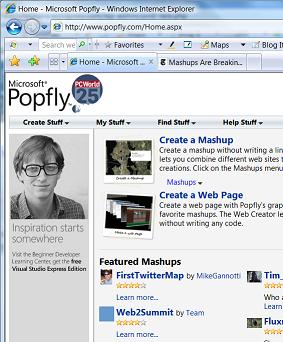
popfly.jpgJohn Markoff has a great story (that phrase belongs on a cut-n-paste clipboard) in today’s NY Times about PopFly, one of my favorite new Microsoft programs because it is so darned fun, and easy, and flexible – and potentially revolutionary.

I’m both a friend and fan of Markoff, but read his piece and you’ll see what I mean, as the examples he cites are pretty cool – or jump to the site itself.

PopFly is getting a lot of attention and coverage, landing on PCWorld’s list in December of “25 Most Innovative Products of the Year.”

Continue reading

Ominous Look at Second Life

Robert O’Harrow Jr. of the Washington Post has a solid story today on the IC’s attitude towards Second Life and similar virtual worlds.  I myself would say “attitudes” because there is a broader and more creative range of thinking than is reflected in the story.  There’s a mention of HiPiHi, a new Chinese virtual world, which I’m sure is a land free of any sort of espionage potential whatsoever. </sarcasm>

O’Harrow (whose overwriting skills I’ve noted before) cites ominously an anonymous source with this line:

“Virtual worlds are ready-made havens,” said a senior intelligence official who declined to be identified because of the nature of his work. “There’s no way to monitor it.”

Well, in fact of course there are ways to monitor it, they’re just hard, time-intensive, and require careful thought and imagination, mindful of legal restrictions and appropriateness.  Hmm… that makes it a lot like intelligence work in the real world.  Or police work or government work or simple everyday life, for that matter.


AddThis Social Bookmark Button

Driving during the Super Bowl? Use a Mashup First

Fact: According to a report, “Taking Back the Airwaves” in the Buffalo News last month, “Listeners’ relationship with radio has changed in the last 25 years. Radio used to be the main source of music, … but now, like other industries, radio is fighting to reinvent itself in a digital age.”

Analysis: Let’s say you were an Air Force mission planner, and wanted to plan a particular flight over enemy territory.  Time-honored practices (and traditionally clunky but powerful software built custom for the purpose) allow you to overlay the enemy’s known radar-emitting sites, using circles or shapes to indicate the covered and non-covered areas, and to do the same with anti-aircraft missile ranges, allowing the precise planning of a safe flight route.

Now let’s look at a nifty adaptation, showing that there are much more fun and practical everyday uses of such an approach – and now new technologies make it much easier and faster to accomplish! Continue reading

A Quick Long-Term Analysis of GOOG, YHOO, MSFT

Fact: According to Forbes, writing after yesterday’s close of trading, “Unable to topple Google on its own, Microsoft is trying to force crippled rival Yahoo into a shotgun marriage, with a wager worth nearly $42 billion that the two companies together will have a better chance of tackling the Internet search leader…. Microsoft’s $31-per-share offer represented a 62 percent premium to Yahoo’s closing price late Thursday, although it’s below Yahoo’s 52-week high of $34.08 reached less than four months ago.”

Analysis: Most of the buzz about the Microsoft-Yahoo commentary yesterday was simply noise, bleating about the immediate impact (or not) on Google, as if the salience is a snapshot rendered in instantaneous who’s-up-who’s-down.  Yet I had a reader comment yesterday very perceptively on my post, saying “Whether the deal is timed well, overpriced or not, is for time to decide. Which may even take a couple of years!”

That got me to thinking about the value of these three companies over the long-term looking back.  Thanks to the web that’s easy to quantify, at least in terms of stock price; you can do it at MSN or on Yahoo Finance, but just for grins let’s do it at …

Continue reading

Microsoft becomes Microsoft!

Everyone in the blogosphere will light up today on the topic, so not much needs to be said, but I’m glad that at last I can break out the exclamation mark and call my company: Microsoft!

Regarding the purchase of Yahoo!, Dennis Kneale, CNBC’s Business News Media and Technology Editor, had the most vivid word-picture early this morning on the air: “The one guy in America who can’t eat breakfast this morning without feeling sick to his stomach is the Google CEO, Eric Schmidt,” referring to Google’s previous attempts to snag Yahoo!.

I’ve been one of the 400 million users who have a Yahoo! account, for years, with lots of personalized interests and preferences willingly shared in exchange for great user experience like the pioneering MyYahoo portal, which I still like and use, though I also have a tricked-out iGoogle site (eight tabs worth) and now a pretty robust Live Search, Online Live Workspace, and Live Spaces environment.  Imagine the experience and gutsy experimentation that’s coming to Microsoft(!), joining up again with former Yahoo himself Gary Flake (now head of Microsoft’s Live Labs)… it’s pretty exciting.

Keeping score will have to be a longterm effort, of course – start here.