Tellme what you want

The future of social computing is in the integration of various services and technologies – but the fun is already available now. Here’s a nifty demo of the integration of cloud computing’s services with increasingly powerful mobile computers (smartphones or netbooks). Developers can take advantage of far more computational power both locally on the device – faster, cheaper processors thanks to Moore’s Law – and computational power residing on networked data centers.  Think of a business or social activity, and thanks to platforms like the iPhone, Android, and the new Windows Phones, “There’s an app for that.” Or there soon will be.

This quick little demo feels like nothing fancy today – but ten, even five years ago it would have seemed like sci-fi. In fact it’s available now, and uses a new Windows Phone, in this case a Samsung Intrepid, making use of Tellme software from Microsoft integrated with Bing Search web services. The demo intregrates some longtime technologies in their state-of-the-art condition today using cloud-services delivery:

  • Speech-to-text
  • GPS-enabled location-based services
  • Web search
  • Voice-enabled dialing
  • Social media (crowdsourced ratings integrated in search results)
  • Hardware UI (a dedicated TellMe button on the Samsung Intrepid phone)

Share this post on Twitter

Email this post to a friend

AddThis Social Bookmark Button

The promise of mobile augmented reality

Robotvision appMy intention with this blog is always to write medium-length “think-pieces,” about technology, government, or preferably both. I’m working on several (the Jefferson Gov 2.0 piece, the Evil Twin 2.0 piece, and one on “whither the multilingual web”), but they do truly require thought and some free time, so they percolate a bit.

In the meantime, readers like the latest cool demo videos, so for Friday fun here’s another one (watch below or on youTube), which was featured on TechCrunch last night (“Bing comes to the iPhone via Robotvision”), with an augmented reality app for the iPhone which uses Bing Maps and Bing’s real-time data (website here). The company describes itself this way:

Continue reading

How the Crowd Reads Crowd-Sourced News

It turns out that we have lessons to learn from Uganda – more specifically, from web coverage of events in Uganda this week.

I’m constantly trying to improve my own ability to follow real-time world events, whether through social media, advanced search technologies, or aggregation of multiple old/new information technologies. About this time last year, as the Georgian-Russian skirmishes were just kicking off, I wrote about keeping up with information on international events (“Using Web 2.0 to Track a Political Crisis“).

In the intervening year, development of real-time tools and techniques has really blossomed. This past week, the onset of violent political unrest in Uganda has served as yet another crucible in which new techniques and web-based technologies can be tested and tweaked.

Continue reading

Webcast interview from the Government 2.0 Summit

I’ve been attending the Government 2.0 Summit in Washington this week, along with a lot of friends and colleagues from various spots in Silicon Valley, the international tech world, and federal, state, or local government agencies. If you want to follow along on Twitter, there’s a great number of attendees posting real-time notes and comments throughout the sessions.

Over the past couple of months I’ve participated with many colleagues planning the kick-off Gov 2.0 Expo Showcase, which highlighted fantastic new-technology projects from government agencies across the country. One of the great projects showcased is www.NeighborsforNeighbors.org, a collaborative website of rich services run by Joseph Porcelli (on Twitter he’s @josephporcelli). Among the other services on the site is a webcast series of great interviewst all levels, from across the country. , and this afternoon I sat down for a chat.

You can watch it below, on their site, or over on the archived kyte.tv site  – lots of laughs as we talk about my varied experiences in government, and why Microsoft is focusing intently on enabling enterprise Government 2.0 capabilities.  Fun stuff!

[kyte.tv appKey=MarbachViewerEmbedded&uri=channels/202174/553690&tbid=k_168&p=p/s&height=436&width=416]

Email this post to a friend

AddThis Social Bookmark Button

Fighting Social Ills with Social Media

This week I’m traveling in Mexico as part of a unique State Department delegation, bringing American social-media professionals together with Mexican public and private efforts working on building civic society. In particular, the trip is focused on bolstering civic participation efforts aimed at countering the enormous spike in narco-violence in Mexico, including the state of Chihuahua, whose capital Ciudad Juarez we visited on Monday and Tuesday.  I’m joined on the trip by colleagues from Facebook, Google, AT&T, MIT Media Lab, and several other leading social-media professionals. Continue reading

A Face in the Crowd

GovFreshGovFresh is a great new web service which aggregates live feeds of official news from U.S. Government Twitter accounts, YouTube channels, RSS feeds, Facebook pages, Flickr photostreams and more, all in one place. It is one of a new class of interactive Government 2.0 services, portals, and tools – many of them just launching in 2009 – which have the potential of revolutionizing the way citizens get and share information about their government.  (I mention several others below.)

At a time when the Iranian people are battling to keep their access open to Twitter, Facebook, and even phone lines in order to mobilize their anti-dictatorial protests, it is heartening that individuals in the United States and many other corners of the world find their governments increasingly willing to share information widely.

Luke Fretwell is GovFresh’s founder, and he’s becoming a welcome new voice in the debates around government technology policy. Luke recently wrote a blog post arguing “Why Gov 2.0 means the U.S. Government must centralize its Web operations.” A heated debate arose in the comments, including my own strenuous disagreement, and yet I became a fast admirer of Luke, his entrepreneurial energy, and the site’s information value.

GovFresh has been running a great series of profile-interviews in its blog section of leading individuals in the “Gov 2.0” movement, and today I was the chosen subject. The article has the unfortunately exaggerated title (in my case): “Gov 2.0 Hero Lewis Shepherd.”  Here’s an excerpt:

What’s the killer app that will make Gov 2.0 the norm instead of the exception?

Can’t tell you because we’re building it in the lab right now, ha! Seriously, the killer app may be something big and powerful, from an enterprise perspective, though I’d put the odds on something less obvious, but more pervasive. Here’s what I mean. I think often about the roots of the original Progressive movement at the dawn of the 20th Century, and their advocacy of direct-vote referendums, championed by Hiram Johnson and the like. Those give the people a direct say over particular issues, but the downside is that “the people” don’t always exercise informed judgment, and popular opinion can be manipulated and swayed by malevolent interests. So I’m looking to Gov 2.0 capabilities that maintain the representative aspect (the elected official, exercising his or her judgment) while incorporating real-time, structured, unfiltered but managed visualizations of popular opinion and advice. I’m intrigued by new services along these lines like www.you2gov.com, www.govfresh.com, www.govtwit.com, and the like, but I’m also a big proponent of semantic computing – called Web 3.0 by some – and that should lead the worlds of crowdsourcing, prediction markets, and open government data movements to unfold in dramatic, previously unexpected ways. We’re working on cool stuff like that.

At the end of the full interview, I observed that “You can’t watch what’s gone on with social software use in Egypt’s Facebook Revolution, our own 2008 campaign, or Iran’s election protests, without feeling that Patrick Henry and Thomas Jefferson would have been prolific twitterers with awesome blogs.”

In the spirit of empowering the people, instead of lauding one person, I’d like to thank GovFresh for the Hero honor but share the title with those I have worked with in the past few years, and with everyone else around the world engaged in the Gov 2.0 movement – whether they realize that’s what they’re doing or not.

Share this post on Twitter

Email this post to a friend

AddThis Social Bookmark Button

Government Transparency circa 1837

A longtime government watcher told me recently that she’s becoming overwhelmed with the volume of information and self-echoing commentary on “government transparency,” in the  form of official blogs, citizen blogs, Twitter streams, conferences, and even in the pages of those quaint things called “books.”

Save some time. Here is the only piece you need to read about the subject of government openness, with all its implications for honest policy, court politics, and citizen empowerment.  And as you might expect, it’s a fairy tale.

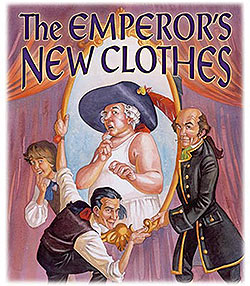
“The Emperor’s New Clothes.” Go on, read it – you haven’t read it since childhood, have you? It’s short, so after you finish it take a moment, if you like, to comment back with your thoughts.

The full text follows, translated from Kejserens nye Klæder,  by Danish poet and author Hans Christian Andersen. There’s also an intellectually annotated version here at SurLaLune, by Information Science scholar Heidi Ann Heiner.

   ~   ~   ~  

Once upon a time there lived a vain Emperor whose only worry in life was to dress in elegant clothes. He changed clothes almost every hour and loved to show them off to his people.

Emperors New ClothesWord of the Emperor’s refined habits spread over his kingdom and beyond. Two scoundrels who had heard of the Emperor’s vanity decided to take advantage of it. They introduced themselves at the gates of the palace with a scheme in mind. “We are two very good tailors and after many years of research we have invented an extraordinary method to weave a cloth so light and fine that it looks invisible. As a matter of fact it is invisible to anyone who is too stupid and incompetent to appreciate its quality.”

The chief of the guards heard the scoundrel’s strange story and sent for the court chamberlain. The chamberlain notified the prime minister, who ran to the Emperor and disclosed the incredible news. The Emperor’s curiosity got the better of him and he decided to see the two scoundrels. “Besides being invisible, your Highness, this cloth will be woven in colors and patterns created especially for you.” The emperor gave the two men a bag of gold coins in exchange for their promise to begin working on the fabric immediately. “Just tell us what you need to get started and we’ll give it to you.” The two scoundrels asked for a loom, silk, gold thread and then pretended to begin working.

The Emperor thought he had spent his money quite well: in addition to getting a new extraordinary suit, he would discover which of his subjects were ignorant and incompetent. A few days later, he called the old and wise prime minister, who was considered by everyone as a man with common sense. “Go and see how the work is proceeding,” the Emperor told him, “and come back to let me know.” The prime minister was welcomed by the two scoundrels. “We’re almost finished, but we need a lot more gold thread. Here, Excellency! Admire the colors, feel the softness!”

The old man bent over the loom and tried to see the fabric that was not there. He felt cold sweat on his forehead. “I can’t see anything,” he thought. “If I see nothing, that means I’m stupid, or worse, incompetent!” If the prime minister admitted that he didn’t see anything, he would be discharged from his office. “What a marvelous fabric, he said then. “I’ll certainly tell the Emperor.”

The two scoundrels rubbed their hands gleefully. They had almost made it. More thread was requested to finish the work. Finally, the Emperor received the announcement that the two tailors had come to take all the measurements needed to sew his new suit. “Come in,” the Emperor ordered. Even as they bowed, the two scoundrels pretended to be holding large roll of fabric. “Here it is your Highness, the result of our labor,” the scoundrels said. “We have worked night and day but, at last, the most beautiful fabric in the world is ready for you. Look at the colors and feel how fine it is.”

Of course the Emperor did not see any colors and could not feel any cloth between his fingers. He panicked and felt like fainting. But luckily the throne was right behind him and he sat down. But when he realized that no one could know that he did not see the fabric, he felt better.

Nobody could find out he was stupid and incompetent. And the Emperor didn’t know that everybody else around him thought and did the very same thing. The farce continued as the two scoundrels had foreseen it. Once they had taken the measurements, the two began cutting the air with scissors while sewing with their needles an invisible cloth. “Your Highness, you’ll have to take Emperors New Clothes 2off your clothes to try on your new ones.” The two scoundrels draped the new clothes on him and then held up a mirror. The Emperor was embarrassed but since none of his bystanders were, he felt relieved. “Yes, this is a beautiful suit and it looks very good on me,” the Emperor said trying to look comfortable. “You’ve done a fine job.”

“Your Majesty,” the prime minister said, “we have a request for you. The people have found out about this extraordinary fabric and they are anxious to see you in your new suit.” The Emperor was doubtful showing himself naked to the people, but then he abandoned his fears. After all, no one would know about it except the ignorant and the incompetent. “All right,” he said. “I will grant the people this privilege.” He summoned his carriage and the ceremonial parade was formed.

A group of dignitaries walked at the very front of the procession and anxiously scrutinized the faces of the people in the street. All the people had gathered in the main square, pushing and shoving to get a better look. Applause welcomed the regal procession. Everyone wanted to know how stupid or incompetent his or her neighbor was but, as the Emperor passed, a strange murmur rose from the crowd. Everyone said, loud enough for the others to hear: “Look at the Emperor’s new clothes. They’re beautiful!” “What a marvelous train!” “And the colors, the colors of that beautiful fabric, I have never seen anything like it in my life!”

They all tried to conceal their disappointment at not being able to see the clothes, and since nobody was willing to admit his own stupidity and incompetence, they all behaved as the two scoundrels had predicted.

A child, however, who had no important job and could only see things as his eyes showed them to him, went up to the carriage. “The Emperor is naked,” he said.

“Fool!” his father reprimanded, running after him. “Don’t talk nonsense!” He grabbed his child and took him away.

But the boy’s remark, which had been heard by the bystanders, was repeated over and over again until everyone cried: “The boy is right! The Emperor is naked! It’s true!”

The Emperor realized that the people were right but could not admit to that. He thought it better to continue the procession under the illusion that anyone who couldn’t see his clothes was either stupid or incompetent.

So he stood, stiffly on his carriage, while behind him a page held his imaginary mantle, carrying the train that wasn’t really there.

The End

Email this post to a friend

AddThis Social Bookmark Button

Microsoft and Google Look at the World Differently

I didn’t think I would have to write this same kind of observation twice within a year. But today, on D-Day, I notice yet again a striking difference between Google and Microsoft.  And in this case, one can almost read the evidence as a snub from Google to the United States, to the nations who united in sacrifice during World War II, and to President Obama on a day of his personal leadership in commemorating international war and peace.

I made a similar observation on Columbus Day, when Microsoft chose to honor Christopher Columbus and his explorations’ significance to American history and the world, while Google chose to honor – wait for it – Paddington Bear’s “birthday.” (See my post from then here.)

Today is of course D-Day, the 65th anniversary of a day in which over 2,000 American soldiers lost their lives, leading the way in the greatest military operation in the history of the world, as the initial landing to liberate Europe and the beginning of the end of the Nazi empire.

Google and Microsoft are two great American companies, which operate globally. Each has a public face to the world through signature online properties – their search engines. In Google’s case, that page at Google.com is their ne plus ultra public face, since they are at core a mighty search engine.

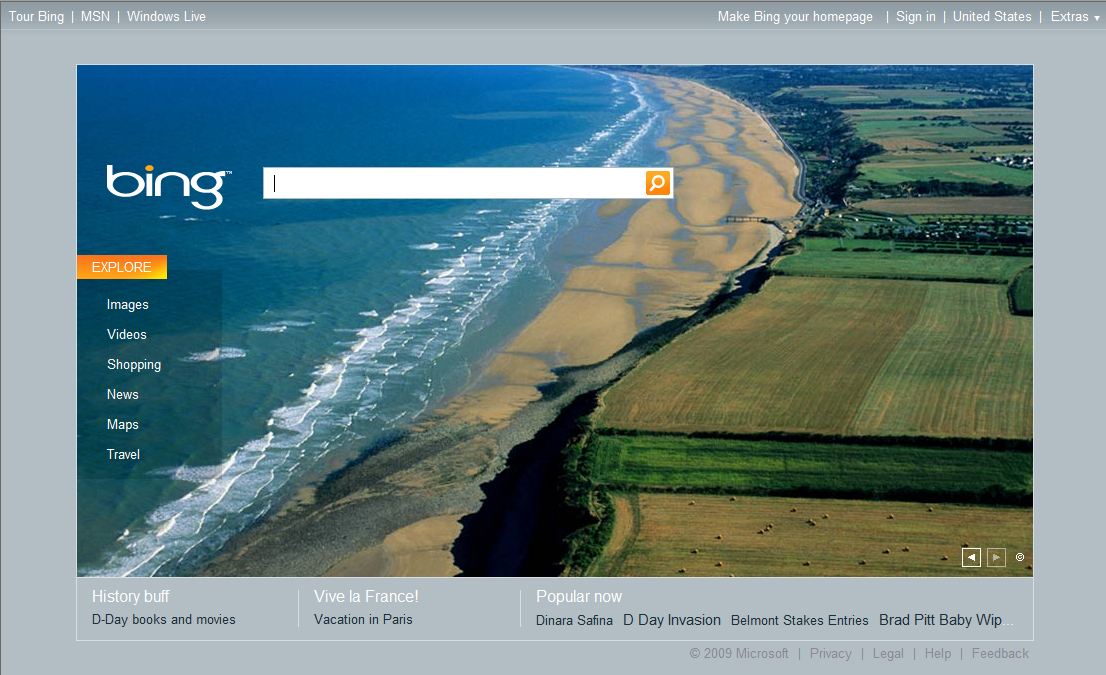
Take a look at the two pages today. Microsoft’s Bing search-engine uses its home page to commemorate D-Day, with a dramatic photograph of Normandy Beach today, and mouse-over popups providing historical highlights and links to more information on the battle’s signficance to World War II and to world history.

Bing D-Day

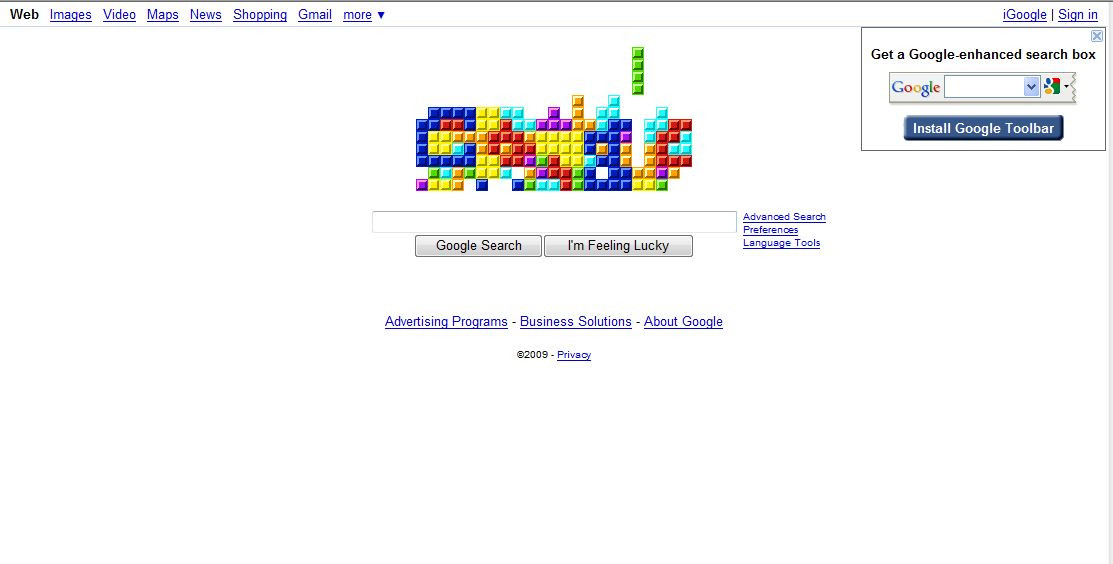
Google uses its home page to commemorate the 25th anniversary of the invention of the computer game Tetris.

Google Tetris

The mouse-over popup on the cutesy Google logo reads, “Celebrating 25 years of the Tetris effect – courtesy of Tetris LLC.”  (I suppose one could read that as, predictably, a coporate ad, right there on Google’s home page.)

Just as I noted on Columbus Day, this doesn’t appear to be a localization issue, or an issue of appealing to a global audience – both Microsoft and Google know my location, and in fact each is serving up a page targeted for me in the United States.

Don’t get me wrong: Tetris was an amusing and absorbing game. As a young guy I spent hours dropping the bars and shapes to fit into the rising pile below.

But at certain moments in life, you put aside childish things. Unless you’re trying to make some other kind of statement.

Note: I am a Microsoft employee. But this is not a Microsoft corporate blog, it’s my personal blog – and I’ve been known to tweak Microsoft here frequently as well.  This is my personal observation space.

I have to admit I am puzzled – and personally appalled – by the decision-making over at the Googleplex, and the statement they choose to send to the world.

President Obama is leading our delegation himself at Normandy Beach today, for the international event with other world leaders remembering a moment of global importance.  Self-evidently Eric Schmidt and the Google gang weren’t on board with that, and by their way of thinking saw something more significant to mark. 

Email this post to a friend


Immersed in Augmented Reality

Here’s a quick post, about a talk I gave this week – but as an excuse to link to a much more compelling presentation given at the TED Talks recently. Yesterday I had the good fortune to deliver the “Technology Keynote” address at the annual International Field Directors and Technology Conference, in Delray Beach, Florida. The IFD&TC is a well-known group in its field – no pun – of the world’s leading academic and government researchers, conducting large-scale and longitudinal social-scientific research studies.

As an example, think of the U.S. Census – and indeed I had the opportunity to spend some time with Cheryl Landman, Chief of the U.S. Census Bureau’s Demographic Surveys Division. You know those large studies drawn from every decade’s data? She runs them. That division’s work should feature prominently (I hope) in the forthcoming U.S. government’s “Data.gov” set of services.

Continue reading

Social Media goes hyper local for emergencies

For the past year, whenever my group has had government visitors to Microsoft labs in Redmond to see advanced technologies, we’ve considered whether or not to show them a demo of a particular “secret project” being developed, now called Microsoft Vine.

vineIf the group was with local or state government, or related to homeland security, or emergency responders and the like, the answer was easier, because that’s the sweet spot it’s designed for.

But I was always tempted to show it even to my federal government friends – and anyone else – just because it’s so impressive!

Continue reading