My bold decision to withdraw from consideration as Obama’s CTO

To: President-Elect Barack Obama

From: Lewis Shepherd

RE: My Imminent Selection as Chief Technology Officer for the United States

Mr. President-Elect, I am hereby reluctantly but insistently withdrawing my name from consideration as your appointment to the newly created position of Chief Technology Officer for our nation.

No, no, please don’t try to persuade me otherwise. My decision is final.

Analysis: My earlier post about John Brennan being President-elect Obama’s “imminent” selection as CIA director is now a curio, given Brennan’s decision yesterday to withdraw from consideration. 

Like any good intelligence analyst writing a balanced assessment, I had included the caveat that the only thing standing between Brennan and the appointment was the likelihood of a last-minute political squabble or contretemps.

This being Washington we’re talking about, that is precisely what happened. 

Continue reading

MS Office Wired, OpenOffice Tired, Google Docs Expired?

google-newsFact: “Google Docs Struggles to Gain Foothold.” “Google Docs Use: Just a Blip.” “Study: Office Fights Off Google Docs Threat.” “OpenOffice Five Times More Popular than Google Docs.”  These are news articles covering the release of a new ClickStream study of typical use of “productivity software” like the Microsoft Office suite (Word, Excel), Google Docs, Google Spreadsheets, OpenOffice, etc. The study “among adult U.S. internet users showed that use of free productivity applications such as Google Docs and OpenOffice remains low, while Microsoft Office is in use by over 50% of adult U.S. internet users and shows no signs of declining popularity.”

Analysis: Well, yesterday I gave Google some nice words because of our joint work with DoD on improving military health IT. So I’m itching to tweak the Big G now, and we have some numbers to examine.  And I wasn’t cherry-picking the titles above either, they were the “most relevant” results on a Google News query this morning for <“Google Docs” OpenOffice Microsoft>.

Continue reading

Google and Microsoft sign up for military duty

Fact: A September 2008 article in the Michigan Business Review holds that “An estimated 70 million people do have access to basic personal health records through their health insurers, with millions more scheduled to receive the service this year, according to health care benefit company Aetna.”  But that doesn’t mean they’re using a PHR.  Aetna also did a study just last year (2007) with the Financial Planning Association, according to the same article and found that “64 percent of respondents said they didn’t know what a personal health record was and of those who did, only 11 percent said they were currently using one.”

Analysis: In the battle to expand access to and use of PHRs, there’s great news on the way for a significant portion of the country: our millions of men and women in the military.

Continue reading

Hot Election Results Here, and Here, and Here

Political junkies are drumming their fingers mid-day this Tuesday.  They’ve likely already voted, but have no access to exit-poll results until early evening.  Mashup maps of results from sites like Twitter, essentially self-selected and self-reported exit polls like this one at SetFive, or this one mapping general Twitter election buzz, are fun but wildly inaccurate as election tracks.

Continue reading

Bill Gates will pay you to save the world

Fact: You have ten days to apply for a $100,000 grant from the Gates Foundation, for your innovative idea in global health research.  It’s a surprisingly simple application process, but you’d better get cracking!

Analysis: Last night the Bill and Melinda Gates Foundation announced the 104 individual winners of their Round 1 funding in the Grand Challenges in Global Health initiative, which “funds research on scientific problems that, if solved, could lead to advances against multiple diseases.”

Continue reading

Currently in Cairo

Cairo Tower, or Gezira Tower, on the Nile

Cairo Tower, or Gezira Tower, on the Nile

I’m currently in Cairo and am trying to carve out time to finish some tech-focused blog posts, in the middle of spending time with the great technologists here and also just wandering around Cairo.

On the former point, I’m spending time with the Cairo Microsoft Innovation Center, in Smart Village just on the western outskirts of town. CMIC is working on some interesting stuff, much of it web-based, including some leading-edge automated translation solutions beyond the neat stuff we’ve already deployed in Windows Live.

On the latter point, i.e. wandering, this is only my second visit, of what I hope and expect will be many in coming years, so I’m still a wide-eyed tourist.  Here are a couple of photographs on Flickr which I took yesterday and last night, from my hotel and walking up and down the Nile through central Cairo, on main avenues and back streets.

On my first visit here in May, I took a bunch of the usual touristy pictures (see them here), including the Pyramids, Sphinx, Museum, etc. Won’t get to do that stuff this trip.

Email this post to a friend

AddThis Social Bookmark Button

Stop being so touchy

Remember Tom Cruise’s virtual 3D in Minority Report? Wouldn’t it be cool if, instead of an iPhone-like touch screen, we could manipulate data and 3D images on screens by simply moving our hands – interacting virtually without touching a keyboard or screen?

Continue reading

Google and Microsoft on Columbus Day

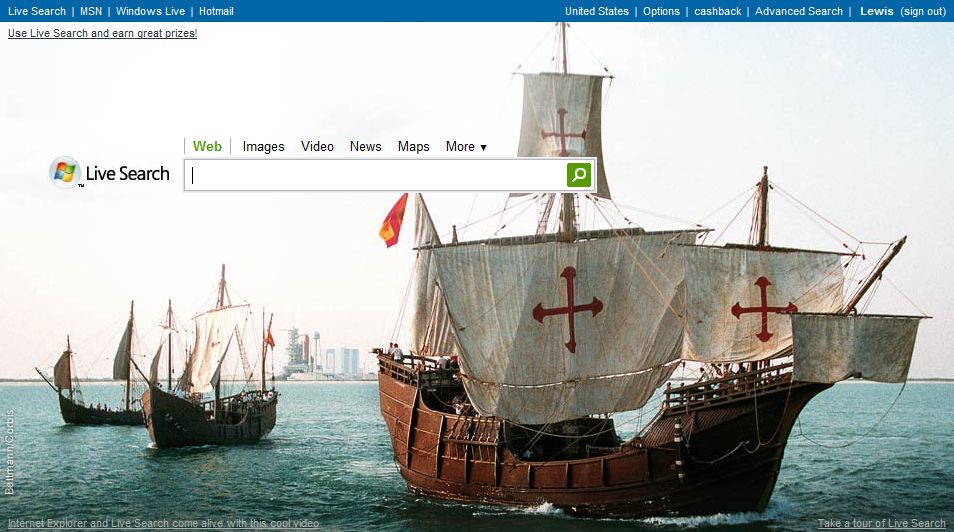
Click to enlargeToday is celebrated in the United States as Columbus Day. I happened to notice that my search engine of choice, at www.Live.com [ed. note: relaunched Bing as of Spring 2009], has a striking image (courtesy of Bettman Corbis archives), as you can see to the left.

As always with the new (improved!) Live Search, there are several hover spots on the page, with pop-up queries about the holiday, “sailing lessons,” Columbus’s trip to the Bahamas, and “the caravel,’ which turns out to be “a small, highly maneuverable, two- or three-masted lateen-rigged ship, created by the Portuguese and used also by them and by the Spanish for long voyages of exploration.”

  Continue reading

Inventing the Software that Invents the Future

Worried about today’s stock market activity? Retreat with me into the security of the bright future that awaits.

Microsoft’s Craig Mundie (pater familias of the Institute for Advanced Technology in Governments), is on a college tour across the nation.  The trip is something of a reprise of jaunts Bill Gates famously made over the years, when he would string together visits to campuses partly to evangelize, partly to recruit, and mostly to get new ideas from bright young (and contrarian) minds.  The Seattle paper today labels these tours as filling the role of Microsoft’s “chief inspiration officer” (“Mundie gives campuses peek at tech’s future”).

Continue reading

Walled-Garden Wikis and Candlepower

Fact: Last night the U.S. Joint Forces Command (JFCOM) announced it has “moved its C2Pedia Registry to the unclassified network enabling more potential users to access and edit the site, hoping it will ultimately improve the quality of data.”  C2Pedia is a MediaWiki-driven online knowledge base of information about Command and Control (C2), with specific information about more than 200 C2 systems used across the Department of Defense and the armed services.

Analysis: The profusion of wikis in official government circles is an interesting expression of the value of social media for enterprise knowledge management, but for the most part inside agency or network firewalls, denying access to the public at large and therefore incorporating only the wisdom of “the inside crowd.” The State Department’s Diplopedia sits on their intranet (ironically called “OpenNet”), as the New York Times pointed out in a story a few weeks ago (“An Internal Wiki that’s Not Classified“), implying a distinction (without a difference to my mind) between Diplopedia and the IC’s Intellipedia, which has an unclassified version as well – but it also sits on a firewalled network!

Jimmy Wales, founder of Wikipedia, testified to Congress recently about the value of wikis and social media within enterprises, and pointed out the distinction between “within-the-agency” verticalized information sharing, a la Diplopedia, and horizontal sharing across organizations as exemplified by the IC’s Intellipedia, which as I mentioned has a firewalled unclassified version as well as its classified-network versions, all accessible from any of the intelligence community’s sixteen agencies and beyond.

Continue reading