Gunning the Microsoft Semantic Engine

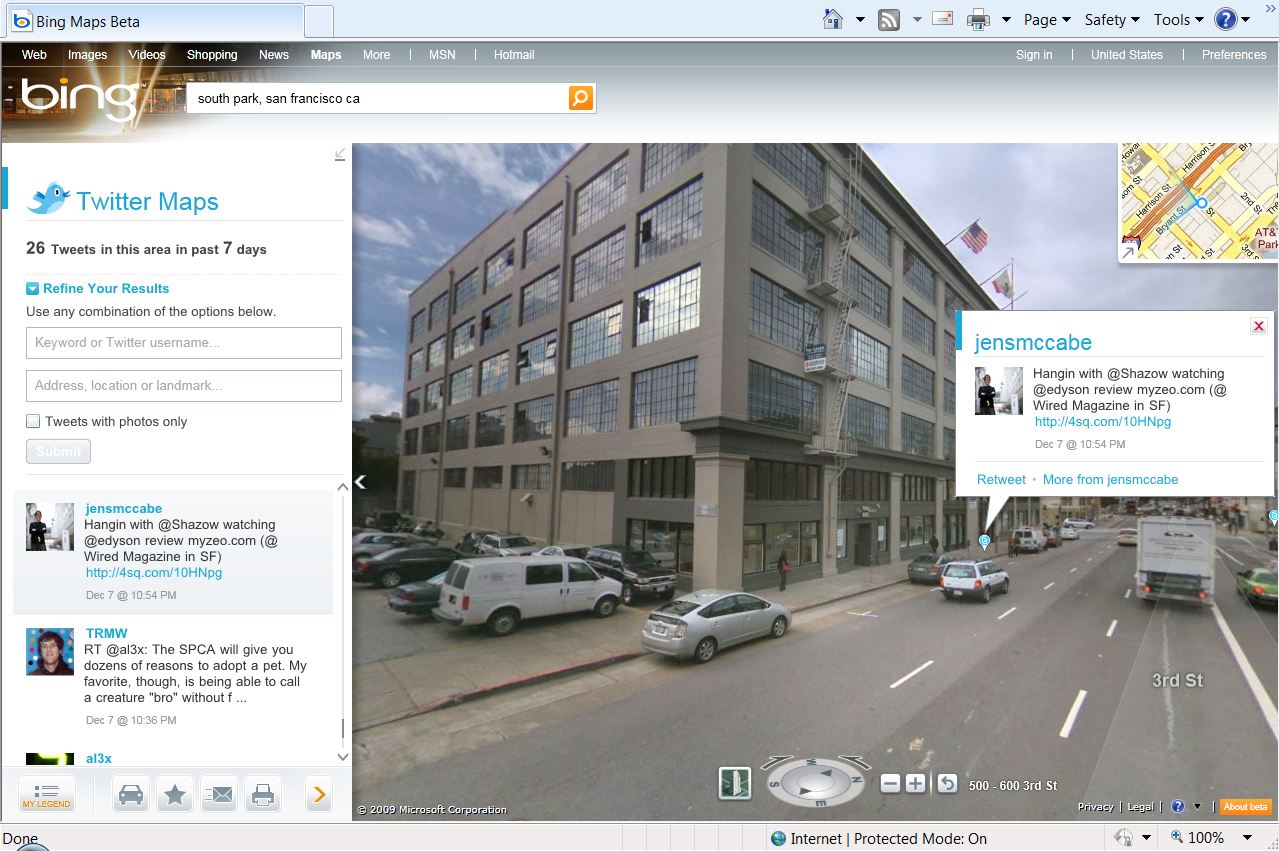
New Bing Maps Beta with embedded data layers from Twitter and other social feeds, click to enlarge screenshot

There’s a lot of information on the Internet already. Every day, more is added – a lot more. And while there are a concomitant number of new analytic or sense-making tools on the web, they butt up against the fact that the data – the all-important data – is held in multiple places, formats, and platforms.

How are we going to deal with all this? One approach is almost mechanical: ensuring that datasets can be accessed commonly, as in our new Microsoft Dallas platform associated with the Windows Azure cloud platform.  In the government realm, the anticipated reliance on “government-as-a-platform” (a meme popularized by Tim O’Reilly) holds promise in allowing somewhat aggregated datasets, openly accessible.

Continue reading

43 Gigabytes of Mobile Data per Day

Here’s a nifty infographic, created by Online Education with several striking statistics about “an average day on the Internet” and the volume of data involved in mobile talk and data, Twitter, blogs, wikis, email, news sites and the like. The numbers are staggering! Continue reading

Why a Cloudlet Beats the Cloud for Mobile Apps

Sure, you know cloud computing. You also know a bit about so-called “private clouds,” which enterprises and government agencies are exploring as an option to combine the power and scale of virtualized cloud architectures with security and control over data.

But what do you know of Cloudlets? They may just be a key to the future of mobile computing.

That’s a possible conclusion from the results so far of a Microsoft Research family of projects called MAUI, short for Mobile Assistance Using Infrastructure. The MAUI approach is to enable a new class of CPU-intensive, and data-intensive, applications for mobile devices – but enable them in a new way.  Today’s mobile devices can’t run such apps, at least not well. And if they stick to the cloud they may never do so.

I’ve just read a fundamental MAUI paper published last month in the IEEE’s Pervasive Computing journal: “The Case for VM-based Cloudlets in Mobile Computing” (November 2009, co-authored by MSR’s Paramvir Bahl along with colleagues from Carnegie Mellon University, AT&T Research, and Lancaster University).

Continue reading

The Purple History of Intelink

When I first began talking with DIA CIO Mike Pflueger and Deputy CIO Mark Greer in the fall of 2003 about the work I’d be doing with them inside government, most of the ideas were big ones: let’s re-architect the DoDIIS enterprise, let’s find and deploy revolutionary new analytical software. One of our thoughts was a little one, but for me personally it turned out to be a most valuable project. They let me pull together a panel for the upcoming 2004 DoDIIS Conference called “Geeks and Geezers,” featuring some of the grand old names of intelligence technology. The panel was a success, and in organizing it, I spent quite a bit of time talking to those giants, or should I say listening to them. I learned an enormous amount about “the early days.” This post describes the important work of one of those fellows. 

Undercover Grrl Band Techno Rave

Friday I had an interesting meeting with Dawn Meyerriecks, who has just begun her new role as the Deputy Director of National Intelligence for Acquisition and Technology. (Read the DNI’s statement on her appointment here in pdf, her bio here, and some reaction – all positive – here and here.)

Never mind what we actually were talking about, she asked me in so it isn’t appropriate to write about that. But to be honest I spent my drive home thinking about the atmospherics and significance of her holding that post in any case.  In a companion post later (“The Purple History of Intelink“) I’ll comment on the significance of her prior background in the Defense Department.

But more striking, right off the bat, is the fact that DNI Dennis Blair has an impressive number of women in high-ranking senior leadership positions. And it’s not just the number, but the particular positions they hold that I like: Dawn Meyerriecks is DDNI/A&T, Priscilla Guthrie is Assistant DNI and Chief Information Officer, Marilyn Vacca is Assistant DNI and Chief Financial Officer. Lisa Porter leads the Intelligence Advanced Research Projects Agency IARPA (I’ve written about her before). Continue reading

A-Space Past and Future

This week marks the second anniversary of the first live internal demo of the intelligence community’s A-Space project, groundbreaking for the IC in its goal of collaborative use of social media across agency lines. Somewhere in Maryland, a remarkable government employee and friend named Mike Wertheimer should pause and quietly celebrate the fruition of his early evangelism for it.

I was still a government employee then, but wrote about the effort at the time here on Shepherd’s Pi (“A-Space: Top-secret social networking“). It makes me chuckle to remember back to those days when it was still mostly unheard-of for IC employees to blog openly on the public web about current technology projects. Now you can’t shut ’em up! 🙂

It made sense, I thought, to set down a few notes at the time for several reasons: Continue reading

Data in the Cloud from Dallas to Mars

There’s a lot going on at this week’s Microsoft Professional Developers Conference (PDC 09); it’s a traditional launchpad for cool new stuff. I thought I’d point out several of the government-relevant announcements and technology roll-outs.

I specifically want to spotlight something called Codename Dallas, and how NASA and others have begun using it. In the keynote this morning Microsoft’s Chief Software Architect Ray Ozzie told PDC attendees (and his streaming-video audience) that a landslide of new sensors and observational systems are changing the world by recording “unimaginable volumes of data… But this data does no good unless we turn the potential into the kenetic, unless we unlock it and innovate in the realm of applications and solutions that’s wrapped around that data.”

Here’s how we’re addressing that, with a bit of step-by-step context on the overall cloud-computing platform enabling it.  The steps are: 1. Azure, 2. Pinpoint, and 3. Dallas.

Continue reading

Para Bellum Web

Tim O'Reilly, Ray Ozzie

Tim O’Reilly created a bit of a stir last night in the tech world by writing a thoughtful essay entitled “The War for the Web.” He’ll be expanding on his thoughts in his keynote address today at the Web 2.0 Expo in New York. From the essay, here’s the core argument:

“[W]e’ve grown used to a world with one dominant search engine, one dominant online encyclopedia, one dominant online retailer, one dominant auction site, one dominant online classified site, and we’ve been readying ourselves for one dominant social network. But what happens when a company with one of these natural monopolies uses it to gain dominance in other, adjacent areas? I’ve been watching with a mixture of admiration and alarm as Google has taken their dominance in search and used it to take control of other, adjacent data-driven applications.

It could be that everyone will figure out how to play nicely with each other, and we’ll see a continuation of the interoperable web model we’ve enjoyed for the past two decades. But I’m betting that things are going to get ugly. We’re heading into a war for control of the web. And in the end, it’s more than that, it’s a war against the web as an interoperable platform. [emphasis added] Instead, we’re facing the prospect of Facebook as the platform, Apple as the platform, Google as the platform, Amazon as the platform, where big companies slug it out until one is king of the hill.

… P.S. One prediction: Microsoft will emerge as a champion of the open web platform, supporting interoperable web services from many independent players, much as IBM emerged as the leading enterprise backer of Linux.

Continue reading

Cyber Deterrence Symposium webcast

As I type this, I’m sitting in a seventh-floor conference area at George Washington University’s Elliott School of International Affairs, listening to the keynote speaker for the second of five panels today in the “Cyber Deterrence Symposium,” a joint production of INSA (the Intelligence and National Security Alliance), and the Homeland Security Policy Institute.

If you’re reading this on the day of the symposium (Monday November 2, 2009), you can tune in to the live webcast of the speakers and panels. It is a stellar line-up, see the roster below.

Continue reading

Stop by Tuesday for dinner or a drink with a great guy (and me)

I’m taking up my duties as a public-spirited citizen next week on Tuesday evening, by hosting a fun little fundraiser for my local Congressman – and if you’re going to be in Washington DC the evening of 10/27 I hope you’ll join me (click here for the invitation and details). It’ll be a fun evening; we’ll be at the ultra-cool Johnny’s Half-Shell on Capitol Hill after all.

Continue reading