Stop being so touchy

Remember Tom Cruise’s virtual 3D in Minority Report? Wouldn’t it be cool if, instead of an iPhone-like touch screen, we could manipulate data and 3D images on screens by simply moving our hands – interacting virtually without touching a keyboard or screen?

Continue reading

Google and Microsoft on Columbus Day

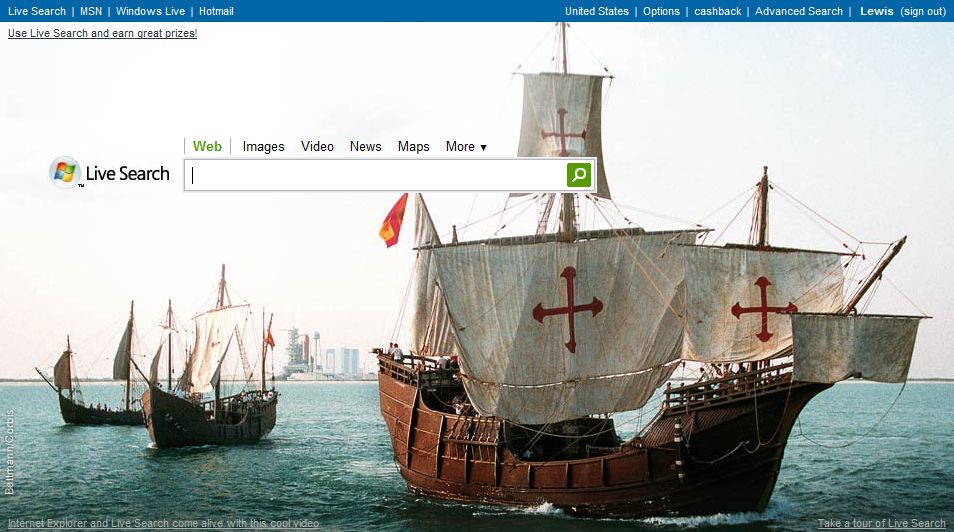
Click to enlargeToday is celebrated in the United States as Columbus Day. I happened to notice that my search engine of choice, at www.Live.com [ed. note: relaunched Bing as of Spring 2009], has a striking image (courtesy of Bettman Corbis archives), as you can see to the left.

As always with the new (improved!) Live Search, there are several hover spots on the page, with pop-up queries about the holiday, “sailing lessons,” Columbus’s trip to the Bahamas, and “the caravel,’ which turns out to be “a small, highly maneuverable, two- or three-masted lateen-rigged ship, created by the Portuguese and used also by them and by the Spanish for long voyages of exploration.”

  Continue reading

Wordy, by Wordle

Lazy Saturday, so a quick & easy retrospective post at a glance.  Here’s a “Wordle” look at my blog content going back over the past week. Click to enlarge.

You can use http://wordle.net to create a word-cloud of any content – a website (by URL) or a bucket of words you paste in. I realize word-clouds are nothing new… but I think they’re way underutilized in HCI.  Fun for political speech analysis; I can just imagine a newspaper front page that consisted of nothing but word-clouds from yesterday’s speeches by President Bush, Senators McCain and Obama, Biden or Palin, cabinet members, foreign officials, Osama’s latest video, and losing sports-team coaches.   “What’d they say?” Well, take a look.

Inventing the Software that Invents the Future

Worried about today’s stock market activity? Retreat with me into the security of the bright future that awaits.

Microsoft’s Craig Mundie (pater familias of the Institute for Advanced Technology in Governments), is on a college tour across the nation.  The trip is something of a reprise of jaunts Bill Gates famously made over the years, when he would string together visits to campuses partly to evangelize, partly to recruit, and mostly to get new ideas from bright young (and contrarian) minds.  The Seattle paper today labels these tours as filling the role of Microsoft’s “chief inspiration officer” (“Mundie gives campuses peek at tech’s future”).

Continue reading

Walled-Garden Wikis and Candlepower

Fact: Last night the U.S. Joint Forces Command (JFCOM) announced it has “moved its C2Pedia Registry to the unclassified network enabling more potential users to access and edit the site, hoping it will ultimately improve the quality of data.”  C2Pedia is a MediaWiki-driven online knowledge base of information about Command and Control (C2), with specific information about more than 200 C2 systems used across the Department of Defense and the armed services.

Analysis: The profusion of wikis in official government circles is an interesting expression of the value of social media for enterprise knowledge management, but for the most part inside agency or network firewalls, denying access to the public at large and therefore incorporating only the wisdom of “the inside crowd.” The State Department’s Diplopedia sits on their intranet (ironically called “OpenNet”), as the New York Times pointed out in a story a few weeks ago (“An Internal Wiki that’s Not Classified“), implying a distinction (without a difference to my mind) between Diplopedia and the IC’s Intellipedia, which has an unclassified version as well – but it also sits on a firewalled network!

Jimmy Wales, founder of Wikipedia, testified to Congress recently about the value of wikis and social media within enterprises, and pointed out the distinction between “within-the-agency” verticalized information sharing, a la Diplopedia, and horizontal sharing across organizations as exemplified by the IC’s Intellipedia, which as I mentioned has a firewalled unclassified version as well as its classified-network versions, all accessible from any of the intelligence community’s sixteen agencies and beyond.

Continue reading

Gartner Says, Sometimes Hype is Necessary

Fact: Gartner is taking the same approach they often critique with their normally-solid “Hype Cycle” reports – arguing that “a little cloud hype” is beneficial if it “captures the imaginations of a broader audience of decision makers.”

Analysis: With their annual “Hype Cycle” reports, Gartner usually does a solid job of tracking over-optimistic assessments of the “latest and greatest” in technology and calling out overly hyped “hot new tech” and providing realistic assessments of the projected future of trends in software, hardware, and business processes.

Sometimes, Gartner slips up, and falls prey to the error they ascribe to others.  That’s the only interpretation I can make on a curious blog posting on an official Gartner blog designed to promote their new book “Mastering the Hype Cycle: Choosing the Right Innovation at the Right Time.”  Mark Raskino, the book’s co-author with longtime analyst Jackie Fenn, argues that “We have to simplify the business proposition behind this ‘big shift’,  explain it well and socialize it deeply to convince non-tech business leaders to buy-in.” 

Mr. Raskino makes clear that he wants to babytalk these business-side executives into believing “a little cloud hype” because, in his words, IT leaders and CIOs “need help explaining the fundamental change.”

Continue reading

Lucky 7, as in Windows 7

When there’s neat stuff nearing release, it’s both professionally fulfilling but also no fun being a Microsoft employee, because you’re (rightly) constrained from blogging about some of the cool technology being cooked up in MSR or in advanced development labs among the product groups.

It means that I wind up passing along links to open stories in the media written by outsiders who wind up getting an early story (mostly) right, through good solid reporting and insightful addition skills, i.e. 2+2=4.

I faced that several months ago when Live Mesh was in the batter’s circle, before its public announcement; I wrote what I could because I was so impressed with the technology and approach, as were the reviews after its unveiling.  Before, I wrote this post among others; and after the announcement I wrote this one

Same scenario now, with “Windows 7.”  You don’t have long to wait (October 27) for the public announcement, but if you’re curious about some of the technical approaches, there are several generally reliable bloggers already writing about “technical details” of the multi-touch, parallel-processing, and cloud-services S+S integration points in the new release. A couple of good quick examples are Mary Jo Foley, “Windows 7 to Get Parallel Processing Tweaks” (she’s not as snarky as usual) and TechRadar’s “Seven Things You Need to Know about Windows 7“).

Email this post to a friend

AddThis Social Bookmark Button

Amazon and Microsoft Intersect in the Cloud

So today Werner Vogels, the much admired CTO of Amazon, has a post over at “All Things Distributed” which directly exemplifies his blog’s subtitle (“building scalable and robust distributed systems“).  The post is “Expanding the Cloud” and describes today’s announcement that Microsoft Windows Server is available on Amazon EC2. As he sums it up, “We can now run the majority of popular software systems in the cloud.”

This means two things.  First, we were able to con cajole convince Amazon essentially to host a beta test for something big, which will indubitably become much, much bigger.

Continue reading

Crisis? Pshaw. Be Bold with Research Investments

Bottom line: The smart companies will weather this fiscal crisis by “steering into the skid,” and actually increasing their investment in the future.

One of my last pieces of advice to DIA’s director before leaving last year was to increase the amount of money annually invested in IT research and innovation. DIA’s technology budget was typically too bloated on the side of operations and maintenance for current systems, and not investing enough in the future, though during my time there we had made significant progress in redressing that, increasing the resources (people and money) put against “what comes next.”

In government-agencies particularly (and many torpid commercial enterprises also), budgeteers make the mistake of throwing money at legacy systems instead of being bold and prioritizing research for the next generation of systems. (Last year I wrote about these issues in “Moving Money to the Left.”)

Now, no one has asked me about my views on the fiscal “bailout package,” which makes sense, particularly when there are people who make far more sense than me expressing their well-founded opinions in ways I thoroughly agree with – such as, say, Harvard economist Jeffrey Miron in his excellent op-ed piece for CNN last night (“Bankruptcy not Bailout is the Answer“).

But a number of people have asked me what the impact on Microsoft might be from the current “crisis” and market volatility.  I have to say that I’m pretty optimistic, precisely because Microsoft is investing in the future, in ways that are designed to carry us through short-term downtimes and on to exciting new platforms.  The company’s cash-rich, which helps. 

 Most importantly, our CEO Steve Ballmer firmly pointed to our increasing bet on our new approaches to the future.  Speaking in Silicon Valley, he said proudly that not only will Microsoft continue to buy about 20 innovative companies a year, but we will also keep spending $9 billion a year, or 14 percent of revenues, on internal research and development. (See the Venture Beat story here.) 


Microsoft “will use the slump as a chance to invest more in our future than the other guys we’re competing with” – Steve Ballmer, quoted in Bloomberg.com  


There are going to be winners and losers coming out of this slump, as there have been in each of the tech slumps I’ve seen in my short (!) life over the past three decades I’ve been involved.  The winners are inevitably those with a vision for the long term and the determination to plan beyond the horizon. 

Microsoft won’t be the only winner (see “Microsoft, Xerox Invest in Innovation” for a description of the Xerox CTO’s similar thoughts), but I’m convinced we will be in the front rank.


Email this post to a friend

AddThis Social Bookmark Button

My latest Twitter fishwrap…

Last 24 hours of my Twitter posts syndicated to ShepherdsPi by LoudTwitter

              ————————————————-

17:42 Uh oh – my latest blogpost just got linked again on MSR homepage… last time that happened global hits were huge tinyurl.com/j4wcv #

17:47 Kicking people out of my office so I can go home myself, debate pizza party! #

22:52 The scrolling WisdomOfCrowd at election.twitter.com was the way to go tonight, funny/piquant/profane/profound … very American #

08:40 taking Photosynth pictures at home, later at Stratford Hall, will eventually post at tinyurl.com/6ebzu7 #

09:01 Still haven’t made it over to Library of Congress to play with their use of Surface. TJ “edited” by Adams? Absurd! tinyurl.com/4gmxdz #

               —————————————————-

If you’re bored, you can follow me in real time at http://twitter.com/lewisshepherd.