Cuil’s Hockey-Stick Decline

The new Cuil search engine, which was the beneficiary of a lot of buzz just two weeks ago, is not yet showing evidence of viral growth, according to new stats from Hitwise tracking service. Quite the contrary.

In fact, in the last few days Cuil has only ranked 34th among all search engines surveyed. 

Admittedly, it’s very early, too early to dismiss them (StartupMeme.com says “Cuil made a fool of itself“).  

Cuil has a cushion of VC funding to pursue the long slog. 

But they’ll never get better press and more media attention than they did over the last 10 days, and despite that I’d venture to say that Cuil’s carving its way into the wrong end of a “long tail.” 

Hey, folks at Cuil: you’re holding the hockey stick the wrong way!


Email this post to a friend

AddThis Social Bookmark Button

If Google Executives were Presidential Candidates…

Sometimes tech executives skate away with hubris (look up Larry Ellison), but more often they run the risk of their words coming back to haunt them. 

Just a little example this week – what a difference a day makes, from Tuesday to Wednesday. I’m sympathetic to politicians and executives who put their words on the line in public, opening themselves to the hazard of after-the-fact Monday morning quarterbacks.   But this is an interesting case with lessons for cloud computing…

Dateline: Tuesday August 5

Dave Girouard, president of Google’s Enterprise unit, was energetically promoting Google Apps at the Pacific Crest Technology Leadership Forum, quoted by TechCrunch and PC Retail Mag: Continue reading

CIA 2.0: The Agency’s CIO and Change

Fact: CIO magazine is running a big story on the CIA’s Chief Information Officer Al Tarasiuk and his IT operation, and their online site is breaking it up into a four-part series running this week.  Below I analyze the series.

Analysis: By the halfway mark in the series, the magazine’s reporter Thomas Wailgum had only accomplished a fairly rote recounting of what CIA is, what its CIO does, and how both those factors have changed since the good ol’ spy days amid the challenges of a post-9/11 world.

Part Onedescribed “a business-IT alignment project like few others,” although it mainly served to introduce CIO magazine’s broad readership to the unfamiliar world of a walled-off intelligence agency, waxing on about the hyper-security at Langley.  Part Two similarly was background on the bureaucratic culture of the agency and its relegation of IT to backwater status – until 9/11 came along.

Continue reading

How to Surf the Multilingual Web

Fact: According to an official press release issued yesterday by a Chinese-government-related organization, “1,500 translators and scholars from 76 countries and regions attended the opening ceremony of the eighteenth International Federation of Translators (FIT for “Fédération Internationale des Traducteurs”) World Congress today at the Shanghai International Convention Center. The theme of the congress is translation and cultural diversity.”

Analysis:  Sure, you’re tempted to scoff at these carbon-based units and their old-fashioned “human translation skills”  – because you  like technology so much – but in the realm of language translation, computers are still lagging behind. There’s a long-running debate over the promise of “machine translation” (MT), as a Wikipedia entry argues:

Continue reading

Washington Post Puts Microsoft on Page A1 – For Good Research!

Stop the presses! Microsoft Research is getting national front page coverage!

The work of Eric Horvitz and Jure Leskovec got top coverage in major newspapers and news sites today.  With that fame, Eric will probably never again be willing to just while away a Friday afternoon with our Microsoft Institute folks, brainstorming some outside-the-box ideas for future work, as he did this week with us in Redmond’s Building 99.

Right after that meeting, I bugged out of Redmond for a red-eye to the east coast.  Back home in DC this morning (Saturday), I opened my Washington Post to find on page A1, “Instant-Messagers Really Are About Six Degrees from Kevin Bacon: Big Microsoft Study Supports Small World Theory.

Continue reading

One of My Dream Web Toys – Now Live

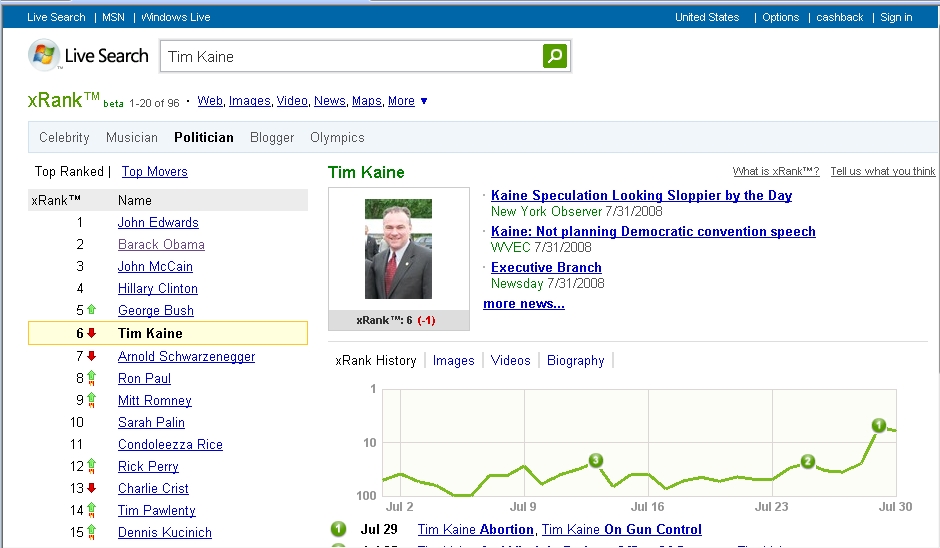
Oh, am I happy.  Here’s where I’ll be, every day, for at least some little period of time: xRank on Politicians.

Every pollster and political consultant will like this – and okay, just plain political junkies anywhere, in this heightened political campaign year.  Politicians themselves will also want to check out their up/down arrow (Virginia Gov. Tim Kaine was hot “with a bullet” for a while because of the Obama VP rumors, but he’s falling now; John Edwards love-child stories are hot-hot-hot! right now).  Check it out yourself

xRank has been live for a while with celebrities’ names – but who cared about that?  Politicians – ah, good stuff.  Maybe we’ll give geeks their Andy Warhol moment and add technologists soon 🙂

Continue reading

Invisibility, Mind-Control, Great Coffee, and a New OS

Lots of interest and blogoshere commentary beginning about “The Mojave Experiment.”

The reaction is reminiscent of one of those Obama or McCain provocative ads posted online, generating far more attention and buzz than the attention they get on the natural by being broadcast.

Sure, it’s a sales pitch, and pretty narrowly geeky at that (thanks GoogleFight!).

But at least it’s an innovative one – as the Wall Street Journal puts it today, “Give Microsoft people credit: They did it with humor, and they weren’t afraid to air the negative stuff.”

Continue reading

Microsoft Sphere, Apple Tablet

Fact: Today is the first public showing of “Sphere,” Microsoft’s newest multi-touch innovation: “After months of rumors, Microsoft researchers are taking the wraps off a prototype that uses an internal projection and vision system to bring a spherical computer display to life. People can touch the surface with multiple fingers and hands to manipulate photos, play games, spin a virtual globe, or watch 360-degree videos.”

Analysis:  The video tells the story, particularly when you keep in mind that Sphere (and its earlier cousin Surface) represent a new multi-touch, multi-interface platform for human use of computing power.  A year ago Surface was still just emerging from the research lab, and now a year later it’s been introduced into AT&T retail stores and is on its way to many other commercial and public environments.  Sphere will be used in similarly unpredictable ways, adopted by third-party developers as an innovative canvas on which they can project cool new uses.

Continue reading

Birth of Cool (Cuil) – History Repeating Itself?

Fact: Cuil reaped the whirlwind of the media buzz it craved today.  As CNET put it, “Google challenger Cuil launched last night in a blaze of glory. And it went down in a ball of flames. Immediately after launch, the criticism started to pile on: results were incomplete, weird, and missing.”

Analysis:  For several months I’ve had running an RSS feed along the right-hand side of the ol’ blogspace here, entitled “Who’s Talking about ‘the next Google.'”  Ha ha – the RSS feed pulls from a Google News query.

Well, if you judge by the echo chamber hungry for positive tech news amid a down market, you might think “the next Google” has emerged: the birth of Cuil.  (Extra credit if you’re a Miles Davis jazz fan, by the way.)  I may retire the crown, or at least the RSS feed.  Here’s some of the global attention:

Continue reading

Three Key Promotions in U.S. Intelligence

In the old days of Kremlinology, our side’s “Soviet analysts” (I was one as a kid, back in 1985-86) would pore over personnel lists and announcements of Politburo or Central Committee appointments, seeking clues to the direction of Party doctrine and intent. Military personnel promotions and reassignments were also studied closely to divine any insight into Soviet military policy.

There’s not a direct analogy to American military leadership promotions, but those lists are also studied intently, by peers and colleagues within the military branches, and also by experts throughout defense industry circles who can often decode Pentagon politics by watching who gets an extra star and who gets passed over.

Friday the U.S. Senate confirmed several key Army promotions, including three which I consider to be the most critical military intelligence positions in the nation. 

Continue reading