How to Keep Up with the Semantic Space

Fact: Reshma Sohoni, chief executive of Seedcamp (the VC accelerator focusing on European tech startups) said in an interview this week that “In the past few months, we’ve seen a lot more developments around the semantic web,” and talked about the coming value of semantic web services.  

Analysis:  There’s never-ending buzz about the semantic space. Just this week John Conroy writing at the Content Matters blog had a long and interesting piece examining “three ingredients needed to enable and popularize the semantic Web,” with the aim of answering “if we really are on the cusp of a content revolution.”

Also, I admit it, I can’t stop playing with the semantic-space startups, whether it’s Sensebot or the newly launched Evri, or Powerset (just acquired by Microsoft, as I wrote about previously).

Continue reading

IPsec, IPv6, and Security at Your House

Just had a great meeting in Redmond introducing some government friends to Steve Riley, one of Microsoft’s “technical evangelists” on security – network, app, data security and most of all, IP security.  He’s great at the big-picture integrated view of security, including physical security right up through the IP stack – here’s a video of a recent talk he gave at Microsoft’s TechNet called “The Fortified Data Center in Your Future.”

Check out his blog and you’ll see the kind of topics he works on; just one example of obvious value is a recent post full of real-world down-to-earth security advice for securing your environment at home (home networking, email use, internet browsing, etc for family and friends).

Oh, he’s also been on Twitter for almost a month now, where he mixes interesting finds on security news with offbeat political commentary 🙂  Yet another example of some of the bright people I meet back at the mothership in Redmond….

Email this post to a friend

AddThis Social Bookmark Button

Higher Math on the Sands of Santa Barbara

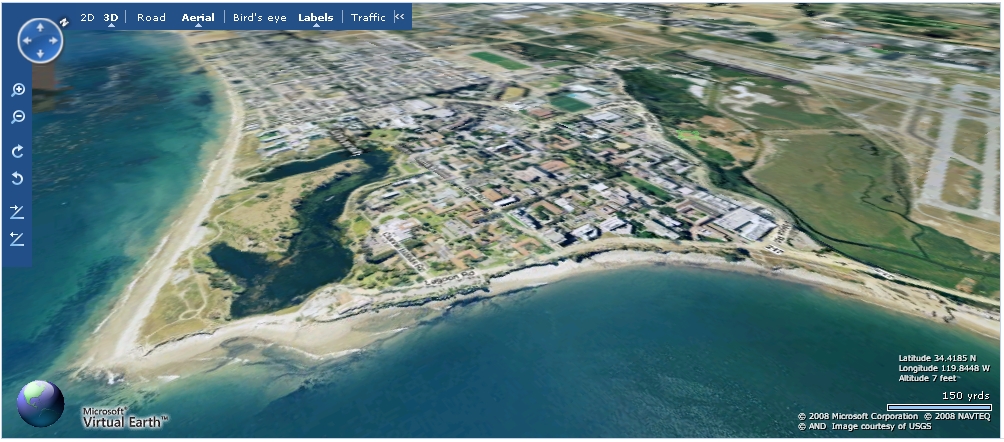
UCSB

UCSB, looking NW

Spent Sunday afternoon with world-renowned mathematician Michael Freedman (short bio here) walking the beach and bluffs above, just northwest of UC Santa Barbara, talking about a number of absurd and not-so-absurd possibilities in the future applications of quantum computing.  Here’s an example of the kind of stuff I was trying, very hard and maybe somewhat successfully, to grasp while walking in the California sun and trying to ignore the nude sunbathers and hang-gliders.  If that’s unhelpful (as most of it is for me), here’s a straightforward description of some of his main work and its possible applications. 

Continue reading

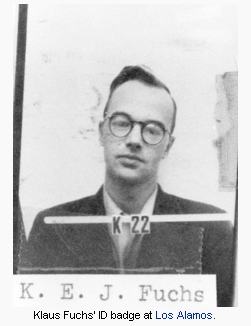
Theory of the Fireball, Supercomputing, and other Los Alamos Tidbits

Back in the early ’90s when I was first dating Kathryn, now the lovely bride, we went on some awesome roadtrips, including many cross-country – great way to get to know someone.  At the time my brother was an Air Force pilot, flying the F-117 stealth fighter, so we once paid him a visit at Holloman AFB on a 10-day drive through the Southwest.  I’ll have to find and upload to Flickr the pictures he took of each of us sitting in its classified cockpit – surely a massive security violation which I lay entirely at his feet (lucky for him he’s retired from the Air Force now and flying for Delta). 

Sadly, the F-117 Night Hawk has also now been officially retired, replaced by the F-22 Raptor.

As much as that was a thrill, though, the highlight of that particular roadtrip was driving up to the Los Alamos plateau and spending some time touring around the Lab, the Museum, and the interesting little town that’s grown up around all that PhD talent in the middle of the high desert.

That lab’s on my mind because I’ve been thinking about supercomputing and the revolution it could undergo thanks to quantum computing. I’m in Santa Barbara visiting the “Station Q” research program in quantum computing, and will write more about quantum computing soon, since I’m actually beginning to understand it.

But as an interesting artifact in my preparatory reading, Microsoft’s John Manferdelli sent me a link to a Federation of Atomic Scientists archive of declassified Los Alamos National Lab technical reports and publications, from “the good old days” at Los Alamos.

Continue reading

Latest NASA Launch: Viral Marketing

Fact: Aviation Week has a piece today (“Funding Biggest ISS Obstacle“) outlining the budgetary woes of the International Space Station program, noting that the five partnering national space agencies which jointly operate the ISS “say they are eager to use the facility as a stepping stone for lunar and Martian exploration, but they first must find a way to sustain operations beyond the present partnership agreement….The main question mark about extending operations is related to funding and not technical issues. No road map or timetable for prolonging the ISS lifetime can be established until these financial issues have been resolved.”

Analysis: I’m a fan of space research and travel, and I’d like to see more funding and attention go into the American space effort, and with it more American ability to collaborate on international space ventures.

Continue reading

Research and Intelligence … Research for Intelligence

I’ll be at Penn State University for the next couple of days, at the Research in American conference.  This particular conference, with the theme “Connecting Technology Thought Leaders with Government Officials,” is sponsored by the Office of the Director of National Intelligence, focusing on their Science and Technology area. 

Here’s the agenda for the conference, which has an excellent lineup of technologists presenting their approaches and progress. 

ODNI turned to the Intelligence and National Security Alliance (INSA) to host and run the conference.  Someone, somewhere in the chain, slipped up and invited me as the Keynote speaker for Tuesday – I’m planning to do the thing with no slides and to speak (in part) about the emerging possibilities of revolutionary research in a post Web 2.0 world.

For some sobering background information,  check out a recent tour of the research-funding horizon by Amy Ellis Nutt in the New Jersey Star-Ledger (“As research funds stagnate, science in state of crisis“).  Here’s a taste:

Once the world’s gold standard, American scientific enterprise is in free fall. Short of government funds and strapped for cash, researchers across the country are abandoning promising avenues of scientific investigation and, increasingly, the profession of science itself.” – Amy Ellis Nutt, The Star-Ledger

Do you share that pessimism?  Think it’s overstated?

I’ll give an update about the conference tomorrow.

Email this post to a friend

AddThis Social Bookmark Button

Test for Prediction Markets: They Say Obama, but Polls Say It’s Tied

Fact: According to the latest Rasmussen poll released Saturday July 12, and promptly headlined by the Drudge Report, “The race for the White House is tied. The Rasmussen Reports daily Presidential Tracking Poll for Saturday shows Barack Obama and John McCain each attract 43% of the vote.” Newsweek is reporting a similar result in its own poll, with Obama moving down and McCain up (“Obama, McCain in Statistical Dead Heat“), and other polls increasingly show a similarly close race.

Analysis: I’ve been tracking the growing divide between two quite different methods purporting to offer statistical predictive analysis for the November presidential election. Polls are saying one thing, but Prediction Markets are saying another. 

Continue reading

The “Rush to the Cloud” – Not So Fast…

Had a great time on Wednesday on a panel at the “Defense 2.0” conference, at the Arlington Ritz-Carlton.  I believe I learned as much from my fellow panelists from Cisco, IBM and so forth – about the importance of information security and assurance – as any conference in recent memory.  The story in Government Computer News (“Defense 2.0 a Work in Progress“) captures the views of most of the speakers. 

I had a gentle and gentlemanly disagreement with the keynote speaker, Mike Nelson.  Mike has a distinguished career, working with Internet-inventor Al Gore while he was VP, and later Director of Internet Technology and Strategy at IBM.  I offered that he was perhaps slightly overly enamored of the “rush to the Cloud” school of thinking.  I’ve written about that school of thought before, and the balance of where computing power is likely to reside in future, given Moore’s Law for the foreseeable future.  The GCN quotes capture my thinking in short form: there’ll be the cloud, along with increasingly powerful computing in local form factors (some desktops, more laptops, handhelds, mobiles, and embedded-computing forms of all sorts).

Continue reading

A-SpaceX, Google, and Virtual Tuesday

Yesterday I had a “virtual world vibe” going.  At 5:30 a.m. when my dog Jack woke me up offering to take me for a walk, the first thing I noticed on my mobile was a series of tweets from Chris Rasmussen, NGA’s social software guru, posted the night before.  Twitter is interesting for a lot of reasons, but one is the ability to snatch asynchronous stream-of-consciousness statements, from strangers and friends alike, as they pass by in the microblogosphere conversation.

Chris went on a tear about Second Life, with several hilarious observations and comments within the space of an hour, so here are several from his public Twitter feed:

Continue reading

Up Late? Innovate.

Here’s some quick thought-provoking advice from Phil McKinney, who runs HP’s Innovation Program Office.  (Phil has his own blog as well, but the advice comes from an interview yesterday in the San Jose Mercury News.)

Q. One of your tips for innovation is to stay up late, because that’s when your filters are down. (The mental filters that rule out wild ideas, which might turn out to be good ones.) Do you still do that?

A. “Oh yeah, it drives my wife crazy. The idea really is to go back to things you’d do before you were successful, before you learned that you’ve always got to be on your guard.”

Man, do I swear by that!  Phil has some other points that I’m less enamored with, mostly because I don’t believe he’s thinking very radically.  His point that in the future we might be data-mining healthcare histories is undercut by the fact that we’re already doing it, as I blogged yesterday

Another less-than-startling prediction: We’ll still be using Second-Life style virtual worlds two decades from now?  Please!  I suppose we’ll also still be changing toner cartridges!!

Check out Phil’s blog, it reflects his innovative thinking better 🙂   But don’t read it till after midnight…

 
Email this post to a friend

AddThis Social Bookmark Button