Slate of the Union Day

Today is “Slate of the Union” day, when the two most charismatic individuals in recent American history go on stage and attempt to reclaim mantles as innovators. I’ll leave aside the fellow with lower poll numbers for now (President Obama). More eyes in the tech world will be watching as Steve Jobs makes his newest product announcement, the Apple tablet/Tabloid/iSlate thing iPad (it’s official).

Back in the late 1980s I worked for the legendary “Mayor of Silicon Valley” Tom McEnery (he was actually the mayor of San Jose), and we did many joint projects with Apple, particularly with CEO John Sculley, a great guy.

Continue reading

Follow the USS Carl Vinson to Haiti

As I write on Wednesday afternoon (EST), the scenes of chaos, death, and destruction in Haiti are only now beginning to be visible to the outside world through media. As horrific and heart-rending as those scenes are, they serve a purpose in letting other nations comprehend the magnitude of the crisis and the urgency required in lending direct aid. The U.S. military is uniquely positioned to contribute.

Flight Deck of the USS Carl Vinson

What a difference a day makes: barely 24 hours ago, several hours before the earthquake struck, the Nimitz-class supercarrier USS Carl Vinson (CVN 70) was cranking up its nuclear engines and setting a peaceful course out of Hampton Roads at the base of the Chesapeake Bay, Virginia. At long last after completing a complex overhaul and new sea trials, she was heading south, to make the South America turn and return to homeport in San Diego as part of the Pacific Fleet.

Continue reading

To fix intelligence analysis you have to decide what’s broken

“More and more, Xmas Day failure looks to be wheat v. chaff issue, not info sharing issue.” – Marc Ambinder, politics editor for The Atlantic, on Twitter last night.

Marc Ambinder, a casual friend and solid reporter, has boiled down two likely avenues of intelligence “failure” relevant to the case of Umar Farouk Abdulmutallab and his attempted Christmas Day bombing on Northwest Airlines Flight 253.  In his telling, they’re apparently binary – one is true, not the other, at least for this case.

The two areas were originally signalled by President Obama in his remarks on Tuesday, when he discussed the preliminary findings of “a review of our terrorist watch list system …  so we can find out what went wrong, fix it and prevent future attacks.” 

Let’s examine these two areas of failure briefly – and what can and should be done to address them.

Continue reading

Cruise Missiles and Yemeni Neighborhoods

“The US is planning retaliatory strikes in Yemen against al-Qaida over its attempt to blow up a transatlantic flight on Christmas Day.  American officials […] warn that finding those responsible is unlikely to be swift and say that identifying other ‘high-value’ al-Qaida targets for retaliatory attack would also be a priority.” – The Guardian (U.K.), 12/30/2009

As U.S. officials are quoted mulling cruise-missile strikes on Yemen, it should be noted that the Yemeni government, such as it is, has already been fighting the hard slog – on the ground, rooting out Al Qaeda in Yemeni neighborhoods and villages.

Below is an interesting 7 minutes of film fresh from Yemen,  just posted to youTube today:  a moment-by-moment video documenting the Arhab raid by the Yemeni Counter-Terrorist Unit (CTU) on an Al-Qaeda-in-the-Arabian-Peninsula (AQAP) safe-house, on 17 December, the same day as a coordinated U.S. cruise missile attack on another site.

Continue reading

Total Recall for Public Servants

MyLifeBits is a Microsoft Research project led by the legendary Gordon Bell, designed to put “all of his atom- and electron-based bits in his local Cyberspace….MyLifeBits includes everything he has accumulated, written, photographed, presented, and owns (e.g. CDs).” 

SenseCam - Click to enlarge

Among other technical means, Bell uses the SenseCam, a remarkable prototype from Microsoft Research.  It’s a nifty little wearable device that combines high-capacity memory, a fisheye lens passively capturing 3,000 images a day, along with an infrared sensor, temperature sensor, light sensor, accelerometer, and USB interface. My group has played with SenseCam a bit, and shared it with quite a few interested government parties and partners. More info on SenseCam here, and more on its parent Sensors and Devices Group in MSR.  

Continue reading

Intel and AMD Think Outside the Box

Everyone in Washington DC is indoors today because of the season’s first snow, or venturing only within an easy snow-shovel’s carry from the front door. DC always comes to a near-halt with even a dusting of snow, so with a foot or more last night and today, folks are immobile.  Here are my photos of our snow fun today, and below to entertain the snowbound I have three separate videos of innovation from Intel, Microsoft, and Advanced Micro Devices (AMD).

Continue reading

Inside Cyber Warfare

One year ago, the buzz across the government/technology nexus was focused on a pair of political guessing games. Neophytes mostly engaged in debating over whom the newly-elected President would name to be the nation’s first Chief Technology Officer. Grizzled Pentagon veterans and the more sober Silicon Valley types wondered instead who would get the nod as President Obama’s “Cyber Czar.”

Continue reading

Education for Information Security in a Connected World

Much of what I work on involves technologies which address information security and cyber security. So I have to ask, Who is training our next generation of technologists? And are those educators doing enough to focus on the dynamically changing demands of Information Security?

Those fundamental questions took me to Chicago recently, to take part in a roundtable discussion sponsored by DeVry University, “The Demand for Information Security in a Connected World.”

Continue reading

Gunning the Microsoft Semantic Engine

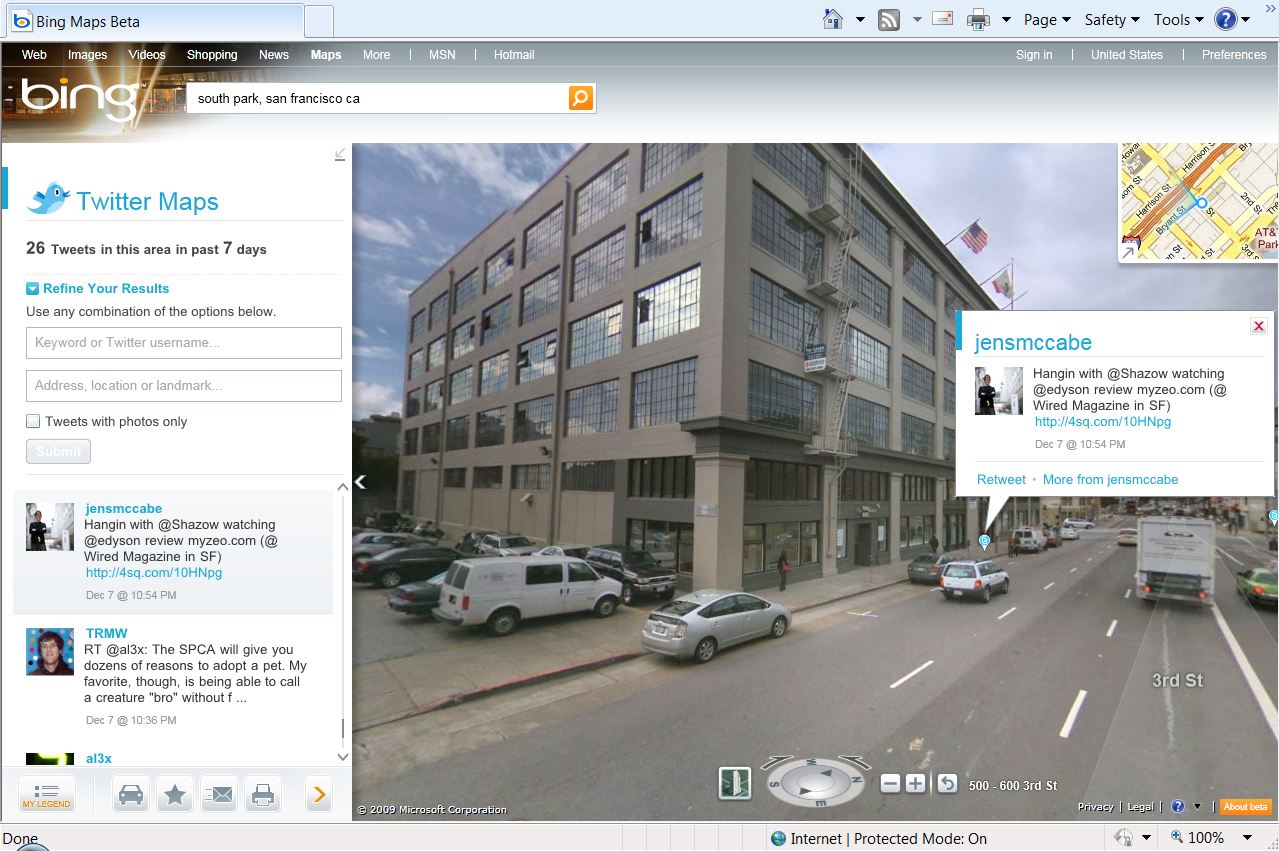
New Bing Maps Beta with embedded data layers from Twitter and other social feeds, click to enlarge screenshot

There’s a lot of information on the Internet already. Every day, more is added – a lot more. And while there are a concomitant number of new analytic or sense-making tools on the web, they butt up against the fact that the data – the all-important data – is held in multiple places, formats, and platforms.

How are we going to deal with all this? One approach is almost mechanical: ensuring that datasets can be accessed commonly, as in our new Microsoft Dallas platform associated with the Windows Azure cloud platform.  In the government realm, the anticipated reliance on “government-as-a-platform” (a meme popularized by Tim O’Reilly) holds promise in allowing somewhat aggregated datasets, openly accessible.

Continue reading

43 Gigabytes of Mobile Data per Day

Here’s a nifty infographic, created by Online Education with several striking statistics about “an average day on the Internet” and the volume of data involved in mobile talk and data, Twitter, blogs, wikis, email, news sites and the like. The numbers are staggering! Continue reading