I’ve had the good fortune to work with talented folks in my (short) time in Washington, since moving back East in 2002, particularly in the Intelligence Community and Department of Defense. And one such fellow at DoD has been Bob Lentz, the outgoing deputy assistant secretary of Defense for information and identity assurance – the Chief Information Assurance Officer and equivalent to a private-sector CISO.
I gave an interview this afternoon to Federal News Radio (AM 1500 in the DC area, worldwide at www.FederalNewsRadio.com), on Bob’s tenure, and what will come next for DoD in the wake of his departure. You can read the news story about the interview here, or listen to the entire 15-minute interview as an mp3:
How do intelligence analysts handle the long-discussed problem of information overload? (The same question goes for information workers and government data of any kind.)
The future of social computing is in the integration of various services and technologies – but the fun is already available now. Here’s a nifty demo of the integration of cloud computing’s services with increasingly powerful mobile computers (smartphones or netbooks). Developers can take advantage of far more computational power both locally on the device – faster, cheaper processors thanks to Moore’s Law – and computational power residing on networked data centers. Think of a business or social activity, and thanks to platforms like the iPhone, Android, and the new Windows Phones, “There’s an app for that.” Or there soon will be.
This quick little demo feels like nothing fancy today – but ten, even five years ago it would have seemed like sci-fi. In fact it’s available now, and uses a new Windows Phone, in this case a Samsung Intrepid, making use of Tellme software from Microsoft integrated with Bing Search web services. The demo intregrates some longtime technologies in their state-of-the-art condition today using cloud-services delivery:
Speech-to-text
GPS-enabled location-based services
Web search
Voice-enabled dialing
Social media (crowdsourced ratings integrated in search results)
Hardware UI (a dedicated TellMe button on the Samsung Intrepid phone)
My intention with this blog is always to write medium-length “think-pieces,” about technology, government, or preferably both. I’m working on several (the Jefferson Gov 2.0 piece, the Evil Twin 2.0 piece, and one on “whither the multilingual web”), but they do truly require thought and some free time, so they percolate a bit.
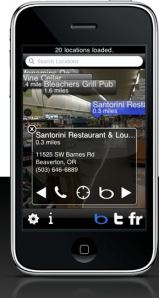
In the meantime, readers like the latest cool demo videos, so for Friday fun here’s another one (watch below or on youTube), which was featured on TechCrunch last night (“Bing comes to the iPhone via Robotvision”), with an augmented reality app for the iPhone which uses Bing Maps and Bing’s real-time data (website here). The company describes itself this way:
What is the “user interface of tomorrow”? In the past I have chronicled some cool Microsoft Research prototypes of flexible touchscreen interfaces – and even touchless interfaces! And now this month one of my friends in MSR, Mary Czerwinski, has written in Venture Beat that “those types of interfaces could be the tip of the iceberg”:
A whole new set of interfaces are in the works at various stages of research and development… I have colleagues working on tongue-based interaction, bionic contacts lenses, a muscle-computer interface, and brain-computer interaction.” – Mary Czerwinski
Not bad! But working devices along those lines are several years away, so for now we’re stuck with the tablet form-factor as the primary basis for natural input. I’ve used a tablet PC on and off for the past five years, happily. My wife now uses an HP tablet.
So I’ve been eagerly following the blogosphere’s hyperventilation about the much-rumored, still-unseen Apple tablet computer, which has been variously described as being close to launch, far from launch, and non-existent.
It turns out that we have lessons to learn from Uganda – more specifically, from web coverage of events in Uganda this week.
I’m constantly trying to improve my own ability to follow real-time world events, whether through social media, advanced search technologies, or aggregation of multiple old/new information technologies. About this time last year, as the Georgian-Russian skirmishes were just kicking off, I wrote about keeping up with information on international events (“Using Web 2.0 to Track a Political Crisis“).
In the intervening year, development of real-time tools and techniques has really blossomed. This past week, the onset of violent political unrest in Uganda has served as yet another crucible in which new techniques and web-based technologies can be tested and tweaked.
I’ve been attending the Government 2.0 Summit in Washington this week, along with a lot of friends and colleagues from various spots in Silicon Valley, the international tech world, and federal, state, or local government agencies. If you want to follow along on Twitter, there’s a great number of attendees posting real-time notes and comments throughout the sessions.
Over the past couple of months I’ve participated with many colleagues planning the kick-off Gov 2.0 Expo Showcase, which highlighted fantastic new-technology projects from government agencies across the country. One of the great projects showcased is www.NeighborsforNeighbors.org, a collaborative website of rich services run by Joseph Porcelli (on Twitter he’s @josephporcelli). Among the other services on the site is a webcast series of great interviewst all levels, from across the country. , and this afternoon I sat down for a chat.
You can watch it below, on their site, or over on the archived kyte.tv site – lots of laughs as we talk about my varied experiences in government, and why Microsoft is focusing intently on enabling enterprise Government 2.0 capabilities. Fun stuff!
This week I’m traveling in Mexico as part of a unique State Department delegation, bringing American social-media professionals together with Mexican public and private efforts working on building civic society. In particular, the trip is focused on bolstering civic participation efforts aimed at countering the enormous spike in narco-violence in Mexico, including the state of Chihuahua, whose capital Ciudad Juarez we visited on Monday and Tuesday. I’m joined on the trip by colleagues from Facebook, Google, AT&T, MIT Media Lab, and several other leading social-media professionals. Continue reading →
I’ll call the moment: the cyber security field is now past its giddy buzzword peak.
Gartner is well known for preparing “hype cycle” analysis of technology sectors, as in their recent publication of the 2009 “Hype Cycle for Social Software.” That report got a lot of attention on Twitter and in blogs, naturally; social medians are nothing if not self-reflective regarding their community. I thought an interesting take was by an IBM developer, who compared the 2008 version against the new one, measuring the changes in predicted “time to maturity” for individual technologies, and thereby coming up with something like a measure of acceleration. By that measure, individual blogging and social search made the most rapid gains.
Here’s a nifty demo of a very small piece of software, that could find daily use for large numbers of people in any large enterprise, or any shopper in a mall – anywhere someone’s wandering in a large building or complex looking for a specific office, conference room, storefront, or location – especially indoors where GPS is of no use.
It’s called GoMap, and I think it could have great applicability for government complexes, which have lots of rabbit-warren hallways, lots of constantly-reassigned workers, and lots of visitors.
I missed GoMap’s first public unveiling today because I’m on the east coast this week, mostly for the Cybersecurity “Leap Ahead” conference in Arlington Virginia which wrapped up today; I will write about the conference separately.
But that meant I had to miss the bar-camp-style WinMoDevCamp today on the Microsoft campus in Redmond. There was a lot of buzz around this DevCamp, and there’ll be others in 6 more cities soon (Austin, London, New York, San Francisco, Singapore, and Toronto) as developers gear up for the upcoming release of the Windows Mobile 6.5 operating system. You can get registration information about the future events at the main WinMoDevCamp site (props to Todd Bishop on his TechFlash blog for highlighting the series).
The GoMap prototype makes innovative location-aware use of Microsoft Tag and TagReader (the high-capacity color barcodes developed by Microsoft Research), to solve the problem of having no GPS capability indoors – check out the short video.
WinMoDevCamp is an indication that there’s a real explosion of app development going on in the Windows Mobile world, to match the equally exciting iPhone app and Android app activity. There’s been a feeling in Microsoft that our best advantages are the large installed base through third-party WinMo phone manufacturers, plus Microsoft’s long experience nurturing app developers on other platforms (.Net as a good example). But I personally think that superior innovation is going to be the battleground, and we’re well positioned for that as well, with a lot of exciting things emerging from Microsoft Research and different advanced development labs in product groups. GoMap’s one example.
Not sure of the timeline for GoMap, but you can use TagReader right now, without the GoMap piece. It’s a free download on the Tag webpage, or you can get it on any mobile phone (yes, even the exploding iPhone) at http://gettag.mobi.



 My intention with this blog is always to write medium-length “think-pieces,” about technology, government, or preferably both. I’m working on several (the Jefferson Gov 2.0 piece, the Evil Twin 2.0 piece, and one on “whither the multilingual web”), but they do truly require thought and some free time, so they percolate a bit.
 Shepherd's Pi