


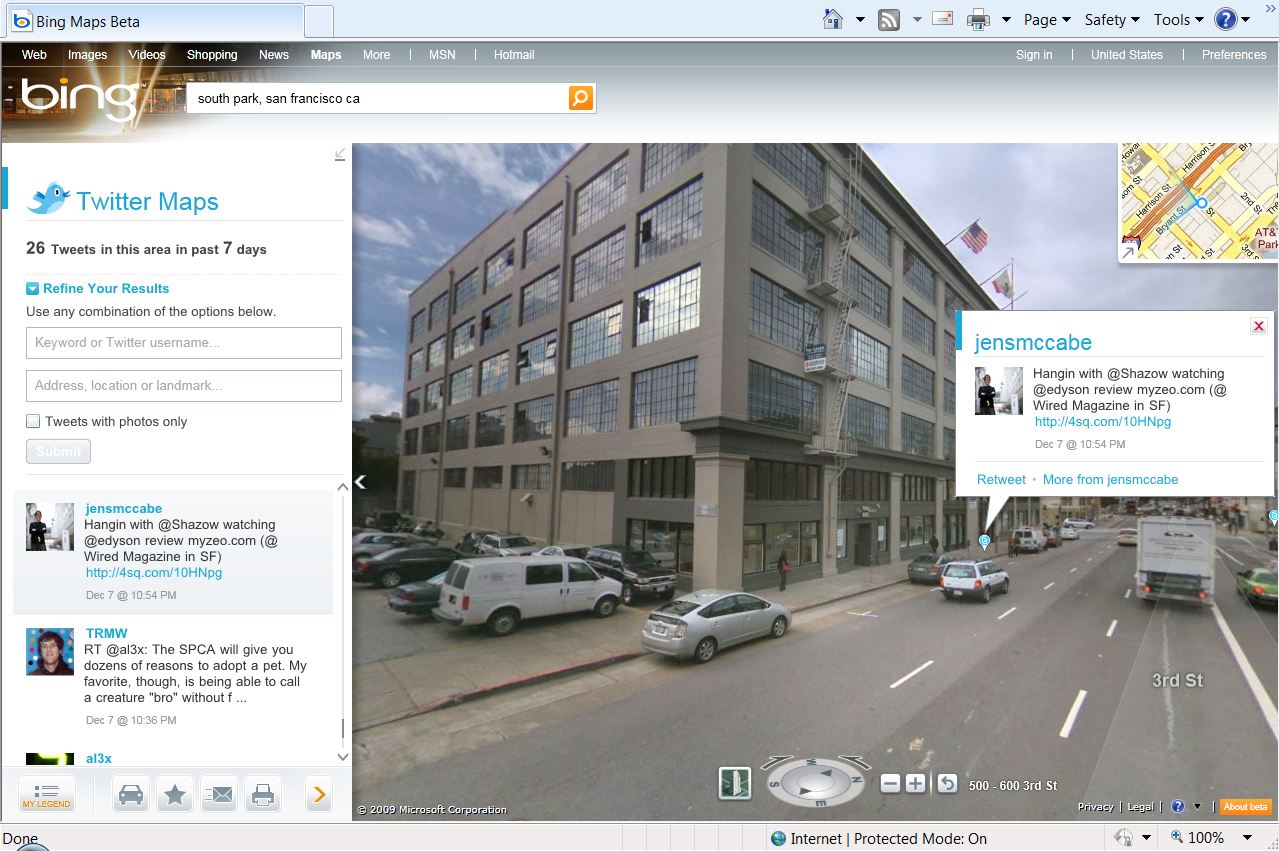
New Bing Maps Beta with embedded data layers from Twitter and other social feeds, click to enlarge screenshot
There’s a lot of information on the Internet already. Every day, more is added – a lot more. And while there are a concomitant number of new analytic or sense-making tools on the web, they butt up against the fact that the data – the all-important data – is held in multiple places, formats, and platforms.
How are we going to deal with all this? One approach is almost mechanical: ensuring that datasets can be accessed commonly, as in our new Microsoft Dallas platform associated with the Windows Azure cloud platform. In the government realm, the anticipated reliance on “government-as-a-platform” (a meme popularized by Tim O’Reilly) holds promise in allowing somewhat aggregated datasets, openly accessible.
Filed under: innovation, Microsoft, R&D, Technology | Tagged: Alien, API, BI, Bing, Bing Maps, data, database, desktop search, developer, Duncan Davenport, GAAP, Google, Government, IDC, information work, information worker, Intelligence, internet, KM, knowledge management, Los Angeles, Microsoft, Microsoft Semantic Engine, MSE, Naveen Garg, PDC, REST, search, search engine, semantic, SQL, SQL Server, T-SQL, text, Tim O'Reilly, UI, unstructured data, UX, web, Windows 7, www | 3 Comments »

 And that, accurately enough, leads to Alien. The truth about Alien, fortunately, is benign, at least for Americans concerned about privacy issues. The Post’s misguided premise, that Alien is “about new ways of using personal information,” strays from the fact that DIA information is solely on valid intelligence targets and non-US persons only. “Both the law and strict oversight enforce this,” reads
 Shepherd's Pi