Lucky 7, as in Windows 7

When there’s neat stuff nearing release, it’s both professionally fulfilling but also no fun being a Microsoft employee, because you’re (rightly) constrained from blogging about some of the cool technology being cooked up in MSR or in advanced development labs among the product groups.

It means that I wind up passing along links to open stories in the media written by outsiders who wind up getting an early story (mostly) right, through good solid reporting and insightful addition skills, i.e. 2+2=4.

I faced that several months ago when Live Mesh was in the batter’s circle, before its public announcement; I wrote what I could because I was so impressed with the technology and approach, as were the reviews after its unveiling.  Before, I wrote this post among others; and after the announcement I wrote this one

Same scenario now, with “Windows 7.”  You don’t have long to wait (October 27) for the public announcement, but if you’re curious about some of the technical approaches, there are several generally reliable bloggers already writing about “technical details” of the multi-touch, parallel-processing, and cloud-services S+S integration points in the new release. A couple of good quick examples are Mary Jo Foley, “Windows 7 to Get Parallel Processing Tweaks” (she’s not as snarky as usual) and TechRadar’s “Seven Things You Need to Know about Windows 7“).

Email this post to a friend

AddThis Social Bookmark Button

Google, Microsoft, and Medical Research

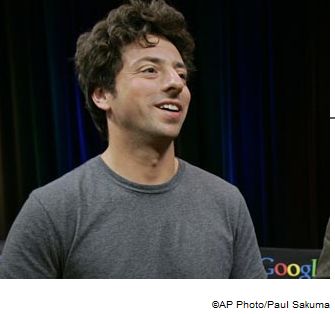
Fact: Two stark numbers are published today about Google co-founder Sergey Brin. First, the annual update of the “Forbes 400” wealthiest billionaires reports that Brin’s personal net worth is $15.9 billion (though that’s down some $2.7 billion from last year, due to the decline of Google’s stock price by 40% since last November).  More importantly, Brin himself wrote in his personal blog today that by having genetic research done on himself, “I learned something very important to me — I carry the G2019S mutation… it is clear that I have a markedly higher chance of developing Parkinson’s in my lifetime than the average person. In fact, it is somewhere between 20% to 80% depending on the study and how you measure.”

Analysis: Sergey Brin’s own blog account of his discovery is a remarkably personal and touching piece, dealing with his mother and her own belated diagnosis of Parkinson’s, and the scientific boundaries of current genetic research and the implications one can draw from this immature field of science.

(c) AP Photo, Paul Sakuma

This was only the second post on Sergey’s new blog; the blog’s name is “Too” – and the first post merely stated the rationale for that name (“Welcome to my personal blog. While Google is a play on googol, too is a play on the much smaller number – two. It also means ‘in addition,’ as this blog reflects my life outside of work”). 

If his refreshing honesty and thoughtfulness today are going to be the calibre of his writing, I’m going to be a regular reader. 

His piece reminds me of Steve Jobs’ modern classic, his 2005 Stanford Commencement Address.  If you’ve never read that, then stop reading my words right now, and go read that. You’ll find yourself over the weekend thinking about your own approach to life.

But back to Brin and genetic research.  It will be interesting to watch what Google’s research arm is able to do in the area of medical and health research.  To make progress in bioengineering and genetics, “organizing the world’s information” is absolutely paramount and of course that’s Google’s mission statement.

Continue reading

WIRED Cracks Cyber-Battle Code

Just a quick note between conflicting conference sessions in different locations around the DC Beltway, to note that WIRED’s premier national-security blogger Noah Schactman may have just cracked the code – or at least “a” code – on where the ongoing dispute over “control of cyber” is heading in national security circles, in his latest DangerRoom post (“Air Force Cyber Command Could Return, with Nukes“).

The dispute has been reported lightly, in places like the NextGov blog (“The Cyber Command Power Play?”), and usually boils down to a perceived battle between the U.S. Air Force and the nation’s Intelligence Community, over control of the increasingly central issue of cyber offense and cyber defense.

Continue reading

Gartner sees Hype Cycle for Social Software

Fact: Gartner now says that “Web 2.0 software” is falling from its “Peak of Inflated Expectations” and is on its way to a “Trough of Disillusionment.”  However, Gartner finds that wiki software has traversed that path already and is now well on its way up again to mature enterprise acceptance as a valuable productivity tool.

Analysis: Gartner’s just released their 2008 “Hype Cycle” report on Social Software – you know, stuff like public virtual worlds and Web 2.0 tools.

(I don’t know the legality of republishing the actual chart itself, so I’m not including it; I use the Microsoft enteprise license to access Gartner research.  I do note that a Web 2.0 enthusiast from the Netherlands has already posted the new Hype Cycle chart another new and related Hype Cycle chart, on “emerging technologies,” as a Flickr image here. There’s great overlap between the two reports.)

I’ve written before about the usefulness of Gartner analyses; I have to admit that Hype Cycles are my favorites. There’s something about internally debating their judgment calls as your eye travels the path, from pre-adoption “Technology Triggers,” through the bubble-esque “Peak of Inflated Expectations,” and right down into the depths of the “Trough of Disillusionment.” 

If you’re an enterprise IT guy, in a CIO or CTO role or investigating/recommending/approving new technology investments, you really wind up focusing most time on the slow ascending climb to the right of the chart, what Gartner calls the “Slope of Enlightenment.”  Just as in the old days when corporate “data-processing” chiefs lived by the mantra “No one ever got fired for buying IBM,” today’s CIO’s rely on technology that has essentially graduated to Gartner’s “Plateau of Productivity.”

Several other initial observations on the chart:the two Hype Cycle charts:

  • Newest disruptive technology trigger charted: “Erasable Paper Printing Systems,” something being researched by numerous large companies like HP and Microsoft as well as already in startup mode, but pegged by Gartner as still 10 years or more from mainstream adoption
  • Microsoft’s Surface has achieved brand dominance, as Gartner puts “Surface Computers” on the rise in visibility
  • Other key investments of Microsoft Research are validated with positive momentum ascribed to “Mobile Robots,” “Augmented Reality,” and “Green IT,” though only the last one is within 5 years of mature adoption
  • “Cloud Computing” is still on the rise, not having peaked in hype yet, though many would find that hard to believe – with its Time Magazine cover last year, it’s practically reached the point of being satired on The Daily Show
  • “Public Virtual Worlds” are right alongside “Web 2.0” in still heading down toward their disappointment trough
  • Furthest to the right – meaning most mature and enterprise-worthy – is the seemingly venerable “Basic Web Services.”

I really like these reports for a number of reasons – among other things, it looking at them together makes clear the social aspect of a number of more mature technologies (Tablet PC, Electronic Paper) which I favor, and which too often are recognized only for their technical aspects, not the socially enabling and disruptive benefits within and across organizations. 

The Gartner report also allows the blogosphere and twitterverse to step back from the moment-to-moment faddishness of the social software sector, and reflect upon the larger context of the individual technologies.  One measure of health: not a single technology earned the dubious distinction of “Obsolete Before Plateau,” a mark of shame which Gartner regularly applies to technologies that are getting hype but show no longterm promise.

Taken together, the social software space appears robust and very, very interesting.  Get a hold of the full report, it’s worth it.

Note: post updated 8/12/2008 to add references to a second Hype Cycle report on “Emerging Technologies”


Email this post to a friend

AddThis Social Bookmark Button

Click on My Head and You’re Classified 2.0

Fact: According to the latest McKinsey Global Survey report, “Building the Web 2.0 Enterprise,” many companies find themselves actually changing organizationally, both internally and externally, as a result of adopting Web 2.0 tools and practices. 

Continue reading

A-SpaceX, Google, and Virtual Tuesday

Yesterday I had a “virtual world vibe” going.  At 5:30 a.m. when my dog Jack woke me up offering to take me for a walk, the first thing I noticed on my mobile was a series of tweets from Chris Rasmussen, NGA’s social software guru, posted the night before.  Twitter is interesting for a lot of reasons, but one is the ability to snatch asynchronous stream-of-consciousness statements, from strangers and friends alike, as they pass by in the microblogosphere conversation.

Chris went on a tear about Second Life, with several hilarious observations and comments within the space of an hour, so here are several from his public Twitter feed:

Continue reading

Semantic Reality (Microsoft Acquires Powerset)

Fact: At last, the public announcement this afternoon of one of the most-rumored secrets in tech: Microsoft is acquiring Powerset, taking us one major step forward in semantic technologies. 

Analysis: There’ll be plenty of analysts looking at this, and I expect the acquisition will get a lot of buzz just as Powerset did originally when launched.  After all, Microsoft is buying a company which was called a “Google-Killer” by everyone from the New York Times to various esoteric search-technology blogs.  [Update: it’s already started on TechCrunch.]

If you haven’t used Powerset’s first announced product, semantic searching of Wikipedia, check it out on their site and you’ll begin to see why there’s been so much interest in their technical approach. I’ve known founder Barney Pell for a while now, and we’ve mused about the possibilities of adding Powerset’s strengths to Microsoft’s global scale.  The more I played with PowerLabs, before its full launch, the more I was convinced of its power.

When I was working at DIA, one of our dreams was a semantically enabled intelligence enterprise. IC analysts and advanced users within any other enterprise vertical are going to find some very interesting capabilities finally possible when Powerset technology is wedded to the FAST search software already being deployed at web scale. But that’s only the beginning.  Continue reading

Required Reading on Innovation and Patents

FACT:  If you’re a fan of Malcolm Gladwell’s tremendous books (“The Tipping Point” and “Blink“), then you probably read the New Yorker magazine just to get his articles.  He has a new piece this week, “In the Air: Who Says Big Ideas are Rare?” in which he describes the phenomenally appealing work of the legendary Nathan Myhrvold and his current gig running “Intellectual Ventures,” often mistaken for a VC firm.  Gladwell recounts the facts that Myhrvold “graduated from high school at fourteen. He started Microsoft’s research division, leaving, in 1999, with hundreds of millions.”  It is what he’s done since then that grabs the mind, particularly if you’re interested in invention and innovation:

Continue reading

Update on Facebook-in-Egypt

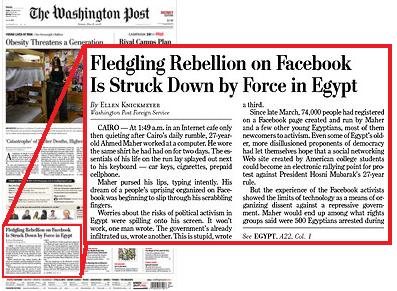
FACT: According to a Sunday Washington Post front-page story today recounting the events leading up to May 4, a “day of strike” called for by social-networkers as a protest against government policies, “By late afternoon, of the 74,000 people who had registered on the Facebook protest page, only 15 – three men and 12 women – were still eager to gather for a protest.”  [Note: the Facebook page had only been launched in late March.]

ANALYSIS: Last week I wrote about media coverage of Egypt’s Facebook affair, and noted that the Post and others had only covered it on media blogs, not in the actual newspaper.

This morning I picked up my Sunday-morning Post and saw the story, “Fledgling Rebellion on Facebook Is Struck Down by Force in Egypt,” right on the front page, which means that across Washington this morning, and other capital cities through clipping services, many in the foreign policy elite and punditocracy may be reading for the first time about the Web 2.0 facet of these events. 

Reporter Ellen Knickmeyer also posted today a related online “Field Notes” column about the challenges of covering the Facebook activists.

AddThis Social Bookmark Button