EU says, Costs of Open Source Outweigh the Benefits?

FACT: According to a Reuters story today, “The European Commission, a thorn in Microsoft’s side for its antitrust campaigns against the software giant, is falling short in its own internal attempt to promote more competition in the technology sector. The European Union executive has so far not followed its own policy that it purchase office software and operating systems with open standards as well as Microsoft products.”

(c) European CommunityIn the money quote, according to the Reuters story, the EU’s director of IT solutions “said in an interview arranged by a spokeswoman for Commissioner Siim Kallas, who oversees procurement, that studies showed the costs of moving to open source outweighed the benefits.” 

  Continue reading

How to Find Research: Here, There, Everywhere

FACT: The Washington Post today has a story in the Business section (“Intelligence Agency Joins U-Md. Research Center“) about the relationship between IARPA and the University of Maryland, the location of the planned new IARPA headquarters. 

ANALYSIS: UMd has a set of valuable relationships with the public- and private-sector national security community, and the IARPA startup is just the latest agency to benefit.   Proximity is key, for research and bureaucracy.  In Maryland’s case, IARPA Director Lisa Porter told an IEEE interviewer last month that “It’s nice not to be sitting right next to one particular agency. It’s also nice to be near a university because we’re sending a message that we want to bring in nontraditional partners: academia, industry. It sends a nice message that we’re embracing the broad community to help us solve these challenging problems.”

I lament sometimes that Charlottesville (home to my undergraduate alma mater) is a good two hours away from DC, as even that distance puts a frustrating limit on the amount of joint work that winds up being done with Virginia faculty and students. 

Continue reading

Web Security and New Media in Politics

FACT: The Obama presidential campaign has been lauded for innovative uses of the Web and social media, particularly for fundraising and volunteer recruitment.  But as PC World has just reported, “Two months after their Web site was hacked, the organizers of Barack Obama’s presidential campaign are looking for a network security expert to help lock down their Web site…. Security experts said this is the first time they can remember seeing a Web security job advertised for a political campaign.”

ANALYSIS:  I wrote before about my experience in 1994-95 helping build one of the Internet’s first political campaign websites – I designed the content and wrote much of it, for Mayor Frank Jordan of San Francisco.  (The pages were literally built and posted by mayoral son Thomas Jordan, by the way, who was then a college student at UC-Berkeley; he went on to great things at Pixar.)   At the time, with such a simple site, we didn’t have to worry much about security – or so we thought, and luckily the worst scandal in those early years involved domain-squatting by certain rival campaigns.

As PC World points out, though, “Obama’s Web site, built by Facebook cofounder Chris Hughes, has been the model of Web 2.0 campaigning, using social-networking techniques to raise funds and build a broad base of active, Internet-savvy supporters. But security experts have long warned that powerful Web site features also open new avenues for attack.”

Continue reading

At Craigslist, “Traffic just keeps going up…”

Back in 1994-96 I was working for the Mayor of San Francisco (Frank Jordan, “the one before Willie Brown” as one friend persisted in calling him), and among other projects I was working on policies to nurture and promote the emerging  Internet economy, particularly the slowly burgeoning culture of Web startups – at times it seemed like the center of the universe was around South Park in the city’s South of Market neighborhood.  For the Mayor’s ’95 re-election campaign we put up one of the first political campaign websites, winning an award from “Campaigns & Elections” magazine. 

One of the cool people I worked with on innovative ideas for the nascent Web back then was Craig Newmark, founder of Craigslist. Like many people in San Francisco, I remember when using Craigslist was synonymous with “finding local S.F. stuff,” and have watched with delighted awe as the site (nonprofit empire!) has grown over the years.  The model absolutely rocks, in its simplicity, consistent innovation, and its universality.

Continue reading

War is Virtual Hell

FACT: According to market research compiled by Microsoft, the global market for Modeling and Simulation (M&S) software/hardware platforms across all industries, including the defense industry, has hit $18 billion per year; the cumulative growth rate is estimated at 9.6% annually.

ANALYSIS:  The lovely wife and I have been lackadaisically house-hunting down in Virginia’s Northern Neck, the Athens of America and the cradle of our democracy. The Neck is the birthplace of George Washington, the Lee brothers (the revolutionary patriots about whom John Adams used the phrase, “This Band of Brothers,” among them Declaration of Independence signers Richard Henry Lee and Francis Lightfoot Lee, not to mention their later nephew Robert E. Lee), James Monroe, John Ballentine, etc. etc. 

Anyway, recently we toured the historic 1859 house at Braehead, an 18-acre estate actually located within the Civil War battlefield in Fredericksburg, Virginia. The house is for sale, and while it’s likely overpriced (like everything else on the market these days) [this observation has been energetically and somewhat persuasively disputed by the listing agent, who read the post], but we enjoyed the tour.  I’ve posted many (too many) photos of our little tour here.  My interest in the house is the historic angle: it’s actually where Robert E. Lee visited and took breakfast on the morning of the Battle of Fredericksburg in 1862, one of his successful efforts against U.S. forces.  Here’s an article about Braehead’s history and historic preservation.

It was in fact at Fredericksburg that Lee spoke the words which would sum up the entire war, nay all wars, as he witnessed thousands of Union soldiers falling in battle to Confederate guns on the hills above the Rappahannock River: “It is well that war is so terrible, lest we grow too fond of it.”  

Continue reading

How to Run a State-of-the-Art Technology Program – Quietly

FACT: In the new movie “Iron Man,” defense-contracting billionaire and engineering genius Tony Stark (played by Robert Downey Jr.) designs and builds a suit capable of individual flight (highly engineered control surfaces powered by an “arc-reactor” – it is Hollywood after all). During his first test flight, zooming straight up from Malibu and stressing the system to its max, he asks his onboard computer, “What’s the altitude record for the SR-71?” His computer responds back, “85,000 feet,” whereupon he zooms past that ceiling.

ANALYSIS: Funny moment, and excellent movie.  In its honor, below I’m going to give you access to a remarkable, recently declassified document describing one of America’s boldest Cold War technical achievements.  If you’ve ever run (or wanted to run) a high-tech company or program, like Tony Stark in the movie, you’ll appreciate the startling scope of the work – and if you’ve recently worked in DoD or the Intelligence Community you’ll marvel at how they did it “in the good old days.”

Continue reading

Update on Facebook-in-Egypt

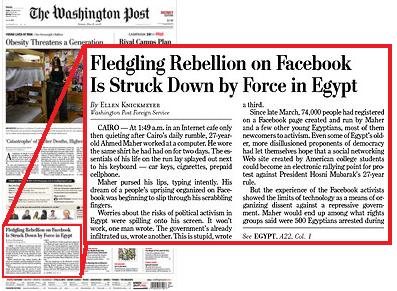
FACT: According to a Sunday Washington Post front-page story today recounting the events leading up to May 4, a “day of strike” called for by social-networkers as a protest against government policies, “By late afternoon, of the 74,000 people who had registered on the Facebook protest page, only 15 – three men and 12 women – were still eager to gather for a protest.”  [Note: the Facebook page had only been launched in late March.]

ANALYSIS: Last week I wrote about media coverage of Egypt’s Facebook affair, and noted that the Post and others had only covered it on media blogs, not in the actual newspaper.

This morning I picked up my Sunday-morning Post and saw the story, “Fledgling Rebellion on Facebook Is Struck Down by Force in Egypt,” right on the front page, which means that across Washington this morning, and other capital cities through clipping services, many in the foreign policy elite and punditocracy may be reading for the first time about the Web 2.0 facet of these events. 

Reporter Ellen Knickmeyer also posted today a related online “Field Notes” column about the challenges of covering the Facebook activists.

AddThis Social Bookmark Button 

Social Networking in Egypt Takes a Political Turn

FACT: In the past two days, reporters for the Los Angeles Times and the Washington Post have each written accounts of the ongoing confrontation in Egypt between the government and online activists – the “Facebook Revolution” as the Post reporter terms it, hyperbolically. One interesting aspect: the two accounts are not carried as actual news stories in the “newspaper” (real or virtual), but as blog posts by the reporters on dedicated foreign-correspondent blogs. The Washington Post account is on the “PostGlobal” uber-blogsite, under Jack Fairweather’s “Islam’s Advance” blog, while the L.A. Times account is on the “Babylon & Beyond” blog, which carries a sub-head of “Observations from Iraq, Iran, Israel, the Arab World and Beyond.”

ANALYSIS: Up to now there’s been little coverage in traditional American media outlets of the emerging political tenor of some social networks in Egypt over the past several months. Major newspapers and the cable-news channels have not explored the topic, but I just returned from some time in Egypt and I learned that of course it is a widely covered and discussed topic there.  One young woman in her 30s, an urban professional, told me “I’m on Facebook all day long!”

Every morning outside my hotel room I would find an English-language newspaper, and for many days in a row it was a different paper – often because they were weekly editions.  That gave me the opportunity to read a variety of opinions from a somewhat broad band, as measured in “distance to/from the government position.”  

Helpfully, on May 6 2008 the Egyptian Mail included a summary of the raging controversy over Facebook, noting that “In Egypt, Facebook is the stage for the latest twist in the generation gap, playing host to politically hungry young Egyptians eager to take on their ageing leader.”  Only at the end of the article did I notice that it was reprinted from a New-York-based Egyptian blogger, the respected Mona Eltahawwy.

Continue reading

IARPA and the Virtual Long Tail

FACT: This week, the Intelligence Advanced Research Projects Activity, an arm of the Director of National Intelligence (DNI), launched its new unclassified website.  What’s there is initially fairly minimal, but they’ll be adding to the public information posted there regularly.

ANALYSIS:  I spent the week in Orlando, as a Keynote speaker at the IARPA “Incisive Analysis Conference.”  I’ll be writing a little more about the conference in the near future, as I saw some great demo’s and spoke to the principal investigators on many excellent and far-sighted advanced research projects sponsored by IARPA.  It was great to be there and to see so many old friends from the intelligence community, the national labs (PNNL, Sandia, Oak Ridge, Livermore), DoD, and innovative commercial R&D outfits.  Also, as the first IARPA conference since the organization’s launch, it was an opportunity to hear new director Lisa Porter communicate her vision and principles, which she did well and I’ll discuss those soon as well.  (She also kidded me about my efforts to make her a cultural phenomenon, but I blamed it on WIRED magazine.)

Continue reading

“Legally Blonde 2.0” – SoCal Spook at Harvard

Shout out to Chris Rasmussen, a former colleague in the intell biz who emails that he’ll be speaking on uses of Web 2.0 approaches in the Intelligence Community at Harvard’s Kennedy School of Government in June…. as he put it in his email, “I’m pretty sure Danish dudes from southern California have been legallyblonde2.jpgblacklisted from Harvard for hundreds of years. Well the times are changing.”

Chris has been involved in social-networking and other 2.0 efforts in the IC, both at the enterprise level and in grass-roots form — accomplishing the latter and encouraging the former (strongly).  The Kennedy School program, “Web 2.0: Taking Action in Government”  is advertised as “examining the lessons learned from first movers in both business and government and distilling what actions government leaders must now take to harness the power of these new tools and business models.”  (more info here

I especially like that the conference is being organized with the help of Don Tapscott, co-author of  an excellent book: Wikinomics: How Mass Collaboration Changes Everything.

Continue reading