Inventing the Software that Invents the Future

Worried about today’s stock market activity? Retreat with me into the security of the bright future that awaits.

Microsoft’s Craig Mundie (pater familias of the Institute for Advanced Technology in Governments), is on a college tour across the nation.  The trip is something of a reprise of jaunts Bill Gates famously made over the years, when he would string together visits to campuses partly to evangelize, partly to recruit, and mostly to get new ideas from bright young (and contrarian) minds.  The Seattle paper today labels these tours as filling the role of Microsoft’s “chief inspiration officer” (“Mundie gives campuses peek at tech’s future”).

Continue reading

Gartner Says, Sometimes Hype is Necessary

Fact: Gartner is taking the same approach they often critique with their normally-solid “Hype Cycle” reports – arguing that “a little cloud hype” is beneficial if it “captures the imaginations of a broader audience of decision makers.”

Analysis: With their annual “Hype Cycle” reports, Gartner usually does a solid job of tracking over-optimistic assessments of the “latest and greatest” in technology and calling out overly hyped “hot new tech” and providing realistic assessments of the projected future of trends in software, hardware, and business processes.

Sometimes, Gartner slips up, and falls prey to the error they ascribe to others.  That’s the only interpretation I can make on a curious blog posting on an official Gartner blog designed to promote their new book “Mastering the Hype Cycle: Choosing the Right Innovation at the Right Time.”  Mark Raskino, the book’s co-author with longtime analyst Jackie Fenn, argues that “We have to simplify the business proposition behind this ‘big shift’,  explain it well and socialize it deeply to convince non-tech business leaders to buy-in.” 

Mr. Raskino makes clear that he wants to babytalk these business-side executives into believing “a little cloud hype” because, in his words, IT leaders and CIOs “need help explaining the fundamental change.”

Continue reading

Hiding new technology in plain sight

If I’m giving a private demo of an advanced technology or piece of software that Microsoft is cooking up, I often encounter the response, “Yeah, but we’ll probably never see this released, will we?”

Continue reading

Microsoft Sphere, Apple Tablet

Fact: Today is the first public showing of “Sphere,” Microsoft’s newest multi-touch innovation: “After months of rumors, Microsoft researchers are taking the wraps off a prototype that uses an internal projection and vision system to bring a spherical computer display to life. People can touch the surface with multiple fingers and hands to manipulate photos, play games, spin a virtual globe, or watch 360-degree videos.”

Analysis:  The video tells the story, particularly when you keep in mind that Sphere (and its earlier cousin Surface) represent a new multi-touch, multi-interface platform for human use of computing power.  A year ago Surface was still just emerging from the research lab, and now a year later it’s been introduced into AT&T retail stores and is on its way to many other commercial and public environments.  Sphere will be used in similarly unpredictable ways, adopted by third-party developers as an innovative canvas on which they can project cool new uses.

Continue reading

IPsec, IPv6, and Security at Your House

Just had a great meeting in Redmond introducing some government friends to Steve Riley, one of Microsoft’s “technical evangelists” on security – network, app, data security and most of all, IP security.  He’s great at the big-picture integrated view of security, including physical security right up through the IP stack – here’s a video of a recent talk he gave at Microsoft’s TechNet called “The Fortified Data Center in Your Future.”

Check out his blog and you’ll see the kind of topics he works on; just one example of obvious value is a recent post full of real-world down-to-earth security advice for securing your environment at home (home networking, email use, internet browsing, etc for family and friends).

Oh, he’s also been on Twitter for almost a month now, where he mixes interesting finds on security news with offbeat political commentary 🙂  Yet another example of some of the bright people I meet back at the mothership in Redmond….

Email this post to a friend

AddThis Social Bookmark Button

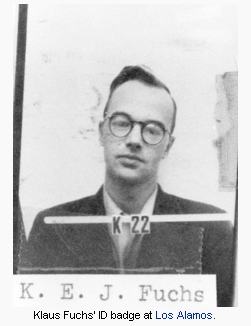
Theory of the Fireball, Supercomputing, and other Los Alamos Tidbits

Back in the early ’90s when I was first dating Kathryn, now the lovely bride, we went on some awesome roadtrips, including many cross-country – great way to get to know someone.  At the time my brother was an Air Force pilot, flying the F-117 stealth fighter, so we once paid him a visit at Holloman AFB on a 10-day drive through the Southwest.  I’ll have to find and upload to Flickr the pictures he took of each of us sitting in its classified cockpit – surely a massive security violation which I lay entirely at his feet (lucky for him he’s retired from the Air Force now and flying for Delta). 

Sadly, the F-117 Night Hawk has also now been officially retired, replaced by the F-22 Raptor.

As much as that was a thrill, though, the highlight of that particular roadtrip was driving up to the Los Alamos plateau and spending some time touring around the Lab, the Museum, and the interesting little town that’s grown up around all that PhD talent in the middle of the high desert.

That lab’s on my mind because I’ve been thinking about supercomputing and the revolution it could undergo thanks to quantum computing. I’m in Santa Barbara visiting the “Station Q” research program in quantum computing, and will write more about quantum computing soon, since I’m actually beginning to understand it.

But as an interesting artifact in my preparatory reading, Microsoft’s John Manferdelli sent me a link to a Federation of Atomic Scientists archive of declassified Los Alamos National Lab technical reports and publications, from “the good old days” at Los Alamos.

Continue reading

Sales Guy vs Web Dude

The website where I first saw this video wrote, “This would be funny if it weren’t so true.”  No – it’s funny because it’s so true!  Yes, even in government IT settings.

The video’s here; adolescent language warning, a la South Park. If you don’t get the jokes, just reboot your system. 3 times.

Email this post to a friend

AddThis Social Bookmark Button

Tradecraft in the Long Tail

Fact: Chris Anderson, WIRED editor in chief and author of the Internet-era classic book “The Long Tail,” also runs a couple of Ning social networks focusing on what the intelligence community would call IMINT, or imagery intelligence – specifically DIY Drones, “a site for all things about amateur Unmanned Aerial Vehicles (UAVs): How-to’s, videos, discussion and more,” and PictEarth, “a Social Network used to collect, link and geotag RC, UAV/UAS or Kite derived Earth imagery for use in 3D Globe Programs including Google Earth, Virtual Earth, World Wind and ArcGIS Explorer.”

Analysis:  With these sites, Chris Anderson is promoting what he calls “Crowdsourced Aerial Imagery.”  In the mission statement for DIY Drones, he writes that “Reasons to make your own UAV range from a fun technical challenge, student contests, aerial photography and mapping (what we call “GeoCrawling”), and scientific sensing. We are primarily interested in civilian, not military, UAV uses here.” (Emphasis is in the original.)

Let’s presume that individual DoD or intelligence-agency personnel have an interest in such issues, and maybe even in spending their personal time by keeping current and following the crowd’s interest in such topics, by participating in these new social networks.  One can then assume that others from foreign intelligence might have some interest in tracking those very IC personnel, by observing their activities within social networks (and not just Ning ones).  No spectacular logic needed for that.

The CIA has had some challenges in understanding their field presence within the Long Tail. 

Continue reading

“The Largest Social Network Ever Analyzed”

FACT: According to ComScore data cited in a story in Monday’s FInancial Times, “Facebook, the fast-growing social network, has taken a significant lead over MySpace in visitor numbers for the first time… Facebook attracted more than 123 million unique visitors in May, an increase of 162 per cent over the same period last year… That compared with 114.6 million unique visitors at MySpace, Facebook’s leading rival, whose traffic grew just 5 per cent during the same period… The findings mark the first time that Facebook, launched in 2004, has taken a significant lead in unique visitors, [and] come at a time of change inside Facebook, as the one-time upstart attempts to transform itself into a leading media company.

ANALYSIS:  This week several members of the Microsoft Institute met in Redmond with a visiting friend from government, and among other talks we had a very interesting discussion with Eric Horvitz, a Microsoft Research principal researcher and manager.  Eric’s well known for his work in artificial intelligence and currently serves as president of the Association for the Advancement of Artificial Intelligence (AAAI).

We talked about one of Eric’s recent projects for quite a while: “Planetary-Scale Views on a Large Instant-Messaging Network,” a project which has been described by his co-author as “the largest social network ever analyzed.” 

Continue reading

Pentagon’s New Program for Innovation, in Context

FACT: According to an article in today’s Washington Post, the Pentagon has announced “the selection of six university professors who will form the first class of the National Security Science and Engineering Faculty Fellows Program. The professors will receive grants of up to $600,000 per year for up to five years to engage in basic research — essentially a bet by the Pentagon that they will make a discovery that proves vital to maintaining the superiority of the U.S. military.”

ANALYSIS: This new program is an innovation from DoD’s Director of Defense Research and Engineering (DDR&E), and since tomorrow I’ll be at Ft. McNair for a two-day conference sponsored by DDR&E on Strategic Communications, I’ll congratulate John Young and his staff for the good idea.

But the Post article falls short in two ways: one immediate (it leaves out key information about next year’s program and the upcoming deadline!) and one longer-term (it ignores the overall context of federal support for R&D).  I’ll fill in the blanks below.

Continue reading