WIRED Cracks Cyber-Battle Code

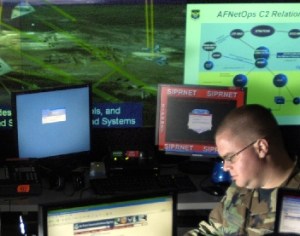
Just a quick note between conflicting conference sessions in different locations around the DC Beltway, to note that WIRED’s premier national-security blogger Noah Schactman may have just cracked the code – or at least “a” code – on where the ongoing dispute over “control of cyber” is heading in national security circles, in his latest DangerRoom post (“Air Force Cyber Command Could Return, with Nukes“).

The dispute has been reported lightly, in places like the NextGov blog (“The Cyber Command Power Play?”), and usually boils down to a perceived battle between the U.S. Air Force and the nation’s Intelligence Community, over control of the increasingly central issue of cyber offense and cyber defense.

Continue reading

How to Run a State-of-the-Art Technology Program – Quietly

FACT: In the new movie “Iron Man,” defense-contracting billionaire and engineering genius Tony Stark (played by Robert Downey Jr.) designs and builds a suit capable of individual flight (highly engineered control surfaces powered by an “arc-reactor” – it is Hollywood after all). During his first test flight, zooming straight up from Malibu and stressing the system to its max, he asks his onboard computer, “What’s the altitude record for the SR-71?” His computer responds back, “85,000 feet,” whereupon he zooms past that ceiling.

ANALYSIS: Funny moment, and excellent movie.  In its honor, below I’m going to give you access to a remarkable, recently declassified document describing one of America’s boldest Cold War technical achievements.  If you’ve ever run (or wanted to run) a high-tech company or program, like Tony Stark in the movie, you’ll appreciate the startling scope of the work – and if you’ve recently worked in DoD or the Intelligence Community you’ll marvel at how they did it “in the good old days.”

Continue reading

IARPA and the Virtual Long Tail

FACT: This week, the Intelligence Advanced Research Projects Activity, an arm of the Director of National Intelligence (DNI), launched its new unclassified website.  What’s there is initially fairly minimal, but they’ll be adding to the public information posted there regularly.

ANALYSIS:  I spent the week in Orlando, as a Keynote speaker at the IARPA “Incisive Analysis Conference.”  I’ll be writing a little more about the conference in the near future, as I saw some great demo’s and spoke to the principal investigators on many excellent and far-sighted advanced research projects sponsored by IARPA.  It was great to be there and to see so many old friends from the intelligence community, the national labs (PNNL, Sandia, Oak Ridge, Livermore), DoD, and innovative commercial R&D outfits.  Also, as the first IARPA conference since the organization’s launch, it was an opportunity to hear new director Lisa Porter communicate her vision and principles, which she did well and I’ll discuss those soon as well.  (She also kidded me about my efforts to make her a cultural phenomenon, but I blamed it on WIRED magazine.)

Continue reading

Air Wars: the Air Force Takes Heat for its PR

FACT: A heated online debate is erupting about a particular photo posted online, and the brouhaha around it focuses on whether or not classified details are contained therein, thus revealing them. 

ANALYSIS: Given that others are even now writing extensively about this photo and its controversy I thought I would add a couple of thoughts.  Don’t bother blaming me for linking to the photo, by the way; given the attention and reposting/rehosting it has already received, the glare of publicity can only serve to prod better security practices. 

I expect to see parody versions on Flickr soon, with “Area 51” touches.

And so to my related thoughts: recently, an active-duty USAF officer and regular reader emailed me about one of my posts concerning Rod Beckstrom and the new National Cyber Security Center, which he had not previously heard of.  He wrote that in discussing it with a colleague, the response was “I thought the Air Force Cyber Command already had the mission to coordinate all cyber security efforts.”

Continue reading

Social (Network) Science

Fact: The social-networking site LinkedIn claims as users “17,000,000+ Professionals, 500,000+ Senior Executives, Executives from 498 Fortune 500 companies, [and] 65,000 new Professionals every week.”

Analysis: Since I hold the title of “chief technology officer” for my group at Microsoft, I regularly check the widely-read blog CTOvision, written by Bob Gourley, CTO of Crucial Point.

CollaborationlogosYesterday he posted a very solid summary of several social networking tools, including my preferred LinkedIn.  If you’re not up to speed on the genre it is a helpful cheatsheet and “buyer’s guide.”

The technology area deserves the attention. There are a dozen or more such sites for each that Gourley covers, and he chooses the ones that have shown growth and potential longevity; why invest any time adding personal data to a site just to watch it disappear? We’ve all had that happen. And yet hockey-stick growth has to be managed – LinkedIn for example has come in for some critical attention for some snafus along the way.

Let’s look at some efforts to understand more about the science behind the software….

Continue reading

The Future of Army’s “Future Combat Systems”

Fact:  The U.S. Army is currently in the midst of a multi-year, $6 billion software development program which it says “dwarfs Microsoft Windows.”

Analysis: The Washington Post did a long piece on the U.S. Army’s gargantuan Future Combat Systems program today, not overly critical but quite skeptical. 

Some highlights of the program itself, which has its own comprehensive site maintained by the Army: 

  • FCS is the “Big Kahuna” of Army modernization, full-on system-of-systems;
  • It’s a $200 billion program, called the most thorough modernization of the Army since WWII;
  • All depends on a massive software development effort led by Boeing; 
  • The S/W development cost alone is around $6 billion (H/W costs are much larger, for the actual weapons, tanks, etc.).

When I was serving at the Defense Intelligence Agency, I was aware that (a) everyone associated with FCS had their fingers crossed and eyes closed when talking about it; (b) everyone not associated with it used the same tone of voice about FCS as they used about FBI’s Virtual Case File and NSA’s Trailblazer – two well-known large-scale failed technology programs.  Many people who know more about FCS than I do consider it a pipe-dream (here’s a good Heritage Foundation backgrounder on the program).  Yet the program continues to spend billions and the Army is slogging on with it.

So here’s what I really think about it: Continue reading