Pentagon’s New Program for Innovation, in Context

FACT: According to an article in today’s Washington Post, the Pentagon has announced “the selection of six university professors who will form the first class of the National Security Science and Engineering Faculty Fellows Program. The professors will receive grants of up to $600,000 per year for up to five years to engage in basic research — essentially a bet by the Pentagon that they will make a discovery that proves vital to maintaining the superiority of the U.S. military.”

ANALYSIS: This new program is an innovation from DoD’s Director of Defense Research and Engineering (DDR&E), and since tomorrow I’ll be at Ft. McNair for a two-day conference sponsored by DDR&E on Strategic Communications, I’ll congratulate John Young and his staff for the good idea.

But the Post article falls short in two ways: one immediate (it leaves out key information about next year’s program and the upcoming deadline!) and one longer-term (it ignores the overall context of federal support for R&D).  I’ll fill in the blanks below.

Continue reading

War is Virtual Hell

FACT: According to market research compiled by Microsoft, the global market for Modeling and Simulation (M&S) software/hardware platforms across all industries, including the defense industry, has hit $18 billion per year; the cumulative growth rate is estimated at 9.6% annually.

ANALYSIS:  The lovely wife and I have been lackadaisically house-hunting down in Virginia’s Northern Neck, the Athens of America and the cradle of our democracy. The Neck is the birthplace of George Washington, the Lee brothers (the revolutionary patriots about whom John Adams used the phrase, “This Band of Brothers,” among them Declaration of Independence signers Richard Henry Lee and Francis Lightfoot Lee, not to mention their later nephew Robert E. Lee), James Monroe, John Ballentine, etc. etc. 

Anyway, recently we toured the historic 1859 house at Braehead, an 18-acre estate actually located within the Civil War battlefield in Fredericksburg, Virginia. The house is for sale, and while it’s likely overpriced (like everything else on the market these days) [this observation has been energetically and somewhat persuasively disputed by the listing agent, who read the post], but we enjoyed the tour.  I’ve posted many (too many) photos of our little tour here.  My interest in the house is the historic angle: it’s actually where Robert E. Lee visited and took breakfast on the morning of the Battle of Fredericksburg in 1862, one of his successful efforts against U.S. forces.  Here’s an article about Braehead’s history and historic preservation.

It was in fact at Fredericksburg that Lee spoke the words which would sum up the entire war, nay all wars, as he witnessed thousands of Union soldiers falling in battle to Confederate guns on the hills above the Rappahannock River: “It is well that war is so terrible, lest we grow too fond of it.”  

Continue reading

Business Executives for National Security, and Dana Carvey?

Went to the big BENS gala last night (Business Executives for National Security) in downtown Washington, along with some Microsoft colleagues – the company was a sponsor – and several guests who fit right in with the rest of the crowd, military brass and IC muckety-mucks.  I first met BENS founder Stanley Weiss back in the late 1980s when he came to Silicon Valley to recruit support for the new group, “a nonpartisan business organization aiming to cut through ideological debates on national security issues.” 

The evening’s billed highlight was the awarding of the annual BENS Eisenhower Award to Sec. of Defense Robert Gates, who gave just a phenomenal speech (see Reuters and AP coverage today, and the full text here). I blogged a couple of days ago about his speech to the Heritage Foundation, which I read the text of, but seeing Gates deliver this speech really impressed me, to be honest. He comes across as sincerely dedicated to fixing some of the fundamental problems of DoD and the intelligence community (his career after all was at CIA and he is obviously a thoughtful critic of the DNI structure and “reforms”).  I sat there wondering whether Gates would be willing to continue at the Pentagon in the next Administration (odds are much higher of that with a McCain victory, obviously, and infinitesimal otherwise).

Brent Scowcroft introduced Gates with a warm and witty tribute, and it was nice to see him in person.  He told several jokes making fun of the Beltway culture, getting big laughs. Gates continued in kind at the beginning of his remarks, before he got serious – keep reading for one of Gates’s best jokes:

Continue reading

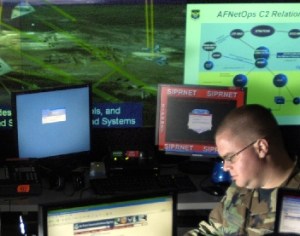
Air Wars: the Air Force Takes Heat for its PR

FACT: A heated online debate is erupting about a particular photo posted online, and the brouhaha around it focuses on whether or not classified details are contained therein, thus revealing them. 

ANALYSIS: Given that others are even now writing extensively about this photo and its controversy I thought I would add a couple of thoughts.  Don’t bother blaming me for linking to the photo, by the way; given the attention and reposting/rehosting it has already received, the glare of publicity can only serve to prod better security practices. 

I expect to see parody versions on Flickr soon, with “Area 51” touches.

And so to my related thoughts: recently, an active-duty USAF officer and regular reader emailed me about one of my posts concerning Rod Beckstrom and the new National Cyber Security Center, which he had not previously heard of.  He wrote that in discussing it with a colleague, the response was “I thought the Air Force Cyber Command already had the mission to coordinate all cyber security efforts.”

Continue reading

A Roadmap for Innovation – from Center or the Edge?

Fact:   In marking its five-year anniversary earlier this month, the Department of Homeland Security released a fact sheet touting the department’s accomplishments in that time, including “establish[ing] the Computer Emergency Readiness Team (US-CERT) to provide a 24-hour watch, warning, and response operations center, which in 2007 issued over 200 actionable alerts on cyber security vulnerabilities or incidents. US-CERT developed the EINSTEIN intrusion detection program, which collects, analyzes, and shares computer security information across the federal civilian government. EINSTEIN is currently deployed at 15 federal agencies, including DHS, and plans are in place to expand the program to all federal departments and agencies.”

Analysis:  I’m not going to write, in this post at least, about US-CERT and EINSTEIN in particular. I will point out that some writers have been skeptical of “Big DHS” progress on cyber security up to now, and the anniversary was an occasion for much cynical commentary. 

cnet-news.jpgCharles Cooper in his popular Coop’s Corner blog on CNet wrote that “when it comes to network security, DHS appears to be more of a wet noodle than even its sharpest critics assumed… Talk with security consultants and former government officials involved with DHS and you come away wondering what these folks do all day.”

Continue reading