Click on My Head and You’re Classified 2.0

Fact: According to the latest McKinsey Global Survey report, “Building the Web 2.0 Enterprise,” many companies find themselves actually changing organizationally, both internally and externally, as a result of adopting Web 2.0 tools and practices. 

Continue reading

CIA 2.0: The Agency’s CIO and Change

Fact: CIO magazine is running a big story on the CIA’s Chief Information Officer Al Tarasiuk and his IT operation, and their online site is breaking it up into a four-part series running this week.  Below I analyze the series.

Analysis: By the halfway mark in the series, the magazine’s reporter Thomas Wailgum had only accomplished a fairly rote recounting of what CIA is, what its CIO does, and how both those factors have changed since the good ol’ spy days amid the challenges of a post-9/11 world.

Part Onedescribed “a business-IT alignment project like few others,” although it mainly served to introduce CIO magazine’s broad readership to the unfamiliar world of a walled-off intelligence agency, waxing on about the hyper-security at Langley.  Part Two similarly was background on the bureaucratic culture of the agency and its relegation of IT to backwater status – until 9/11 came along.

Continue reading

Birth of Cool (Cuil) – History Repeating Itself?

Fact: Cuil reaped the whirlwind of the media buzz it craved today.  As CNET put it, “Google challenger Cuil launched last night in a blaze of glory. And it went down in a ball of flames. Immediately after launch, the criticism started to pile on: results were incomplete, weird, and missing.”

Analysis:  For several months I’ve had running an RSS feed along the right-hand side of the ol’ blogspace here, entitled “Who’s Talking about ‘the next Google.'”  Ha ha – the RSS feed pulls from a Google News query.

Well, if you judge by the echo chamber hungry for positive tech news amid a down market, you might think “the next Google” has emerged: the birth of Cuil.  (Extra credit if you’re a Miles Davis jazz fan, by the way.)  I may retire the crown, or at least the RSS feed.  Here’s some of the global attention:

Continue reading

Three Key Promotions in U.S. Intelligence

In the old days of Kremlinology, our side’s “Soviet analysts” (I was one as a kid, back in 1985-86) would pore over personnel lists and announcements of Politburo or Central Committee appointments, seeking clues to the direction of Party doctrine and intent. Military personnel promotions and reassignments were also studied closely to divine any insight into Soviet military policy.

There’s not a direct analogy to American military leadership promotions, but those lists are also studied intently, by peers and colleagues within the military branches, and also by experts throughout defense industry circles who can often decode Pentagon politics by watching who gets an extra star and who gets passed over.

Friday the U.S. Senate confirmed several key Army promotions, including three which I consider to be the most critical military intelligence positions in the nation. 

Continue reading

Healthcare: It’s the Data, Stupid

Fact: Today’s L.A. Times has a startling report: “A stunning number of people who work in healthcare settings lack paid sick time — as many as 75% of all home health aides, for example… Federal data indicate that as many as 29% of all workers in the ‘healthcare and social assistance’ job sector lack paid sick days. Healthcare employees who work while ill may end up hurting the people they are hired to help….”

Analysis: Mark Twain said the only two sure things in life were death and taxes.  So it’s no surprise that the two presidential campaigns are focusing on healthcare and the economy, since people are universally affected in personal ways.  Forget taxes for today, I’m interested in technology’s role in healthcare, which is growing, and there’s no more potentially game-changing facet of that than the role of data. 

Continue reading

Sales Guy vs Web Dude

The website where I first saw this video wrote, “This would be funny if it weren’t so true.”  No – it’s funny because it’s so true!  Yes, even in government IT settings.

The video’s here; adolescent language warning, a la South Park. If you don’t get the jokes, just reboot your system. 3 times.

Email this post to a friend

AddThis Social Bookmark Button

Semantic Reality (Microsoft Acquires Powerset)

Fact: At last, the public announcement this afternoon of one of the most-rumored secrets in tech: Microsoft is acquiring Powerset, taking us one major step forward in semantic technologies. 

Analysis: There’ll be plenty of analysts looking at this, and I expect the acquisition will get a lot of buzz just as Powerset did originally when launched.  After all, Microsoft is buying a company which was called a “Google-Killer” by everyone from the New York Times to various esoteric search-technology blogs.  [Update: it’s already started on TechCrunch.]

If you haven’t used Powerset’s first announced product, semantic searching of Wikipedia, check it out on their site and you’ll begin to see why there’s been so much interest in their technical approach. I’ve known founder Barney Pell for a while now, and we’ve mused about the possibilities of adding Powerset’s strengths to Microsoft’s global scale.  The more I played with PowerLabs, before its full launch, the more I was convinced of its power.

When I was working at DIA, one of our dreams was a semantically enabled intelligence enterprise. IC analysts and advanced users within any other enterprise vertical are going to find some very interesting capabilities finally possible when Powerset technology is wedded to the FAST search software already being deployed at web scale. But that’s only the beginning.  Continue reading

How to Run a State-of-the-Art Technology Program – Quietly

FACT: In the new movie “Iron Man,” defense-contracting billionaire and engineering genius Tony Stark (played by Robert Downey Jr.) designs and builds a suit capable of individual flight (highly engineered control surfaces powered by an “arc-reactor” – it is Hollywood after all). During his first test flight, zooming straight up from Malibu and stressing the system to its max, he asks his onboard computer, “What’s the altitude record for the SR-71?” His computer responds back, “85,000 feet,” whereupon he zooms past that ceiling.

ANALYSIS: Funny moment, and excellent movie.  In its honor, below I’m going to give you access to a remarkable, recently declassified document describing one of America’s boldest Cold War technical achievements.  If you’ve ever run (or wanted to run) a high-tech company or program, like Tony Stark in the movie, you’ll appreciate the startling scope of the work – and if you’ve recently worked in DoD or the Intelligence Community you’ll marvel at how they did it “in the good old days.”

Continue reading

SecDef Blasts Air Force on ISR

FACT: U.S. military use of airborne drones (UAVs) dawned at the turn of the millenium, with nearly 100 vehicles in use before the Sept. 11 2001 attacks. By the end of that year the number had doubled, with the majority in use in Afghanistan. Today, according to a speech today by Sec. of Defense Bob Gates, “We now have more than 5,000 UAVs, a 25-fold increase since 2001.”

ANALYSIS: The Gates speech today, to an Air Force audience, is being covered mostly with a focus on his “harsh criticism” of that service. For example, CNN’s headline was “Defense Secretary Scolds Air Force for War Effort,” or Fox News “Gates Says Air Force Must Step Up Efforts in Iraq, Afghanistan.”  And there was plenty of raw material for the tough stories, including CNN’s inclusion of the Gates soundbite that getting the Air Force to send more surveillance and reconnaissance aircraft to Iraq and Afghanistan has been “like pulling teeth.”

Others (like a Reuters story) struck a less frenzied tone, including more depth about his proposals going forward, and the Defense Department’s actual plans for improved acquisition and use of Intelligence, surveillance, and reconnaissance, or ISR. I’d encourage you to read the full transcript (get it here).  (By the way, here’s some background on ISR and its variants.)

Continue reading

Air Wars: the Air Force Takes Heat for its PR

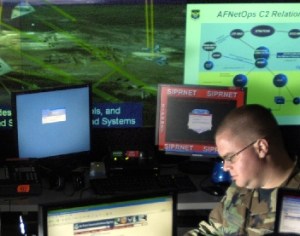
FACT: A heated online debate is erupting about a particular photo posted online, and the brouhaha around it focuses on whether or not classified details are contained therein, thus revealing them. 

ANALYSIS: Given that others are even now writing extensively about this photo and its controversy I thought I would add a couple of thoughts.  Don’t bother blaming me for linking to the photo, by the way; given the attention and reposting/rehosting it has already received, the glare of publicity can only serve to prod better security practices. 

I expect to see parody versions on Flickr soon, with “Area 51” touches.

And so to my related thoughts: recently, an active-duty USAF officer and regular reader emailed me about one of my posts concerning Rod Beckstrom and the new National Cyber Security Center, which he had not previously heard of.  He wrote that in discussing it with a colleague, the response was “I thought the Air Force Cyber Command already had the mission to coordinate all cyber security efforts.”

Continue reading