Stretching collaboration with Embodied Social Proxies

My wife and I are spending Christmas this year at home in Montross, and I’m sad that we’re not visiting with family in North Carolina or California.  But I’ve been looking at some new Microsoft research efforts on how to keep in touch with people in more natural ways, particularly valuable for teams working across geographic distances, which is how our Microsoft Institute works.

The question of how distributed teams can work collaboratively is only going to get more challenging, with out-sourcing and crowd-sourcing. Last week the Institute had a great visitor to our Reston digs: Tony Hey, Microsoft’s Corporate Vice President of External Research.  Tony’s bio on Wikipedia mentions his thirty years as a leading European academic (particle physics was his game), along with the excellent books he’s authored: Einstein’s Mirror, and Feynman and Computation.

Continue reading

Click on My Head and You’re Classified 2.0

Fact: According to the latest McKinsey Global Survey report, “Building the Web 2.0 Enterprise,” many companies find themselves actually changing organizationally, both internally and externally, as a result of adopting Web 2.0 tools and practices. 

Continue reading

“The Largest Social Network Ever Analyzed”

FACT: According to ComScore data cited in a story in Monday’s FInancial Times, “Facebook, the fast-growing social network, has taken a significant lead over MySpace in visitor numbers for the first time… Facebook attracted more than 123 million unique visitors in May, an increase of 162 per cent over the same period last year… That compared with 114.6 million unique visitors at MySpace, Facebook’s leading rival, whose traffic grew just 5 per cent during the same period… The findings mark the first time that Facebook, launched in 2004, has taken a significant lead in unique visitors, [and] come at a time of change inside Facebook, as the one-time upstart attempts to transform itself into a leading media company.

ANALYSIS:  This week several members of the Microsoft Institute met in Redmond with a visiting friend from government, and among other talks we had a very interesting discussion with Eric Horvitz, a Microsoft Research principal researcher and manager.  Eric’s well known for his work in artificial intelligence and currently serves as president of the Association for the Advancement of Artificial Intelligence (AAAI).

We talked about one of Eric’s recent projects for quite a while: “Planetary-Scale Views on a Large Instant-Messaging Network,” a project which has been described by his co-author as “the largest social network ever analyzed.” 

Continue reading

Web Security and New Media in Politics

FACT: The Obama presidential campaign has been lauded for innovative uses of the Web and social media, particularly for fundraising and volunteer recruitment.  But as PC World has just reported, “Two months after their Web site was hacked, the organizers of Barack Obama’s presidential campaign are looking for a network security expert to help lock down their Web site…. Security experts said this is the first time they can remember seeing a Web security job advertised for a political campaign.”

ANALYSIS:  I wrote before about my experience in 1994-95 helping build one of the Internet’s first political campaign websites – I designed the content and wrote much of it, for Mayor Frank Jordan of San Francisco.  (The pages were literally built and posted by mayoral son Thomas Jordan, by the way, who was then a college student at UC-Berkeley; he went on to great things at Pixar.)   At the time, with such a simple site, we didn’t have to worry much about security – or so we thought, and luckily the worst scandal in those early years involved domain-squatting by certain rival campaigns.

As PC World points out, though, “Obama’s Web site, built by Facebook cofounder Chris Hughes, has been the model of Web 2.0 campaigning, using social-networking techniques to raise funds and build a broad base of active, Internet-savvy supporters. But security experts have long warned that powerful Web site features also open new avenues for attack.”

Continue reading

Update on Facebook-in-Egypt

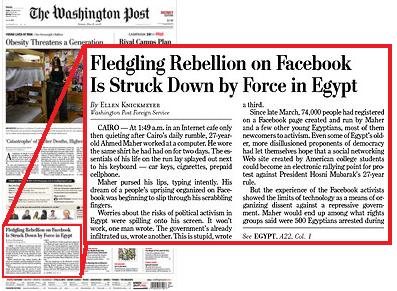
FACT: According to a Sunday Washington Post front-page story today recounting the events leading up to May 4, a “day of strike” called for by social-networkers as a protest against government policies, “By late afternoon, of the 74,000 people who had registered on the Facebook protest page, only 15 – three men and 12 women – were still eager to gather for a protest.”  [Note: the Facebook page had only been launched in late March.]

ANALYSIS: Last week I wrote about media coverage of Egypt’s Facebook affair, and noted that the Post and others had only covered it on media blogs, not in the actual newspaper.

This morning I picked up my Sunday-morning Post and saw the story, “Fledgling Rebellion on Facebook Is Struck Down by Force in Egypt,” right on the front page, which means that across Washington this morning, and other capital cities through clipping services, many in the foreign policy elite and punditocracy may be reading for the first time about the Web 2.0 facet of these events. 

Reporter Ellen Knickmeyer also posted today a related online “Field Notes” column about the challenges of covering the Facebook activists.

AddThis Social Bookmark Button 

Social Networking in Egypt Takes a Political Turn

FACT: In the past two days, reporters for the Los Angeles Times and the Washington Post have each written accounts of the ongoing confrontation in Egypt between the government and online activists – the “Facebook Revolution” as the Post reporter terms it, hyperbolically. One interesting aspect: the two accounts are not carried as actual news stories in the “newspaper” (real or virtual), but as blog posts by the reporters on dedicated foreign-correspondent blogs. The Washington Post account is on the “PostGlobal” uber-blogsite, under Jack Fairweather’s “Islam’s Advance” blog, while the L.A. Times account is on the “Babylon & Beyond” blog, which carries a sub-head of “Observations from Iraq, Iran, Israel, the Arab World and Beyond.”

ANALYSIS: Up to now there’s been little coverage in traditional American media outlets of the emerging political tenor of some social networks in Egypt over the past several months. Major newspapers and the cable-news channels have not explored the topic, but I just returned from some time in Egypt and I learned that of course it is a widely covered and discussed topic there.  One young woman in her 30s, an urban professional, told me “I’m on Facebook all day long!”

Every morning outside my hotel room I would find an English-language newspaper, and for many days in a row it was a different paper – often because they were weekly editions.  That gave me the opportunity to read a variety of opinions from a somewhat broad band, as measured in “distance to/from the government position.”  

Helpfully, on May 6 2008 the Egyptian Mail included a summary of the raging controversy over Facebook, noting that “In Egypt, Facebook is the stage for the latest twist in the generation gap, playing host to politically hungry young Egyptians eager to take on their ageing leader.”  Only at the end of the article did I notice that it was reprinted from a New-York-based Egyptian blogger, the respected Mona Eltahawwy.

Continue reading

Social (Network) Science

Fact: The social-networking site LinkedIn claims as users “17,000,000+ Professionals, 500,000+ Senior Executives, Executives from 498 Fortune 500 companies, [and] 65,000 new Professionals every week.”

Analysis: Since I hold the title of “chief technology officer” for my group at Microsoft, I regularly check the widely-read blog CTOvision, written by Bob Gourley, CTO of Crucial Point.

CollaborationlogosYesterday he posted a very solid summary of several social networking tools, including my preferred LinkedIn.  If you’re not up to speed on the genre it is a helpful cheatsheet and “buyer’s guide.”

The technology area deserves the attention. There are a dozen or more such sites for each that Gourley covers, and he chooses the ones that have shown growth and potential longevity; why invest any time adding personal data to a site just to watch it disappear? We’ve all had that happen. And yet hockey-stick growth has to be managed – LinkedIn for example has come in for some critical attention for some snafus along the way.

Let’s look at some efforts to understand more about the science behind the software….

Continue reading