Once you get past Filter Failure

How do intelligence analysts handle the long-discussed problem of information overload? (The same question goes for information workers and government data of any kind.)

Continue reading

Tellme what you want

The future of social computing is in the integration of various services and technologies – but the fun is already available now. Here’s a nifty demo of the integration of cloud computing’s services with increasingly powerful mobile computers (smartphones or netbooks). Developers can take advantage of far more computational power both locally on the device – faster, cheaper processors thanks to Moore’s Law – and computational power residing on networked data centers.  Think of a business or social activity, and thanks to platforms like the iPhone, Android, and the new Windows Phones, “There’s an app for that.” Or there soon will be.

This quick little demo feels like nothing fancy today – but ten, even five years ago it would have seemed like sci-fi. In fact it’s available now, and uses a new Windows Phone, in this case a Samsung Intrepid, making use of Tellme software from Microsoft integrated with Bing Search web services. The demo intregrates some longtime technologies in their state-of-the-art condition today using cloud-services delivery:

  • Speech-to-text
  • GPS-enabled location-based services
  • Web search
  • Voice-enabled dialing
  • Social media (crowdsourced ratings integrated in search results)
  • Hardware UI (a dedicated TellMe button on the Samsung Intrepid phone)

Share this post on Twitter

Email this post to a friend

AddThis Social Bookmark Button

The promise of mobile augmented reality

Robotvision appMy intention with this blog is always to write medium-length “think-pieces,” about technology, government, or preferably both. I’m working on several (the Jefferson Gov 2.0 piece, the Evil Twin 2.0 piece, and one on “whither the multilingual web”), but they do truly require thought and some free time, so they percolate a bit.

In the meantime, readers like the latest cool demo videos, so for Friday fun here’s another one (watch below or on youTube), which was featured on TechCrunch last night (“Bing comes to the iPhone via Robotvision”), with an augmented reality app for the iPhone which uses Bing Maps and Bing’s real-time data (website here). The company describes itself this way:

Continue reading

Fighting Social Ills with Social Media

This week I’m traveling in Mexico as part of a unique State Department delegation, bringing American social-media professionals together with Mexican public and private efforts working on building civic society. In particular, the trip is focused on bolstering civic participation efforts aimed at countering the enormous spike in narco-violence in Mexico, including the state of Chihuahua, whose capital Ciudad Juarez we visited on Monday and Tuesday.  I’m joined on the trip by colleagues from Facebook, Google, AT&T, MIT Media Lab, and several other leading social-media professionals. Continue reading

Navigating Indoors Without GPS

Here’s a nifty demo of a very small piece of software, that could find daily use for large numbers of people in any large enterprise, or any shopper in a mall – anywhere someone’s wandering in a large building or complex looking for a specific office, conference room, storefront, or location – especially indoors where GPS is of no use.

It’s called GoMap, and I think it could have great applicability for government complexes, which have lots of rabbit-warren hallways, lots of constantly-reassigned workers, and lots of visitors.

I missed GoMap’s first public unveiling today because I’m on the east coast this week, mostly for the Cybersecurity “Leap Ahead” conference in Arlington Virginia which wrapped up today; I will write about the conference separately.

But that meant I had to miss the bar-camp-style WinMoDevCamp today on the Microsoft campus in Redmond. There was a lot of buzz around this DevCamp, and there’ll be others in 6 more cities soon (Austin, London, New York, San Francisco, Singapore, and Toronto) as developers gear up for the upcoming release of the Windows Mobile 6.5 operating system.  You can get registration information about the future events at the main WinMoDevCamp site (props to Todd Bishop on his TechFlash blog for highlighting the series).

The GoMap prototype makes innovative location-aware use of Microsoft Tag and TagReader (the high-capacity color barcodes developed by Microsoft Research), to solve the problem of having no GPS capability indoors  – check out the short video.

WinMoDevCamp is an indication that there’s a real explosion of app development going on in the Windows Mobile world, to match the equally exciting iPhone app and Android app activity. There’s been a feeling in Microsoft that our best advantages are the large installed base through third-party WinMo phone manufacturers, plus Microsoft’s long experience nurturing app developers on other platforms (.Net as a good example).  But I personally think that superior innovation is going to be the battleground, and we’re well positioned for that as well, with a lot of exciting things emerging from Microsoft Research and different advanced development labs in product groups. GoMap’s one example.

Not sure of the timeline for GoMap, but you can use TagReader right now, without the GoMap piece. It’s a free download on the Tag webpage, or you can get it on any mobile phone (yes, even the exploding iPhone) at http://gettag.mobi.

Email this post to a friend

AddThis Social Bookmark Button

Microsoft and Google Look at the World Differently

I didn’t think I would have to write this same kind of observation twice within a year. But today, on D-Day, I notice yet again a striking difference between Google and Microsoft.  And in this case, one can almost read the evidence as a snub from Google to the United States, to the nations who united in sacrifice during World War II, and to President Obama on a day of his personal leadership in commemorating international war and peace.

I made a similar observation on Columbus Day, when Microsoft chose to honor Christopher Columbus and his explorations’ significance to American history and the world, while Google chose to honor – wait for it – Paddington Bear’s “birthday.” (See my post from then here.)

Today is of course D-Day, the 65th anniversary of a day in which over 2,000 American soldiers lost their lives, leading the way in the greatest military operation in the history of the world, as the initial landing to liberate Europe and the beginning of the end of the Nazi empire.

Google and Microsoft are two great American companies, which operate globally. Each has a public face to the world through signature online properties – their search engines. In Google’s case, that page at Google.com is their ne plus ultra public face, since they are at core a mighty search engine.

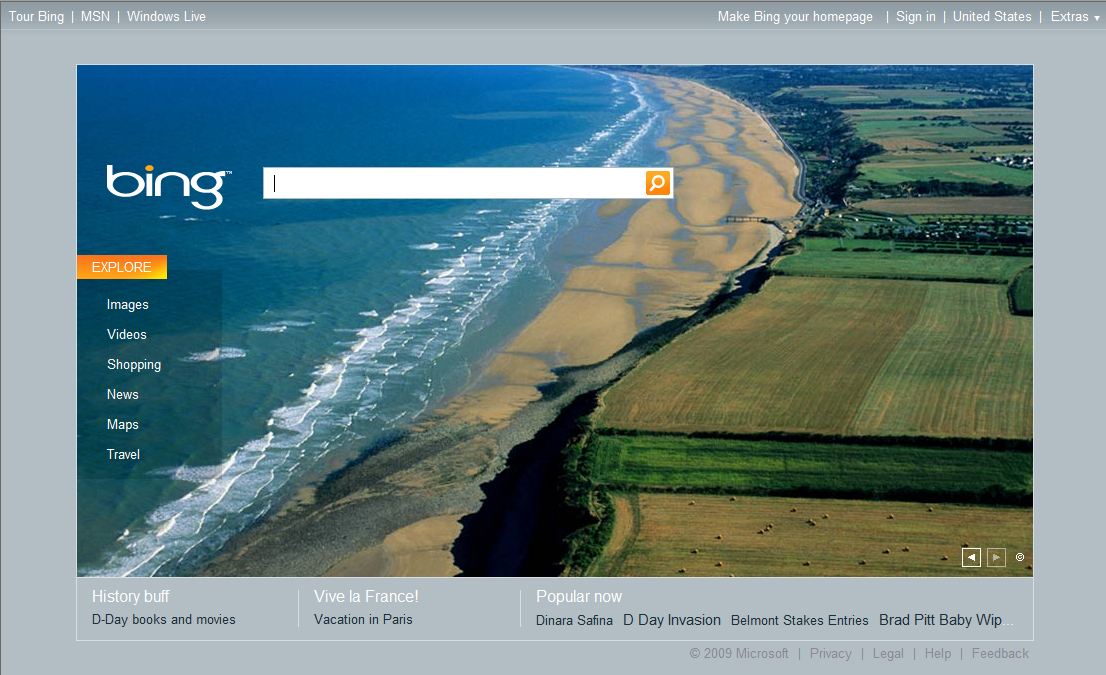
Take a look at the two pages today. Microsoft’s Bing search-engine uses its home page to commemorate D-Day, with a dramatic photograph of Normandy Beach today, and mouse-over popups providing historical highlights and links to more information on the battle’s signficance to World War II and to world history.
Bing D-Day

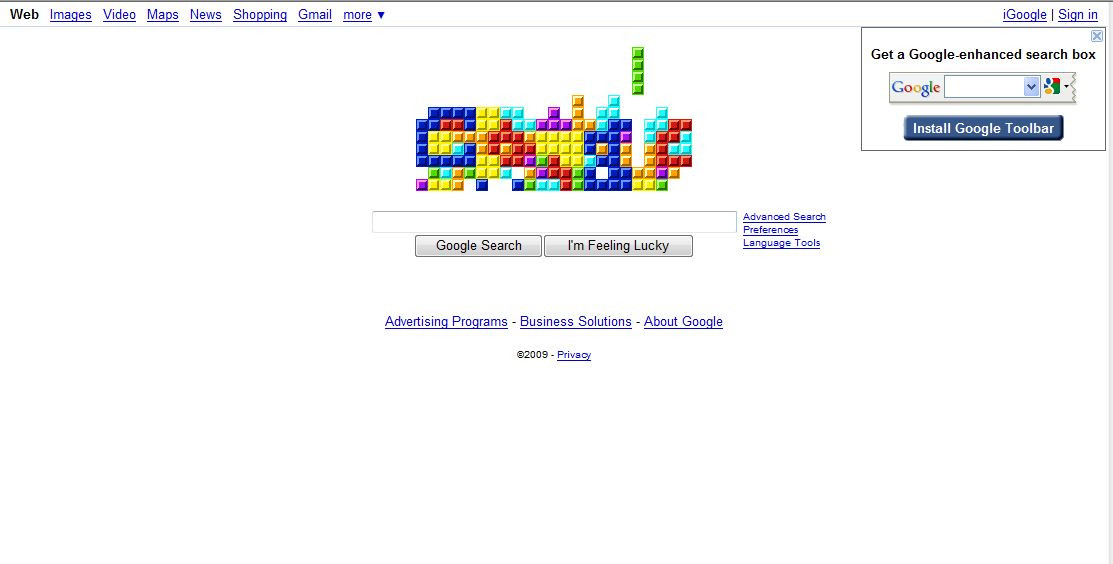
Google uses its home page to commemorate the 25th anniversary of the invention of the computer game Tetris.
Google Tetris

The mouse-over popup on the cutesy Google logo reads, “Celebrating 25 years of the Tetris effect – courtesy of Tetris LLC.”  (I suppose one could read that as, predictably, a coporate ad, right there on Google’s home page.)

Just as I noted on Columbus Day, this doesn’t appear to be a localization issue, or an issue of appealing to a global audience – both Microsoft and Google know my location, and in fact each is serving up a page targeted for me in the United States.

Don’t get me wrong: Tetris was an amusing and absorbing game. As a young guy I spent hours dropping the bars and shapes to fit into the rising pile below.

But at certain moments in life, you put aside childish things. Unless you’re trying to make some other kind of statement.

Note: I am a Microsoft employee. But this is not a Microsoft corporate blog, it’s my personal blog – and I’ve been known to tweak Microsoft here frequently as well.  This is my personal observation space.

I have to admit I am puzzled – and personally appalled – by the decision-making over at the Googleplex, and the statement they choose to send to the world.

President Obama is leading our delegation himself at Normandy Beach today, for the international event with other world leaders remembering a moment of global importance.  Self-evidently Eric Schmidt and the Google gang weren’t on board with that, and by their way of thinking saw something more significant to mark. 

Email this post to a friend


The Scientists Behind the Headline

Obama Promises Major Investment in Science” – AP News story (April 27, 2009)

“The bottom line is that if you’re a fan of new technologies being developed on US soil, you should be pretty damned excited.”Alex Koppelman, writing in Salon.com

President Obama announced today an effort to increase the nation’s investment in research and development spending for the sciences and new technologies.  As Alex Koppelman points out:

One particularly striking point to note about this: That level of funding [an increase to ‘more than three percent of GDP’] would almost meet the amount of money spent on defense. To some extent, that may simply represent a shift in where on the budget certain funds are accounted for, as defense spending has always been a key driver of American scientific research, but it’s still a sharp difference from the normal state of affairs.

I’ve written before (“How to Find Research“) about the need for increased R&D spending, and about the role of the White House Office of Science & Technology Policy in its main role: advising the President and others within the Executive Office of the President on the impacts of science and technology on domestic and international affairs.

OSTP does the hard work – but it is guided in part by the President’s Council of Advisors on Science and Technology, or PCAST.  This group can be a quiet backwater – as it has been on and off for years – or it has the potential to be a dynamic leading voice in advising the Administration on S&T policies, particularly in investments in scientific research and tech innovation.

It looks like we’re on the dynamic upswing, given that President Obama also used today’s high-profile announcement to name his appointments to an all-new PCAST. 

Continue reading

Three cool new projects in Microsoft Research

[April Fool’s Edition]   I haven’t blogged in a little while – been a little busy – so I’ll make up for it with a burst of three cool new things coming out of the inventive lab work at Microsoft Research – improving Twitter, computer performance, and mobile phones.

MegaNano: New High-End Camera for Cellphones

Many people are dissatisfied with the fuzzy quality of photos taken with their built-in cellphone cameras. So Microsoft will be rolling out this summer the most advanced built-in mobile phone-cam on the market, based on a fantastic prototype now in final user testing at Microsoft Research’s Beijing lab.

MegaNanoDubbed the “MegaNano,” the sylish but diminutive camera boasts 72 megapixel resolution and a shutter-speed setting range from 0.003 seconds all the way up to seven hours.

The itty-bitty MegaNano will be launched simultaneously with the new Microsoft Mobile Apps Store, bundled with a nice selection of jackets and outerware with specially reinforced pouch-pockets and backpacks designed to hold the tiny device. 

I know you’ll want one. One beta-tester says, “It’s so small yet so powerful!  I have to remind myself sometimes that the weight on my shoulders is actually a tiny camera!”

Continue reading

Year of Data brings together Apple iPhone, Microsoft Surface, Google Android


Neat video below (Stimulant’s “XRay” project), but first, why I think it’s neat:

Every year is the year of data, I believe.

Continue reading

Elbowing for Obama influence between new CTO, new cyber czar

Today’s Friday – usually a big news day in Washington, whether by design (bury bad news late in a deep weekend news hole) or by human error (bureaucrats tried all week to get something done and slipped it in at the deadline).  There should be Obama cabinet announcements today, and meanwhile tech luminaries across the country are sitting by their phones, drumming their fingers and hoping for a call offering them the position of the nation’s first Chief Technology Officer. Norm Lorentz, who was OMB’s first-ever CTO, told C-SPAN this week that “If I were asked, I would serve in a heartbeat.”

Continue reading