Innovation in Robotics: Government Uses?

Fact: Last week’s Automatica 2008, the big international robotics and automation trade-show, had “over 30,000 trade visitors from around 90 countries,” visiting 900 exhibitors’ booths, according to the conference wrap-up

Analysis: When I spoke recently at an IARPA conference in Orlando, and was asked to give a glimpse into Microsoft’s vision of R&D trends, one of the possibly surprising areas I highlighted was robotics.  We’re making a major push in that area, for reasons that might not be intuitive based on an old-fashioned impression of what Microsoft offers in the government realm.  More on the intelligence community’s potential use below.

Continue reading

“The Largest Social Network Ever Analyzed”

FACT: According to ComScore data cited in a story in Monday’s FInancial Times, “Facebook, the fast-growing social network, has taken a significant lead over MySpace in visitor numbers for the first time… Facebook attracted more than 123 million unique visitors in May, an increase of 162 per cent over the same period last year… That compared with 114.6 million unique visitors at MySpace, Facebook’s leading rival, whose traffic grew just 5 per cent during the same period… The findings mark the first time that Facebook, launched in 2004, has taken a significant lead in unique visitors, [and] come at a time of change inside Facebook, as the one-time upstart attempts to transform itself into a leading media company.

ANALYSIS:  This week several members of the Microsoft Institute met in Redmond with a visiting friend from government, and among other talks we had a very interesting discussion with Eric Horvitz, a Microsoft Research principal researcher and manager.  Eric’s well known for his work in artificial intelligence and currently serves as president of the Association for the Advancement of Artificial Intelligence (AAAI).

We talked about one of Eric’s recent projects for quite a while: “Planetary-Scale Views on a Large Instant-Messaging Network,” a project which has been described by his co-author as “the largest social network ever analyzed.” 

Continue reading

EU says, Costs of Open Source Outweigh the Benefits?

FACT: According to a Reuters story today, “The European Commission, a thorn in Microsoft’s side for its antitrust campaigns against the software giant, is falling short in its own internal attempt to promote more competition in the technology sector. The European Union executive has so far not followed its own policy that it purchase office software and operating systems with open standards as well as Microsoft products.”

(c) European CommunityIn the money quote, according to the Reuters story, the EU’s director of IT solutions “said in an interview arranged by a spokeswoman for Commissioner Siim Kallas, who oversees procurement, that studies showed the costs of moving to open source outweighed the benefits.” 

  Continue reading

How to Find Research: Here, There, Everywhere

FACT: The Washington Post today has a story in the Business section (“Intelligence Agency Joins U-Md. Research Center“) about the relationship between IARPA and the University of Maryland, the location of the planned new IARPA headquarters. 

ANALYSIS: UMd has a set of valuable relationships with the public- and private-sector national security community, and the IARPA startup is just the latest agency to benefit.   Proximity is key, for research and bureaucracy.  In Maryland’s case, IARPA Director Lisa Porter told an IEEE interviewer last month that “It’s nice not to be sitting right next to one particular agency. It’s also nice to be near a university because we’re sending a message that we want to bring in nontraditional partners: academia, industry. It sends a nice message that we’re embracing the broad community to help us solve these challenging problems.”

I lament sometimes that Charlottesville (home to my undergraduate alma mater) is a good two hours away from DC, as even that distance puts a frustrating limit on the amount of joint work that winds up being done with Virginia faculty and students. 

Continue reading

Best Joke by a Supreme Court Justice

FACT: Chief Justice John Roberts said in a speech on Friday that he will increase the number of cases heard by the Supreme Court from two a day to three during the coming term beginning in October, according to an AP account of his speech. Roberts says that if the busier fall schedule lightens the caseload by next spring, he may be able to cut back then. 

ANALYSIS: When Roberts became Chief Justice in 2005, some Court observers wondered whether the younger Chief would begin burdening his colleagues with more work, increasing the Court’s caseload by granting more cases.  Now it looks like he may attack the issue in a slightly different way, hoping to cut a swath through the caseload issue with a burst of activity but not necessarily more cases overall.

Friday, the affable Roberts pointed out that the increase to three arguments each court day might put a strain on the Solicitor General’s Office, since it saddles the burden of arguing the federal government’s side in most of the cases.  But Roberts also pointed out that it’ll mean more work for the journalists who cover the Court – a small but tenacious crowd who like to pass judgment on the Court and its performance regularly.  Roberts then joked: “After careful reflection, I decided I didn’t care.”

Continue reading

Pentagon’s New Program for Innovation, in Context

FACT: According to an article in today’s Washington Post, the Pentagon has announced “the selection of six university professors who will form the first class of the National Security Science and Engineering Faculty Fellows Program. The professors will receive grants of up to $600,000 per year for up to five years to engage in basic research — essentially a bet by the Pentagon that they will make a discovery that proves vital to maintaining the superiority of the U.S. military.”

ANALYSIS: This new program is an innovation from DoD’s Director of Defense Research and Engineering (DDR&E), and since tomorrow I’ll be at Ft. McNair for a two-day conference sponsored by DDR&E on Strategic Communications, I’ll congratulate John Young and his staff for the good idea.

But the Post article falls short in two ways: one immediate (it leaves out key information about next year’s program and the upcoming deadline!) and one longer-term (it ignores the overall context of federal support for R&D).  I’ll fill in the blanks below.

Continue reading

How to Run a State-of-the-Art Technology Program – Quietly

FACT: In the new movie “Iron Man,” defense-contracting billionaire and engineering genius Tony Stark (played by Robert Downey Jr.) designs and builds a suit capable of individual flight (highly engineered control surfaces powered by an “arc-reactor” – it is Hollywood after all). During his first test flight, zooming straight up from Malibu and stressing the system to its max, he asks his onboard computer, “What’s the altitude record for the SR-71?” His computer responds back, “85,000 feet,” whereupon he zooms past that ceiling.

ANALYSIS: Funny moment, and excellent movie.  In its honor, below I’m going to give you access to a remarkable, recently declassified document describing one of America’s boldest Cold War technical achievements.  If you’ve ever run (or wanted to run) a high-tech company or program, like Tony Stark in the movie, you’ll appreciate the startling scope of the work – and if you’ve recently worked in DoD or the Intelligence Community you’ll marvel at how they did it “in the good old days.”

Continue reading

Is It Even Possible to Connect the Dots?

FACT: Among the inspired ideas of polymath Danny Hillis (pioneer of parallel computing) was establishing the Long Now Foundation, whose projects include the millennial Long-Now Clock (“the world’s slowest computer”) and the notion of “Long Bets.”  A Long Bet is an “accountable prediction,” meaning one that has a specified end-date and a testable, wagerable, proposition.  One of the early Long Bets posted wagers $2,000 that “By 2020, no one will have won a Nobel Prize for work on superstring theory, membrane theory, or some other unified theory describing all the forces of nature.”  That particular bet is one of many signs of scientific skepticism about string theory.

ANALYSIS: Even without the ease of hyperlinks, old-fashioned newspapers foster serendipitous connections between articles, particularly if you’re reading a Sunday morning paper with lots of sections. Sunday the Washington Post did me a service by placing in different sections a couple of articles which I connected, about intelligence “failures” and about stock-market prediction, leading me to some web-surfing about the questionable validity of string theory and some related observations about the difficulty of predicting human behavior.

In the Outlook section, the Post has an opinionated and thought-provoking op-ed piece by Mark Lowenthal, one of the most “intelligent” individuals in the recent history of the U.S. intelligence community (after all, he was the 1988 Jeopardy grand champion, as well as a former assistant director of CIA).

Continue reading

Required Reading on Innovation and Patents

FACT:  If you’re a fan of Malcolm Gladwell’s tremendous books (“The Tipping Point” and “Blink“), then you probably read the New Yorker magazine just to get his articles.  He has a new piece this week, “In the Air: Who Says Big Ideas are Rare?” in which he describes the phenomenally appealing work of the legendary Nathan Myhrvold and his current gig running “Intellectual Ventures,” often mistaken for a VC firm.  Gladwell recounts the facts that Myhrvold “graduated from high school at fourteen. He started Microsoft’s research division, leaving, in 1999, with hundreds of millions.”  It is what he’s done since then that grabs the mind, particularly if you’re interested in invention and innovation:

Continue reading

Update on Facebook-in-Egypt

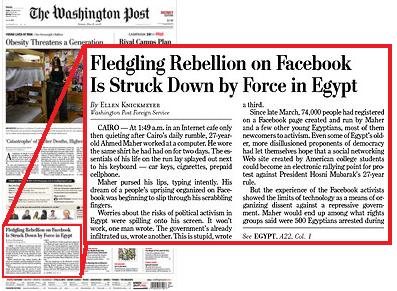
FACT: According to a Sunday Washington Post front-page story today recounting the events leading up to May 4, a “day of strike” called for by social-networkers as a protest against government policies, “By late afternoon, of the 74,000 people who had registered on the Facebook protest page, only 15 – three men and 12 women – were still eager to gather for a protest.”  [Note: the Facebook page had only been launched in late March.]

ANALYSIS: Last week I wrote about media coverage of Egypt’s Facebook affair, and noted that the Post and others had only covered it on media blogs, not in the actual newspaper.

This morning I picked up my Sunday-morning Post and saw the story, “Fledgling Rebellion on Facebook Is Struck Down by Force in Egypt,” right on the front page, which means that across Washington this morning, and other capital cities through clipping services, many in the foreign policy elite and punditocracy may be reading for the first time about the Web 2.0 facet of these events. 

Reporter Ellen Knickmeyer also posted today a related online “Field Notes” column about the challenges of covering the Facebook activists.

AddThis Social Bookmark Button