Massive Data Centers, Right in your Cellphone

I try to keep my cellphone on “vibrate” during meetings; no one needs to know my taste in ringtones. But more importantly, I keep it on so that I can use the browser and web search ability, which I wind up doing almost as often as I check my email.

Yesterday was a good example of the utility of ever-handy web search. My group and I had brought together an international group of government officials to visit Microsoft Research’s annual TechFest.  Tuesday was the “Public Day” with the media and outsiders allowed, so we spent that day at the Microsoft Convention Center with Craig Mundie, Rick Rashid, and a hundred others, but Wednesday morning we offered a series of side briefings for the group at Microsoft’s Executive Briefing Center, on topics of interest to large government and defense agencies.  Topic one was data centers.

Continue reading

TechFest and its Value

I am spending much of the week at Microsoft Research’s annual TechFest, which is proving to be an absolutely mind-blowing experience.  So much, so cool, so out there….

There’s been some good press about the show already (ComputerWorld, and ITWorld for example), and the official Microsoft TechFest site has a wealth of material.  The media were allowed in on the “Public Day” to report on a carefully selected subset of the projects being displayed. But I think the coverage has missed an important difference between this show and something like COMDEX or CeBIT.

Continue reading

Manferdelli Had a Salad, I Had Meatloaf

I had a very pleasant lunch today in Reston with John Manferdelli, one of the engineering legends with whom I’m privileged to work at Microsoft.  (Check out this list, kind of my own corporate “bucket list” of people to meet and listen to).

John arrived in DC a couple of days ago; unlike mere mortals, he decided to spend a weekend day off visiting the University of Maryland Engineering  Library in the Math Building, and told me he’d found a fascinating book on random numbers….

Continue reading

Silverlight 2.0: It’s “1 better than 1.0”

Last week I was visiting an intelligence community facility which has been known for several years for housing some of the brightest and most innovative adopters of Web 2.0 approaches for classified systems. I could say who and where, but then I’d have to… well, not kill anyone, just apologize to all my other friends at other agencies who think they’re the cat’s meow on classified Web 2.0. (With any luck this anonymity now makes each of them think, “Wait, who’s more advanced than we are?  How can we catch up??!”)Well, it turns out they’re excited about something new & cool they would like to use.

Continue reading

Mashup Markoff

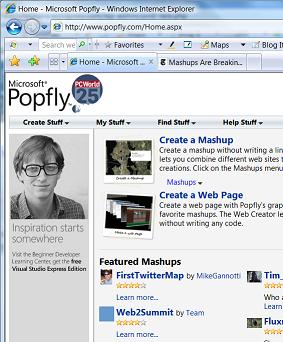
popfly.jpgJohn Markoff has a great story (that phrase belongs on a cut-n-paste clipboard) in today’s NY Times about PopFly, one of my favorite new Microsoft programs because it is so darned fun, and easy, and flexible – and potentially revolutionary.

I’m both a friend and fan of Markoff, but read his piece and you’ll see what I mean, as the examples he cites are pretty cool – or jump to the site itself.

PopFly is getting a lot of attention and coverage, landing on PCWorld’s list in December of “25 Most Innovative Products of the Year.”

Continue reading

Another Microsoft key hire

Fact: In 2007, Walt Disney shot up the ranks in two separate “Most Innovative Companies” lists. On Business Week’s annual list of “The World’s 50 Most Innovative Companies,” Disney zoomed from #43 in 2006, to #8.  Similarly, “The WIRED 40,” WIRED Magazine’s “tenth annual list of the most innovative companies in the world,” saw Disney come from nowhere – not even on the list in 2006 – to rank at #29.  

Analysis: Microsoft again made both lists, including a stellar #5 in Business Week, but rivals Apple and Google held down the top two spots on each list (trading positions).  Not to rest on its laurels, and to gain leverage against such innovative engines, Microsoft today announced it has lured away Disney’s CIO Tony Scott to come to Redmond and bring some of the Mouse’s magic way of supporting innovative spark with a robust and cutting-edge internal IT environment.

Continue reading

IARPA’s First Director: Dr. Lisa Porter

Fact: IARPA has a new Director.

Analysis: The well-known DARPA (part of DoD) will now at last have a full-fledged intelligence-community counterpart. The Intelligence Advanced Research Projects Activity – prosaically called “IARPA” – was created last year, but has been stepping out slowly because [/opinion on] of lack of leadership [/opinion off], with only “interim” place-holder leaders.  Many of my friends who were recruited or absorbed into IARPA at the beginning, as it swallowed the old Disruptive Technologies Office for example, felt that the new org was spinning its wheels without traction, for lack of a strong and stable hand at the helm.  [Note also this recent post on IARPA.]

Today the Director of National Intelligence named Dr. Lisa Porter as IARPA’s first Director. She’s been at NASA, and before that DARPA itself.  She and I were at Stanford at around the same time, although hanging in different crowds – she working on her doctorate in Applied Physics while I was over doing the real heavy lifting in the hardest of all sciences, Political Science 🙂  

I’ve never met her, unless I don’t recall from old DARPA visits, so I did a tiny bit of surfing to clip a few salient tidbits from her DARPA work.

Continue reading

A-Space: Top-secret social networking

Fact: As reported in InformationWeek recently, “In December, the DNI will launch A-Space, a portal that will eventually include everything from wikis, blogs, and social networking; built using SOA.”

Analysis: Our team at DIA got assigned by the Director of National Intelligence (DNI) to design and build A-Space, a brand new social-networking environment for the full intelligence community – “the MySpace for spies.” We’re talking a very high-walled Walled Garden.

I had to devote (not to say divert) some of our most talented people leading the all-important Alien program to this new effort, which really only began in September. Phase I of A-Space must go live by the end of the year; Phase II (with more advanced Web 2.0 capabilities) just a few months later.

Continue reading

VC-like Beauty Contests for Government

Fact: In Mumbai, according to a Wall Street Journal/Hindustan Times Livemint report, “Thirty start-ups have made it to the business plan showcase at TiE-ISB Connect 2007, which closed submissions on 30 September. The annual networking event for entrepreneurs organized by The Indus Entrepreneurs (TiE) along with the Indian School of Business, Hyderabad, will be held from 14-16 November. TiE received close to 400 entries this year….”

Analysis: The Bubble Redux has brought with it a resurgence in business-plan competitions, typically with a panel of venture capitalists as judges. Now along comes YouBeTheVC.com, launched by Mark Modzelewski of Bang Ventures in Cambridge, Mass, who says the competition combines “venture capital and ‘American Idol’ with a little bit of wisdom of the crowd thrown in.” And, believe it or not, he’s got Curt Schilling (yes, of the Red Sox) as a judge – along with web-based voters.

That idea may only surface new contenders for Henry Blodget’s “Bonehead VC Pitch of the Month,” but I’m considering starting a new competition, a beauty-contest to find the best business-plan beauty-contests.

Continue reading

Moving money to the left

Fact: “[Microsoft’s internal] IT organization now spends almost 45% of its budget on new product development, as opposed to maintenance and ongoing support, a notable improvement from 30% in the past.” [source]

Analysis: An increasing challenge for our enterprise IT organization at DIA has been optimizing our performance to the point where we can take money out of operations & maintenance (O&M), and invest it instead in innovation. Why? The intelligence business demands change, reformation, and dramatically improved capabilities. Intelligence isn’t alone; at Gartner’s annual Symposium last December, “driving Innovation” was promoted as an absolute business imperative, and infrastructure consolidation and optimization was billed as a primary enabler to disinvest in tired old-school technology, allowing re-prioritization in innovative approaches.

It all comes down to moving money to the left, earlier in the enterprise IT life-cycle.

Continue reading