WIRED Cracks Cyber-Battle Code

Just a quick note between conflicting conference sessions in different locations around the DC Beltway, to note that WIRED’s premier national-security blogger Noah Schactman may have just cracked the code – or at least “a” code – on where the ongoing dispute over “control of cyber” is heading in national security circles, in his latest DangerRoom post (“Air Force Cyber Command Could Return, with Nukes“).

The dispute has been reported lightly, in places like the NextGov blog (“The Cyber Command Power Play?”), and usually boils down to a perceived battle between the U.S. Air Force and the nation’s Intelligence Community, over control of the increasingly central issue of cyber offense and cyber defense.

Continue reading

When Intelligence Officers Get Social…

Today (and on-and-off this week) I’m attending the Intelligence Community’s “Enterprise 2.0: WIRE and ICES Conference,” up at the Kossiakoff Center at JHU/APL in Maryland, with its focus this year on social software and social networking – not the same thing, of course.

Acronym explanation, with some new ones tossed in:

  • WIRE = CIA’s World Intelligence Review, a very nifty Web 2.0-style classified news site now available on JWICS and SIPRNET.
  • ICES = Intelligence Community’s Enterprise Services group. 
  • And of course, JHU/APL = Johns Hopkins University’s Applied Physics Lab.

Continue reading

Click on My Head and You’re Classified 2.0

Fact: According to the latest McKinsey Global Survey report, “Building the Web 2.0 Enterprise,” many companies find themselves actually changing organizationally, both internally and externally, as a result of adopting Web 2.0 tools and practices. 

Continue reading

CIA 2.0: The Agency’s CIO and Change

Fact: CIO magazine is running a big story on the CIA’s Chief Information Officer Al Tarasiuk and his IT operation, and their online site is breaking it up into a four-part series running this week.  Below I analyze the series.

Analysis: By the halfway mark in the series, the magazine’s reporter Thomas Wailgum had only accomplished a fairly rote recounting of what CIA is, what its CIO does, and how both those factors have changed since the good ol’ spy days amid the challenges of a post-9/11 world.

Part Onedescribed “a business-IT alignment project like few others,” although it mainly served to introduce CIO magazine’s broad readership to the unfamiliar world of a walled-off intelligence agency, waxing on about the hyper-security at Langley.  Part Two similarly was background on the bureaucratic culture of the agency and its relegation of IT to backwater status – until 9/11 came along.

Continue reading

Birth of Cool (Cuil) – History Repeating Itself?

Fact: Cuil reaped the whirlwind of the media buzz it craved today.  As CNET put it, “Google challenger Cuil launched last night in a blaze of glory. And it went down in a ball of flames. Immediately after launch, the criticism started to pile on: results were incomplete, weird, and missing.”

Analysis:  For several months I’ve had running an RSS feed along the right-hand side of the ol’ blogspace here, entitled “Who’s Talking about ‘the next Google.'”  Ha ha – the RSS feed pulls from a Google News query.

Well, if you judge by the echo chamber hungry for positive tech news amid a down market, you might think “the next Google” has emerged: the birth of Cuil.  (Extra credit if you’re a Miles Davis jazz fan, by the way.)  I may retire the crown, or at least the RSS feed.  Here’s some of the global attention:

Continue reading

Three Key Promotions in U.S. Intelligence

In the old days of Kremlinology, our side’s “Soviet analysts” (I was one as a kid, back in 1985-86) would pore over personnel lists and announcements of Politburo or Central Committee appointments, seeking clues to the direction of Party doctrine and intent. Military personnel promotions and reassignments were also studied closely to divine any insight into Soviet military policy.

There’s not a direct analogy to American military leadership promotions, but those lists are also studied intently, by peers and colleagues within the military branches, and also by experts throughout defense industry circles who can often decode Pentagon politics by watching who gets an extra star and who gets passed over.

Friday the U.S. Senate confirmed several key Army promotions, including three which I consider to be the most critical military intelligence positions in the nation. 

Continue reading

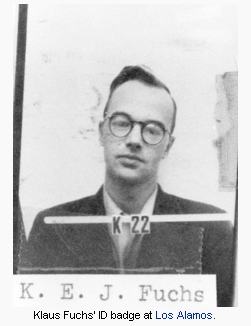
Theory of the Fireball, Supercomputing, and other Los Alamos Tidbits

Back in the early ’90s when I was first dating Kathryn, now the lovely bride, we went on some awesome roadtrips, including many cross-country – great way to get to know someone.  At the time my brother was an Air Force pilot, flying the F-117 stealth fighter, so we once paid him a visit at Holloman AFB on a 10-day drive through the Southwest.  I’ll have to find and upload to Flickr the pictures he took of each of us sitting in its classified cockpit – surely a massive security violation which I lay entirely at his feet (lucky for him he’s retired from the Air Force now and flying for Delta). 

Sadly, the F-117 Night Hawk has also now been officially retired, replaced by the F-22 Raptor.

As much as that was a thrill, though, the highlight of that particular roadtrip was driving up to the Los Alamos plateau and spending some time touring around the Lab, the Museum, and the interesting little town that’s grown up around all that PhD talent in the middle of the high desert.

That lab’s on my mind because I’ve been thinking about supercomputing and the revolution it could undergo thanks to quantum computing. I’m in Santa Barbara visiting the “Station Q” research program in quantum computing, and will write more about quantum computing soon, since I’m actually beginning to understand it.

But as an interesting artifact in my preparatory reading, Microsoft’s John Manferdelli sent me a link to a Federation of Atomic Scientists archive of declassified Los Alamos National Lab technical reports and publications, from “the good old days” at Los Alamos.

Continue reading

Research and Intelligence … Research for Intelligence

I’ll be at Penn State University for the next couple of days, at the Research in American conference.  This particular conference, with the theme “Connecting Technology Thought Leaders with Government Officials,” is sponsored by the Office of the Director of National Intelligence, focusing on their Science and Technology area. 

Here’s the agenda for the conference, which has an excellent lineup of technologists presenting their approaches and progress. 

ODNI turned to the Intelligence and National Security Alliance (INSA) to host and run the conference.  Someone, somewhere in the chain, slipped up and invited me as the Keynote speaker for Tuesday – I’m planning to do the thing with no slides and to speak (in part) about the emerging possibilities of revolutionary research in a post Web 2.0 world.

For some sobering background information,  check out a recent tour of the research-funding horizon by Amy Ellis Nutt in the New Jersey Star-Ledger (“As research funds stagnate, science in state of crisis“).  Here’s a taste:

Once the world’s gold standard, American scientific enterprise is in free fall. Short of government funds and strapped for cash, researchers across the country are abandoning promising avenues of scientific investigation and, increasingly, the profession of science itself.” – Amy Ellis Nutt, The Star-Ledger

Do you share that pessimism?  Think it’s overstated?

I’ll give an update about the conference tomorrow.

Email this post to a friend

AddThis Social Bookmark Button

Test for Prediction Markets: They Say Obama, but Polls Say It’s Tied

Fact: According to the latest Rasmussen poll released Saturday July 12, and promptly headlined by the Drudge Report, “The race for the White House is tied. The Rasmussen Reports daily Presidential Tracking Poll for Saturday shows Barack Obama and John McCain each attract 43% of the vote.” Newsweek is reporting a similar result in its own poll, with Obama moving down and McCain up (“Obama, McCain in Statistical Dead Heat“), and other polls increasingly show a similarly close race.

Analysis: I’ve been tracking the growing divide between two quite different methods purporting to offer statistical predictive analysis for the November presidential election. Polls are saying one thing, but Prediction Markets are saying another. 

Continue reading

A-SpaceX, Google, and Virtual Tuesday

Yesterday I had a “virtual world vibe” going.  At 5:30 a.m. when my dog Jack woke me up offering to take me for a walk, the first thing I noticed on my mobile was a series of tweets from Chris Rasmussen, NGA’s social software guru, posted the night before.  Twitter is interesting for a lot of reasons, but one is the ability to snatch asynchronous stream-of-consciousness statements, from strangers and friends alike, as they pass by in the microblogosphere conversation.

Chris went on a tear about Second Life, with several hilarious observations and comments within the space of an hour, so here are several from his public Twitter feed:

Continue reading