If Google Executives were Presidential Candidates…

Sometimes tech executives skate away with hubris (look up Larry Ellison), but more often they run the risk of their words coming back to haunt them. 

Just a little example this week – what a difference a day makes, from Tuesday to Wednesday. I’m sympathetic to politicians and executives who put their words on the line in public, opening themselves to the hazard of after-the-fact Monday morning quarterbacks.   But this is an interesting case with lessons for cloud computing…

Dateline: Tuesday August 5

Dave Girouard, president of Google’s Enterprise unit, was energetically promoting Google Apps at the Pacific Crest Technology Leadership Forum, quoted by TechCrunch and PC Retail Mag: Continue reading

How to Keep Up with the Semantic Space

Fact: Reshma Sohoni, chief executive of Seedcamp (the VC accelerator focusing on European tech startups) said in an interview this week that “In the past few months, we’ve seen a lot more developments around the semantic web,” and talked about the coming value of semantic web services.  

Analysis:  There’s never-ending buzz about the semantic space. Just this week John Conroy writing at the Content Matters blog had a long and interesting piece examining “three ingredients needed to enable and popularize the semantic Web,” with the aim of answering “if we really are on the cusp of a content revolution.”

Also, I admit it, I can’t stop playing with the semantic-space startups, whether it’s Sensebot or the newly launched Evri, or Powerset (just acquired by Microsoft, as I wrote about previously).

Continue reading

IPsec, IPv6, and Security at Your House

Just had a great meeting in Redmond introducing some government friends to Steve Riley, one of Microsoft’s “technical evangelists” on security – network, app, data security and most of all, IP security.  He’s great at the big-picture integrated view of security, including physical security right up through the IP stack – here’s a video of a recent talk he gave at Microsoft’s TechNet called “The Fortified Data Center in Your Future.”

Check out his blog and you’ll see the kind of topics he works on; just one example of obvious value is a recent post full of real-world down-to-earth security advice for securing your environment at home (home networking, email use, internet browsing, etc for family and friends).

Oh, he’s also been on Twitter for almost a month now, where he mixes interesting finds on security news with offbeat political commentary 🙂  Yet another example of some of the bright people I meet back at the mothership in Redmond….

Email this post to a friend

AddThis Social Bookmark Button

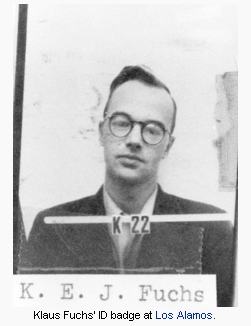
Theory of the Fireball, Supercomputing, and other Los Alamos Tidbits

Back in the early ’90s when I was first dating Kathryn, now the lovely bride, we went on some awesome roadtrips, including many cross-country – great way to get to know someone.  At the time my brother was an Air Force pilot, flying the F-117 stealth fighter, so we once paid him a visit at Holloman AFB on a 10-day drive through the Southwest.  I’ll have to find and upload to Flickr the pictures he took of each of us sitting in its classified cockpit – surely a massive security violation which I lay entirely at his feet (lucky for him he’s retired from the Air Force now and flying for Delta). 

Sadly, the F-117 Night Hawk has also now been officially retired, replaced by the F-22 Raptor.

As much as that was a thrill, though, the highlight of that particular roadtrip was driving up to the Los Alamos plateau and spending some time touring around the Lab, the Museum, and the interesting little town that’s grown up around all that PhD talent in the middle of the high desert.

That lab’s on my mind because I’ve been thinking about supercomputing and the revolution it could undergo thanks to quantum computing. I’m in Santa Barbara visiting the “Station Q” research program in quantum computing, and will write more about quantum computing soon, since I’m actually beginning to understand it.

But as an interesting artifact in my preparatory reading, Microsoft’s John Manferdelli sent me a link to a Federation of Atomic Scientists archive of declassified Los Alamos National Lab technical reports and publications, from “the good old days” at Los Alamos.

Continue reading

The “Rush to the Cloud” – Not So Fast…

Had a great time on Wednesday on a panel at the “Defense 2.0” conference, at the Arlington Ritz-Carlton.  I believe I learned as much from my fellow panelists from Cisco, IBM and so forth – about the importance of information security and assurance – as any conference in recent memory.  The story in Government Computer News (“Defense 2.0 a Work in Progress“) captures the views of most of the speakers. 

I had a gentle and gentlemanly disagreement with the keynote speaker, Mike Nelson.  Mike has a distinguished career, working with Internet-inventor Al Gore while he was VP, and later Director of Internet Technology and Strategy at IBM.  I offered that he was perhaps slightly overly enamored of the “rush to the Cloud” school of thinking.  I’ve written about that school of thought before, and the balance of where computing power is likely to reside in future, given Moore’s Law for the foreseeable future.  The GCN quotes capture my thinking in short form: there’ll be the cloud, along with increasingly powerful computing in local form factors (some desktops, more laptops, handhelds, mobiles, and embedded-computing forms of all sorts).

Continue reading

A-SpaceX, Google, and Virtual Tuesday

Yesterday I had a “virtual world vibe” going.  At 5:30 a.m. when my dog Jack woke me up offering to take me for a walk, the first thing I noticed on my mobile was a series of tweets from Chris Rasmussen, NGA’s social software guru, posted the night before.  Twitter is interesting for a lot of reasons, but one is the ability to snatch asynchronous stream-of-consciousness statements, from strangers and friends alike, as they pass by in the microblogosphere conversation.

Chris went on a tear about Second Life, with several hilarious observations and comments within the space of an hour, so here are several from his public Twitter feed:

Continue reading

Semantic Reality (Microsoft Acquires Powerset)

Fact: At last, the public announcement this afternoon of one of the most-rumored secrets in tech: Microsoft is acquiring Powerset, taking us one major step forward in semantic technologies. 

Analysis: There’ll be plenty of analysts looking at this, and I expect the acquisition will get a lot of buzz just as Powerset did originally when launched.  After all, Microsoft is buying a company which was called a “Google-Killer” by everyone from the New York Times to various esoteric search-technology blogs.  [Update: it’s already started on TechCrunch.]

If you haven’t used Powerset’s first announced product, semantic searching of Wikipedia, check it out on their site and you’ll begin to see why there’s been so much interest in their technical approach. I’ve known founder Barney Pell for a while now, and we’ve mused about the possibilities of adding Powerset’s strengths to Microsoft’s global scale.  The more I played with PowerLabs, before its full launch, the more I was convinced of its power.

When I was working at DIA, one of our dreams was a semantically enabled intelligence enterprise. IC analysts and advanced users within any other enterprise vertical are going to find some very interesting capabilities finally possible when Powerset technology is wedded to the FAST search software already being deployed at web scale. But that’s only the beginning.  Continue reading

How to Find Research: Here, There, Everywhere

FACT: The Washington Post today has a story in the Business section (“Intelligence Agency Joins U-Md. Research Center“) about the relationship between IARPA and the University of Maryland, the location of the planned new IARPA headquarters. 

ANALYSIS: UMd has a set of valuable relationships with the public- and private-sector national security community, and the IARPA startup is just the latest agency to benefit.   Proximity is key, for research and bureaucracy.  In Maryland’s case, IARPA Director Lisa Porter told an IEEE interviewer last month that “It’s nice not to be sitting right next to one particular agency. It’s also nice to be near a university because we’re sending a message that we want to bring in nontraditional partners: academia, industry. It sends a nice message that we’re embracing the broad community to help us solve these challenging problems.”

I lament sometimes that Charlottesville (home to my undergraduate alma mater) is a good two hours away from DC, as even that distance puts a frustrating limit on the amount of joint work that winds up being done with Virginia faculty and students. 

Continue reading

Web Security and New Media in Politics

FACT: The Obama presidential campaign has been lauded for innovative uses of the Web and social media, particularly for fundraising and volunteer recruitment.  But as PC World has just reported, “Two months after their Web site was hacked, the organizers of Barack Obama’s presidential campaign are looking for a network security expert to help lock down their Web site…. Security experts said this is the first time they can remember seeing a Web security job advertised for a political campaign.”

ANALYSIS:  I wrote before about my experience in 1994-95 helping build one of the Internet’s first political campaign websites – I designed the content and wrote much of it, for Mayor Frank Jordan of San Francisco.  (The pages were literally built and posted by mayoral son Thomas Jordan, by the way, who was then a college student at UC-Berkeley; he went on to great things at Pixar.)   At the time, with such a simple site, we didn’t have to worry much about security – or so we thought, and luckily the worst scandal in those early years involved domain-squatting by certain rival campaigns.

As PC World points out, though, “Obama’s Web site, built by Facebook cofounder Chris Hughes, has been the model of Web 2.0 campaigning, using social-networking techniques to raise funds and build a broad base of active, Internet-savvy supporters. But security experts have long warned that powerful Web site features also open new avenues for attack.”

Continue reading