Pentagon’s New Program for Innovation, in Context

FACT: According to an article in today’s Washington Post, the Pentagon has announced “the selection of six university professors who will form the first class of the National Security Science and Engineering Faculty Fellows Program. The professors will receive grants of up to $600,000 per year for up to five years to engage in basic research — essentially a bet by the Pentagon that they will make a discovery that proves vital to maintaining the superiority of the U.S. military.”

ANALYSIS: This new program is an innovation from DoD’s Director of Defense Research and Engineering (DDR&E), and since tomorrow I’ll be at Ft. McNair for a two-day conference sponsored by DDR&E on Strategic Communications, I’ll congratulate John Young and his staff for the good idea.

But the Post article falls short in two ways: one immediate (it leaves out key information about next year’s program and the upcoming deadline!) and one longer-term (it ignores the overall context of federal support for R&D).  I’ll fill in the blanks below.

Continue reading

At Craigslist, “Traffic just keeps going up…”

Back in 1994-96 I was working for the Mayor of San Francisco (Frank Jordan, “the one before Willie Brown” as one friend persisted in calling him), and among other projects I was working on policies to nurture and promote the emerging  Internet economy, particularly the slowly burgeoning culture of Web startups – at times it seemed like the center of the universe was around South Park in the city’s South of Market neighborhood.  For the Mayor’s ’95 re-election campaign we put up one of the first political campaign websites, winning an award from “Campaigns & Elections” magazine. 

One of the cool people I worked with on innovative ideas for the nascent Web back then was Craig Newmark, founder of Craigslist. Like many people in San Francisco, I remember when using Craigslist was synonymous with “finding local S.F. stuff,” and have watched with delighted awe as the site (nonprofit empire!) has grown over the years.  The model absolutely rocks, in its simplicity, consistent innovation, and its universality.

Continue reading

Update on Facebook-in-Egypt

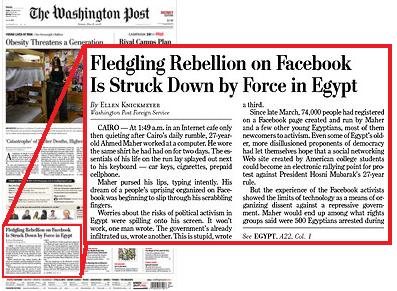
FACT: According to a Sunday Washington Post front-page story today recounting the events leading up to May 4, a “day of strike” called for by social-networkers as a protest against government policies, “By late afternoon, of the 74,000 people who had registered on the Facebook protest page, only 15 – three men and 12 women – were still eager to gather for a protest.”  [Note: the Facebook page had only been launched in late March.]

ANALYSIS: Last week I wrote about media coverage of Egypt’s Facebook affair, and noted that the Post and others had only covered it on media blogs, not in the actual newspaper.

This morning I picked up my Sunday-morning Post and saw the story, “Fledgling Rebellion on Facebook Is Struck Down by Force in Egypt,” right on the front page, which means that across Washington this morning, and other capital cities through clipping services, many in the foreign policy elite and punditocracy may be reading for the first time about the Web 2.0 facet of these events. 

Reporter Ellen Knickmeyer also posted today a related online “Field Notes” column about the challenges of covering the Facebook activists.

AddThis Social Bookmark Button 

Social Networking in Egypt Takes a Political Turn

FACT: In the past two days, reporters for the Los Angeles Times and the Washington Post have each written accounts of the ongoing confrontation in Egypt between the government and online activists – the “Facebook Revolution” as the Post reporter terms it, hyperbolically. One interesting aspect: the two accounts are not carried as actual news stories in the “newspaper” (real or virtual), but as blog posts by the reporters on dedicated foreign-correspondent blogs. The Washington Post account is on the “PostGlobal” uber-blogsite, under Jack Fairweather’s “Islam’s Advance” blog, while the L.A. Times account is on the “Babylon & Beyond” blog, which carries a sub-head of “Observations from Iraq, Iran, Israel, the Arab World and Beyond.”

ANALYSIS: Up to now there’s been little coverage in traditional American media outlets of the emerging political tenor of some social networks in Egypt over the past several months. Major newspapers and the cable-news channels have not explored the topic, but I just returned from some time in Egypt and I learned that of course it is a widely covered and discussed topic there.  One young woman in her 30s, an urban professional, told me “I’m on Facebook all day long!”

Every morning outside my hotel room I would find an English-language newspaper, and for many days in a row it was a different paper – often because they were weekly editions.  That gave me the opportunity to read a variety of opinions from a somewhat broad band, as measured in “distance to/from the government position.”  

Helpfully, on May 6 2008 the Egyptian Mail included a summary of the raging controversy over Facebook, noting that “In Egypt, Facebook is the stage for the latest twist in the generation gap, playing host to politically hungry young Egyptians eager to take on their ageing leader.”  Only at the end of the article did I notice that it was reprinted from a New-York-based Egyptian blogger, the respected Mona Eltahawwy.

Continue reading

Air Wars: the Air Force Takes Heat for its PR

FACT: A heated online debate is erupting about a particular photo posted online, and the brouhaha around it focuses on whether or not classified details are contained therein, thus revealing them. 

ANALYSIS: Given that others are even now writing extensively about this photo and its controversy I thought I would add a couple of thoughts.  Don’t bother blaming me for linking to the photo, by the way; given the attention and reposting/rehosting it has already received, the glare of publicity can only serve to prod better security practices. 

I expect to see parody versions on Flickr soon, with “Area 51” touches.

And so to my related thoughts: recently, an active-duty USAF officer and regular reader emailed me about one of my posts concerning Rod Beckstrom and the new National Cyber Security Center, which he had not previously heard of.  He wrote that in discussing it with a colleague, the response was “I thought the Air Force Cyber Command already had the mission to coordinate all cyber security efforts.”

Continue reading

Google’s Argument to Enterprise IT: “Trust Us”

FACT:  Yesterday, Google’s Dave Girouard, VP of enterprise sales, gave a keynote speech on “The Evolution of Cloud Computing” at FOSE, a Washington trade-show focusing on federal government and military IT customers.  According to a Washington Post reporter’s blog account afterwards:

[Girouard said] “Google will have to do things differently” to work with defense and intelligence agencies, where data security and privacy are held to the tightest standards. But he argued that having information spread across hundreds of different servers is actually more secure than housing data on a few servers at a specific location. “Security is now more virtual than physical,” he said.

ANALYSIS:  The Google salesman (Girouard is VP of enterprise sales) was speaking at FOSE on the same day I made an April Fools blogpost featuring a lame “Cloud Computing” joke (see it here, come back when you stop laughing).  

This year I’m at FOSE as neither buyer nor speaker; the past couple of years I spoke at FOSE, as a DIA official, and I always enjoy walking the exhibit floor, plus I was curious about Girouard’s take on Google’s current move into the federal space.

To be honest I’ve met him before when he was with Virage and he’s a fine fellow, a good salesman.

The rhetoric of his main pitch, though, seems to be battling uphill, and I’m not sure he gets a nuanced distinction.

Continue reading