How Not to Predict Stock Performance

Google hasn’t had a great week on the stock market so far, but it isn’t often that you get to use the words “Google stock” and “kick ’em while they’re down” in the same sentence, so…

I like my own little subtle “inside jokes” a bit too much sometimes. If you’re sharp-eyed you’ll have noticed that on the left-hand margin, down a ways, is an RSS feed featuring the latest news stories which include the phrase, “the next Google.” Yes, I use Google News itself to drive the RSS feed, ha ha.

Continue reading

Manferdelli Had a Salad, I Had Meatloaf

I had a very pleasant lunch today in Reston with John Manferdelli, one of the engineering legends with whom I’m privileged to work at Microsoft.  (Check out this list, kind of my own corporate “bucket list” of people to meet and listen to).

John arrived in DC a couple of days ago; unlike mere mortals, he decided to spend a weekend day off visiting the University of Maryland Engineering  Library in the Math Building, and told me he’d found a fascinating book on random numbers….

Continue reading

Silverlight 2.0: It’s “1 better than 1.0”

Last week I was visiting an intelligence community facility which has been known for several years for housing some of the brightest and most innovative adopters of Web 2.0 approaches for classified systems. I could say who and where, but then I’d have to… well, not kill anyone, just apologize to all my other friends at other agencies who think they’re the cat’s meow on classified Web 2.0. (With any luck this anonymity now makes each of them think, “Wait, who’s more advanced than we are?  How can we catch up??!”)Well, it turns out they’re excited about something new & cool they would like to use.

Continue reading

Opening Doors to Interoperability

I had to write a freshman term paper on Immanuel Kant, and chose as a topic his role in sparking the German Enlightenment, from which I at least learned the word Aufklarung … which surprisingly doesn’t come up much in normal conversation, even when I’m in Germany. But I’ve been thinking about that movement and its ramifications quite a bit, because of the ongoing technology enlightenment driven by “open-source” approaches.

When I announced I was joining Microsoft, several of my friends in the open-source-software “movement” raised their eyebrows and ribbed me for joining the dark side… although the brighter ones also pointed out several important trends and markers through 2006 and 2007, changes in Microsoft behavior and approach which appeared to signal that the company was tacking in a much more open direction. Ray Ozzie’s joining of the company, and his announced projects, were taken as significant, along with several software launches (both in the Live world and elsewhere) with fundamentally open foundations.

Today the company is making public what Steve Ballmer and Ray Ozzie are calling “important changes to our technology and business practices that will enhance the interoperability of our products and expand the technical information we share with developers, partners, customers, and competitors.” All to the good, including more comprehensive information about the new “Interoperability by Design” approach.

Continue reading

Social (Network) Science

Fact: The social-networking site LinkedIn claims as users “17,000,000+ Professionals, 500,000+ Senior Executives, Executives from 498 Fortune 500 companies, [and] 65,000 new Professionals every week.”

Analysis: Since I hold the title of “chief technology officer” for my group at Microsoft, I regularly check the widely-read blog CTOvision, written by Bob Gourley, CTO of Crucial Point.

CollaborationlogosYesterday he posted a very solid summary of several social networking tools, including my preferred LinkedIn.  If you’re not up to speed on the genre it is a helpful cheatsheet and “buyer’s guide.”

The technology area deserves the attention. There are a dozen or more such sites for each that Gourley covers, and he chooses the ones that have shown growth and potential longevity; why invest any time adding personal data to a site just to watch it disappear? We’ve all had that happen. And yet hockey-stick growth has to be managed – LinkedIn for example has come in for some critical attention for some snafus along the way.

Let’s look at some efforts to understand more about the science behind the software….

Continue reading

Mashup Markoff

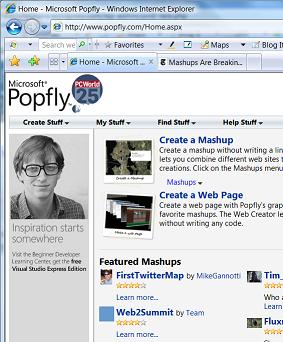
popfly.jpgJohn Markoff has a great story (that phrase belongs on a cut-n-paste clipboard) in today’s NY Times about PopFly, one of my favorite new Microsoft programs because it is so darned fun, and easy, and flexible – and potentially revolutionary.

I’m both a friend and fan of Markoff, but read his piece and you’ll see what I mean, as the examples he cites are pretty cool – or jump to the site itself.

PopFly is getting a lot of attention and coverage, landing on PCWorld’s list in December of “25 Most Innovative Products of the Year.”

Continue reading

Seeking Business Intelligence

I had breakfast this morning with Gartner’s Lisa Gross and we were able to talk about her continuing work in support of my old haunts – the agencies of the Intelligence Community. She’s first-rate at understanding the IT needs of large-scale government enterprises, and has always been known as a trusted adviser for CIOs, CTOs, and senior IT executives across many federal agencies.

I was recounting to her that when I first started at Microsoft (oh these many weeks), I was ecstatic at finding on our corporate intranet seemingly total unfettered access to Gartner research reports and white papers (along with similar access to Forrester research and reports).  The mother lode! 

Continue reading

The Three-Way Race, in Politics and Search

On the eve of the Super Tuesday primaries I’ve noticed a small but curious synchronicity, a sideways rhyming, between the Microsoft – Google – Yahoo elephant dance, and the back-and-forth among the top remaining candidates on the Republican and Democratic sides in the presidential primaries.

In graduate school I once wrote an 85-page study of “The Strategic Triangle: U.S., Soviet, and PRC Realignment during the 1970s.” Ah, the good old days of Henry Kissinger and grand-game geopolitics. But let’s stick to the more prosaic cage match dominating our politics right now.  Last week, John Edwards finally dropped out (or “suspended” his campaign, preserving some shred of pre-convention viability I suppose), and in doing so he refused to endorse either Barack Obama or Hillary Clinton. Both campaigns said great things about Edwards *after* he left the race, of course, the better to woo his supporters.  But before he dropped out, while he was still showing up in debates, both Clinton and Obama (and their surrogates) showed quite a bit of peevish annoyance that the third-place fellow wasn’t giving up and tossing them his endorsement.

Similarly, Mike Huckabee is hanging on by a thread on the Republican side, to the great solace of John McCain and the fuming of Mitt Romney, the latter believing that Huckabee’s conservative supporters would line up with him in a binary choice between Romney and McCain. (Would that count as a Baptist-to-Mormon conversion?) Romney spent the weekend bashing Huckabee even more than his putative rival, McCain.  Triangulation and frustration boil over into a combustible mix, obviously.

The same combination appears to be brewing in the Googleplex, while investors and analysts dump on the once shiny GOOG, which tanked yet again today, dropping below $500. 

Continue reading

Driving during the Super Bowl? Use a Mashup First

Fact: According to a report, “Taking Back the Airwaves” in the Buffalo News last month, “Listeners’ relationship with radio has changed in the last 25 years. Radio used to be the main source of music, … but now, like other industries, radio is fighting to reinvent itself in a digital age.”

Analysis: Let’s say you were an Air Force mission planner, and wanted to plan a particular flight over enemy territory.  Time-honored practices (and traditionally clunky but powerful software built custom for the purpose) allow you to overlay the enemy’s known radar-emitting sites, using circles or shapes to indicate the covered and non-covered areas, and to do the same with anti-aircraft missile ranges, allowing the precise planning of a safe flight route.

Now let’s look at a nifty adaptation, showing that there are much more fun and practical everyday uses of such an approach – and now new technologies make it much easier and faster to accomplish! Continue reading

A Quick Long-Term Analysis of GOOG, YHOO, MSFT

Fact: According to Forbes, writing after yesterday’s close of trading, “Unable to topple Google on its own, Microsoft is trying to force crippled rival Yahoo into a shotgun marriage, with a wager worth nearly $42 billion that the two companies together will have a better chance of tackling the Internet search leader…. Microsoft’s $31-per-share offer represented a 62 percent premium to Yahoo’s closing price late Thursday, although it’s below Yahoo’s 52-week high of $34.08 reached less than four months ago.”

Analysis: Most of the buzz about the Microsoft-Yahoo commentary yesterday was simply noise, bleating about the immediate impact (or not) on Google, as if the salience is a snapshot rendered in instantaneous who’s-up-who’s-down.  Yet I had a reader comment yesterday very perceptively on my post, saying “Whether the deal is timed well, overpriced or not, is for time to decide. Which may even take a couple of years!”

That got me to thinking about the value of these three companies over the long-term looking back.  Thanks to the web that’s easy to quantify, at least in terms of stock price; you can do it at MSN or on Yahoo Finance, but just for grins let’s do it at …

Continue reading