The Cyber Trough of Disillusionment

I’ll call the moment: the cyber security field is now past its giddy buzzword peak.

Gartner is well known for preparing “hype cycle” analysis of technology sectors, as in their recent publication of the 2009 “Hype Cycle for Social Software.” That report got a lot of attention on Twitter and in blogs, naturally; social medians are nothing if not self-reflective regarding their community. I thought an interesting take was by an IBM developer, who compared the 2008 version against the new one, measuring the changes in predicted “time to maturity” for individual technologies, and thereby coming up with something like a measure of acceleration. By that measure, individual blogging and social search made the most rapid gains.

But I notice something missing on the full list of 79 Gartner hype cycle reports: there’s not one about “cyber security.”

Continue reading

A Face in the Crowd

GovFreshGovFresh is a great new web service which aggregates live feeds of official news from U.S. Government Twitter accounts, YouTube channels, RSS feeds, Facebook pages, Flickr photostreams and more, all in one place. It is one of a new class of interactive Government 2.0 services, portals, and tools – many of them just launching in 2009 – which have the potential of revolutionizing the way citizens get and share information about their government.  (I mention several others below.)

At a time when the Iranian people are battling to keep their access open to Twitter, Facebook, and even phone lines in order to mobilize their anti-dictatorial protests, it is heartening that individuals in the United States and many other corners of the world find their governments increasingly willing to share information widely.

Luke Fretwell is GovFresh’s founder, and he’s becoming a welcome new voice in the debates around government technology policy. Luke recently wrote a blog post arguing “Why Gov 2.0 means the U.S. Government must centralize its Web operations.” A heated debate arose in the comments, including my own strenuous disagreement, and yet I became a fast admirer of Luke, his entrepreneurial energy, and the site’s information value.

GovFresh has been running a great series of profile-interviews in its blog section of leading individuals in the “Gov 2.0” movement, and today I was the chosen subject. The article has the unfortunately exaggerated title (in my case): “Gov 2.0 Hero Lewis Shepherd.”  Here’s an excerpt:

What’s the killer app that will make Gov 2.0 the norm instead of the exception?

Can’t tell you because we’re building it in the lab right now, ha! Seriously, the killer app may be something big and powerful, from an enterprise perspective, though I’d put the odds on something less obvious, but more pervasive. Here’s what I mean. I think often about the roots of the original Progressive movement at the dawn of the 20th Century, and their advocacy of direct-vote referendums, championed by Hiram Johnson and the like. Those give the people a direct say over particular issues, but the downside is that “the people” don’t always exercise informed judgment, and popular opinion can be manipulated and swayed by malevolent interests. So I’m looking to Gov 2.0 capabilities that maintain the representative aspect (the elected official, exercising his or her judgment) while incorporating real-time, structured, unfiltered but managed visualizations of popular opinion and advice. I’m intrigued by new services along these lines like www.you2gov.com, www.govfresh.com, www.govtwit.com, and the like, but I’m also a big proponent of semantic computing – called Web 3.0 by some – and that should lead the worlds of crowdsourcing, prediction markets, and open government data movements to unfold in dramatic, previously unexpected ways. We’re working on cool stuff like that.

At the end of the full interview, I observed that “You can’t watch what’s gone on with social software use in Egypt’s Facebook Revolution, our own 2008 campaign, or Iran’s election protests, without feeling that Patrick Henry and Thomas Jefferson would have been prolific twitterers with awesome blogs.”

In the spirit of empowering the people, instead of lauding one person, I’d like to thank GovFresh for the Hero honor but share the title with those I have worked with in the past few years, and with everyone else around the world engaged in the Gov 2.0 movement – whether they realize that’s what they’re doing or not.

Share this post on Twitter

Email this post to a friend

AddThis Social Bookmark Button

Microsoft and Google Look at the World Differently

I didn’t think I would have to write this same kind of observation twice within a year. But today, on D-Day, I notice yet again a striking difference between Google and Microsoft.  And in this case, one can almost read the evidence as a snub from Google to the United States, to the nations who united in sacrifice during World War II, and to President Obama on a day of his personal leadership in commemorating international war and peace.

I made a similar observation on Columbus Day, when Microsoft chose to honor Christopher Columbus and his explorations’ significance to American history and the world, while Google chose to honor – wait for it – Paddington Bear’s “birthday.” (See my post from then here.)

Today is of course D-Day, the 65th anniversary of a day in which over 2,000 American soldiers lost their lives, leading the way in the greatest military operation in the history of the world, as the initial landing to liberate Europe and the beginning of the end of the Nazi empire.

Google and Microsoft are two great American companies, which operate globally. Each has a public face to the world through signature online properties – their search engines. In Google’s case, that page at Google.com is their ne plus ultra public face, since they are at core a mighty search engine.

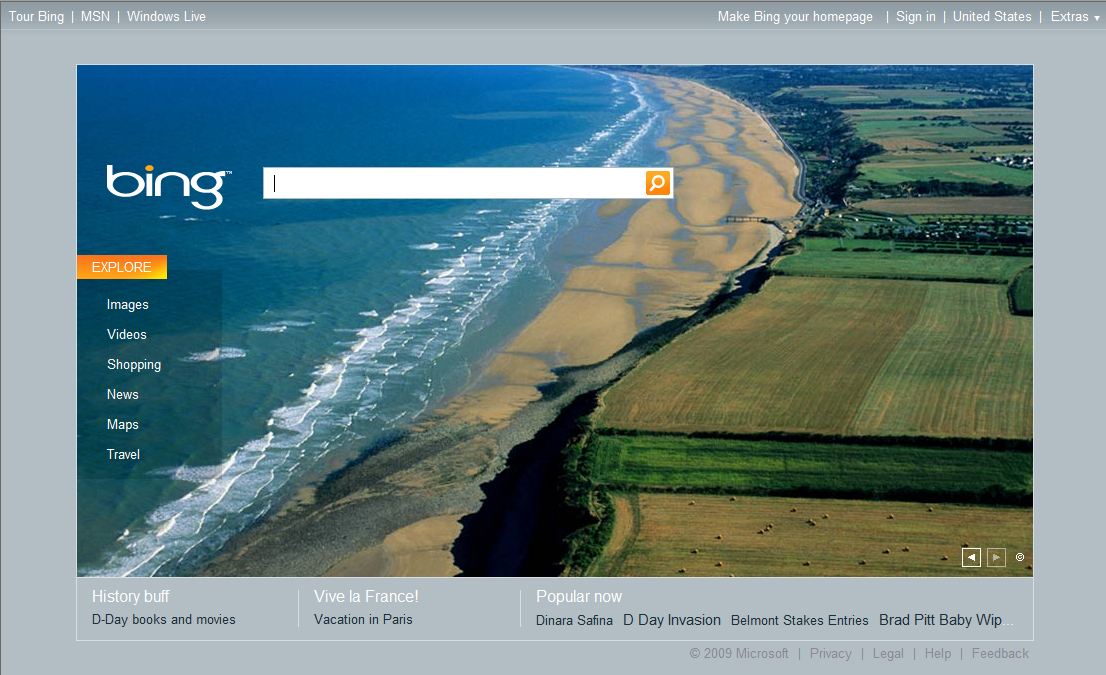
Take a look at the two pages today. Microsoft’s Bing search-engine uses its home page to commemorate D-Day, with a dramatic photograph of Normandy Beach today, and mouse-over popups providing historical highlights and links to more information on the battle’s signficance to World War II and to world history.
Bing D-Day

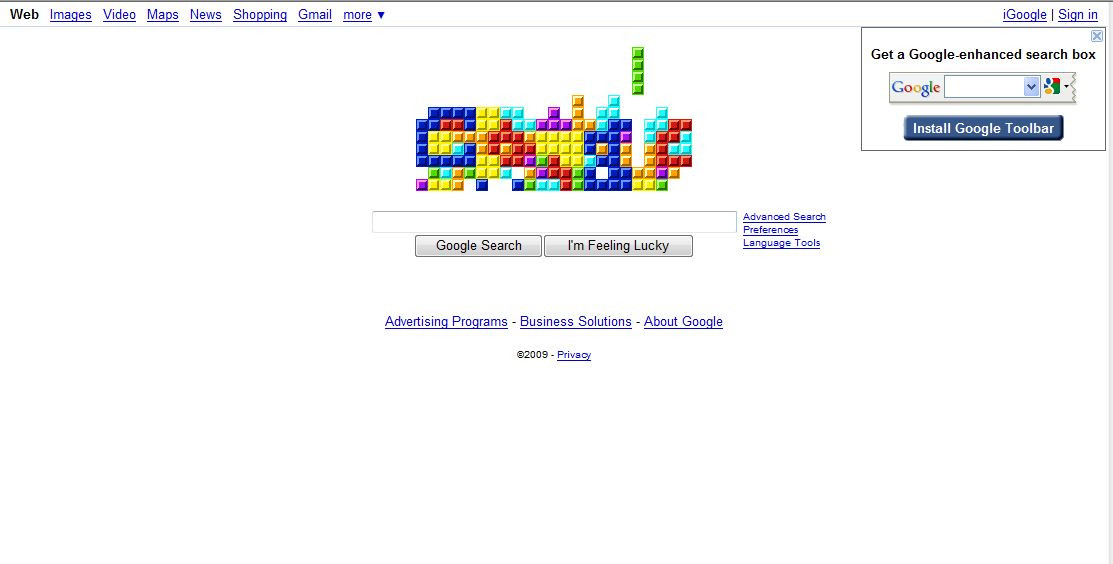
Google uses its home page to commemorate the 25th anniversary of the invention of the computer game Tetris.
Google Tetris

The mouse-over popup on the cutesy Google logo reads, “Celebrating 25 years of the Tetris effect – courtesy of Tetris LLC.”  (I suppose one could read that as, predictably, a coporate ad, right there on Google’s home page.)

Just as I noted on Columbus Day, this doesn’t appear to be a localization issue, or an issue of appealing to a global audience – both Microsoft and Google know my location, and in fact each is serving up a page targeted for me in the United States.

Don’t get me wrong: Tetris was an amusing and absorbing game. As a young guy I spent hours dropping the bars and shapes to fit into the rising pile below.

But at certain moments in life, you put aside childish things. Unless you’re trying to make some other kind of statement.

Note: I am a Microsoft employee. But this is not a Microsoft corporate blog, it’s my personal blog – and I’ve been known to tweak Microsoft here frequently as well.  This is my personal observation space.

I have to admit I am puzzled – and personally appalled – by the decision-making over at the Googleplex, and the statement they choose to send to the world.

President Obama is leading our delegation himself at Normandy Beach today, for the international event with other world leaders remembering a moment of global importance.  Self-evidently Eric Schmidt and the Google gang weren’t on board with that, and by their way of thinking saw something more significant to mark. 

Email this post to a friend


Immersed in Augmented Reality

Here’s a quick post, about a talk I gave this week – but as an excuse to link to a much more compelling presentation given at the TED Talks recently. Yesterday I had the good fortune to deliver the “Technology Keynote” address at the annual International Field Directors and Technology Conference, in Delray Beach, Florida. The IFD&TC is a well-known group in its field – no pun – of the world’s leading academic and government researchers, conducting large-scale and longitudinal social-scientific research studies.

As an example, think of the U.S. Census – and indeed I had the opportunity to spend some time with Cheryl Landman, Chief of the U.S. Census Bureau’s Demographic Surveys Division. You know those large studies drawn from every decade’s data? She runs them. That division’s work should feature prominently (I hope) in the forthcoming U.S. government’s “Data.gov” set of services.

Continue reading

Social Media goes hyper local for emergencies

For the past year, whenever my group has had government visitors to Microsoft labs in Redmond to see advanced technologies, we’ve considered whether or not to show them a demo of a particular “secret project” being developed, now called Microsoft Vine.

vineIf the group was with local or state government, or related to homeland security, or emergency responders and the like, the answer was easier, because that’s the sweet spot it’s designed for.

But I was always tempted to show it even to my federal government friends – and anyone else – just because it’s so impressive!

Continue reading

The Scientists Behind the Headline

Obama Promises Major Investment in Science” – AP News story (April 27, 2009)

“The bottom line is that if you’re a fan of new technologies being developed on US soil, you should be pretty damned excited.”Alex Koppelman, writing in Salon.com

President Obama announced today an effort to increase the nation’s investment in research and development spending for the sciences and new technologies.  As Alex Koppelman points out:

One particularly striking point to note about this: That level of funding [an increase to ‘more than three percent of GDP’] would almost meet the amount of money spent on defense. To some extent, that may simply represent a shift in where on the budget certain funds are accounted for, as defense spending has always been a key driver of American scientific research, but it’s still a sharp difference from the normal state of affairs.

I’ve written before (“How to Find Research“) about the need for increased R&D spending, and about the role of the White House Office of Science & Technology Policy in its main role: advising the President and others within the Executive Office of the President on the impacts of science and technology on domestic and international affairs.

OSTP does the hard work – but it is guided in part by the President’s Council of Advisors on Science and Technology, or PCAST.  This group can be a quiet backwater – as it has been on and off for years – or it has the potential to be a dynamic leading voice in advising the Administration on S&T policies, particularly in investments in scientific research and tech innovation.

It looks like we’re on the dynamic upswing, given that President Obama also used today’s high-profile announcement to name his appointments to an all-new PCAST. 

Continue reading

Place your bets on research

No reason to sugarcoat the Microsoft quarterly financial report issued this afternoon: it reflected the bad news in the overall economy.  Revenue down, earnings down, profits down. 

What I did find most interesting was the silver lining as Business Week points out in its coverage. Like most of Wall Street apparently (MSFT stock rose in after-hours trading), Business Week was impressed with some of the positive steps taken by the company:

Maybe the most striking news is Microsoft’s crisp cost-cutting. Who knew this Midas of the computer industry knew how to scale back so well? In the quarter, administrative costs fell by more than $1 billion, from $2.3 billion to $913 million. And the company completed its first ever general layoff, of 5,000 people. The company did not cut into its R&D budget, however. Spending there rose from $2 billion to $2.2 billion.”

It’s that last point that I’m focusing on, as it demonstrates that the company is living up to CEO Ballmer’s pledge to increase our annual R&D spending – amid this deep recession – from $8 billion a year to over $9 billion.

At a time when most budgets are hurting, that’s quite an investment.  If you’d like to know what we’re getting for that, check out http://research.microsoft.com, or for the most up-to-date reports, use Twitter to follow @MSFTResearch – this week, the Twitter feed has focused on papers and demonstrations we’re presenting at the 18th International World Wide Web Conference (WWW2009).

Email this post to a friend

AddThis Social Bookmark Button

Three cool new projects in Microsoft Research

[April Fool’s Edition]   I haven’t blogged in a little while – been a little busy – so I’ll make up for it with a burst of three cool new things coming out of the inventive lab work at Microsoft Research – improving Twitter, computer performance, and mobile phones.

MegaNano: New High-End Camera for Cellphones

Many people are dissatisfied with the fuzzy quality of photos taken with their built-in cellphone cameras. So Microsoft will be rolling out this summer the most advanced built-in mobile phone-cam on the market, based on a fantastic prototype now in final user testing at Microsoft Research’s Beijing lab.

MegaNanoDubbed the “MegaNano,” the sylish but diminutive camera boasts 72 megapixel resolution and a shutter-speed setting range from 0.003 seconds all the way up to seven hours.

The itty-bitty MegaNano will be launched simultaneously with the new Microsoft Mobile Apps Store, bundled with a nice selection of jackets and outerware with specially reinforced pouch-pockets and backpacks designed to hold the tiny device. 

I know you’ll want one. One beta-tester says, “It’s so small yet so powerful!  I have to remind myself sometimes that the weight on my shoulders is actually a tiny camera!”

Continue reading

Year of Data brings together Apple iPhone, Microsoft Surface, Google Android


Neat video below (Stimulant’s “XRay” project), but first, why I think it’s neat:

Every year is the year of data, I believe.

Continue reading

Microsoft gives Intel a ride

For once, Intel shares space on a Microsoft bus, and not the other way around. (For the more typical arrangement, see Wikipedia’s straightforward history of the Wintel platform, still “the dominant desktop and laptop computer architecture”).

I’ve been following some of the output from this week’s World Economic Forum in Davos, and noticed this very cute paragraph from the always interesting blog by Intel’s VP for Corporate Social Responsibility, Will Swope:

Earlier today I had just 12 minutes to get from a hotel on the “far end” of Davos back to the conference center. The session I was exiting had been organized by the World Economic Forum, so they organized vans to assure that the participants could get back to the main conference center. I was on the phone when I walked outside (feeble excuse for what I’m about to write), saw the van, and climbed in. At that time, Craig Mundie turned to me and said, “Will, this is the Microsoft shuttle.” He was quite gracious, would not let me leave, made room, and they gave me a ride to the center. Embarrassing…geez, you think?

Will, that’s not embarrassing!  But it does show that Craig Mundie’s a mensch.  Don’t know how to be a mensch? Guy Kawasaki can help you out.

Email this post to a friend

AddThis Social Bookmark Button