Way Ahead and Far Behind

Today’s Washington Post has a story on its front page: “Staff Finds White House in the Technological Dark Ages.”

Two years after launching the most technologically savvy presidential campaign in history, Obama officials ran smack into the constraints of the federal bureaucracy yesterday, encountering a jumble of disconnected phone lines, old computer software, and security regulations forbidding outside e-mail accounts.”

“What does that mean in 21st-century terms? No Facebook to communicate with supporters. No outside e-mail log-ins. No instant messaging. Hard adjustments for a staff that helped sweep Obama to power through, among other things, relentless online social networking.”  -Washington Post

Some say that whoever has been responsible for information technology in the White House itself should be fired — but then perhaps the change of Administration just took care of that  🙂 

Overall, this situation is familiar to anyone who has worked in what I call “Big-G  IT” or the information technology of a federal government agency. I’ve argued about its challenges and sub-optimality before: see my previous pieces on “Roadmap for Innovation: From the Center to the Edge,” and more specifically “Puncturing Circles of Bureaucracy.”  In that latter piece back in March of 2008, I wrote about the “the defensive perimeters of overwhelming bureaucratic torpor,” and the frustrating reality within much of Big Government: “Federal employees have an entire complex of bizarrely-incented practices and career motivations, which make progress on technology innovation very difficult, not to mention general business-practice transformation as a whole.”

Here’s the truly frustrating, mind-bending part: it isn’t always true!  Other elements of the White House have cutting-edge, world-class technologies operating day in, day out.

Continue reading

A Semantic-Touch-Flexible-Cloud Future Prototype

One of the more popular posts I wrote in 2008 about Microsoft Research prototypes featured the “Research Desktop” project, bringing together semantic analysis with Web 2.0-style user interfaces. MSR is now supplementing those concepts with more natural interfaces and new display and touch technologies.

ces-future-prototypes

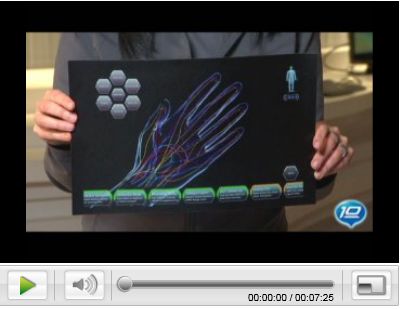
Tonight at the Las Vegas 2009 Consumer Electronics Show, Janet Galore of Microsoft’s Strategic Prototyping unit was onstage with Steve Ballmer, showing a conceptual demo of several technologies of the future which could significantly change the way people find, share and use information. Take a look at the video, which shows among other things new touch capabilities, semantic analysis, “Software + Services” integration of device computation with cloud computing, and flexible active displays.

By the way, that last one – flexible displays – was just highlighted by Bob Gourley in his New Year’s “Look Ahead: Some Technology Developments to Expect in 2009.”  I think this video’s example, about six and a half minutes ino the scene, really makes clear the startling promise of new displays.

Email this post to a friend

AddThis Social Bookmark Button

Stretching collaboration with Embodied Social Proxies

My wife and I are spending Christmas this year at home in Montross, and I’m sad that we’re not visiting with family in North Carolina or California.  But I’ve been looking at some new Microsoft research efforts on how to keep in touch with people in more natural ways, particularly valuable for teams working across geographic distances, which is how our Microsoft Institute works.

The question of how distributed teams can work collaboratively is only going to get more challenging, with out-sourcing and crowd-sourcing. Last week the Institute had a great visitor to our Reston digs: Tony Hey, Microsoft’s Corporate Vice President of External Research.  Tony’s bio on Wikipedia mentions his thirty years as a leading European academic (particle physics was his game), along with the excellent books he’s authored: Einstein’s Mirror, and Feynman and Computation.

Continue reading

Elbowing for Obama influence between new CTO, new cyber czar

Today’s Friday – usually a big news day in Washington, whether by design (bury bad news late in a deep weekend news hole) or by human error (bureaucrats tried all week to get something done and slipped it in at the deadline).  There should be Obama cabinet announcements today, and meanwhile tech luminaries across the country are sitting by their phones, drumming their fingers and hoping for a call offering them the position of the nation’s first Chief Technology Officer. Norm Lorentz, who was OMB’s first-ever CTO, told C-SPAN this week that “If I were asked, I would serve in a heartbeat.”

Continue reading

Several new Microsoft advanced technologies

Fact: As reported in TechCrunch and other sites today, “Microsoft’s Live Labs has just released Thumbtack, a web clipping service that allows users to compile links, media, and text snippets into online storage bins for future reference. Users can also share their Thumbtack collections with their peers, allowing them to collaborate by adding new clips and notations… The service works fine on IE7 and Firefox, and isn’t OS dependent. Each of these clippings can be sorted into folders called ‘Collections’, which can be published to the web via RSS, embedded in blogs, opened to friends for collaboration, or kept private for safe keeping.”  [There’s also a good Ars Technica review of Thumbtack here.]

Continue reading

March of progress with human consequences

Fact: Today Cisco announced a new program with “learning solutions partners” to support China’s growing IT infrastructure by “Nurturing Talent in More Than 100 Training Centers Across 31 Cities in China” (Cisco Launches Talent Development Strategy for China“)

Analysis: One day last week an enterprising handyman in my little town of Montross, Virginia spied a large sinkhole in the long driveway leading up to our house. He offered to my wife that he’d fill and level the hole for $20.  Sold! Continue reading

My bold decision to withdraw from consideration as Obama’s CTO

To: President-Elect Barack Obama

From: Lewis Shepherd

RE: My Imminent Selection as Chief Technology Officer for the United States

Mr. President-Elect, I am hereby reluctantly but insistently withdrawing my name from consideration as your appointment to the newly created position of Chief Technology Officer for our nation.

No, no, please don’t try to persuade me otherwise. My decision is final.

Analysis: My earlier post about John Brennan being President-elect Obama’s “imminent” selection as CIA director is now a curio, given Brennan’s decision yesterday to withdraw from consideration. 

Like any good intelligence analyst writing a balanced assessment, I had included the caveat that the only thing standing between Brennan and the appointment was the likelihood of a last-minute political squabble or contretemps.

This being Washington we’re talking about, that is precisely what happened. 

Continue reading

Superpowers battle, in computing.

Fact: According to a WIRED report earlier this week, “A new crop of supercomputers is breaking down the petaflop speed barrier, pushing high-performance computing into a new realm that could change science more profoundly than at any time since Galileo.”

Continue reading

MS Office Wired, OpenOffice Tired, Google Docs Expired?

google-newsFact: “Google Docs Struggles to Gain Foothold.” “Google Docs Use: Just a Blip.” “Study: Office Fights Off Google Docs Threat.” “OpenOffice Five Times More Popular than Google Docs.”  These are news articles covering the release of a new ClickStream study of typical use of “productivity software” like the Microsoft Office suite (Word, Excel), Google Docs, Google Spreadsheets, OpenOffice, etc. The study “among adult U.S. internet users showed that use of free productivity applications such as Google Docs and OpenOffice remains low, while Microsoft Office is in use by over 50% of adult U.S. internet users and shows no signs of declining popularity.”

Analysis: Well, yesterday I gave Google some nice words because of our joint work with DoD on improving military health IT. So I’m itching to tweak the Big G now, and we have some numbers to examine.  And I wasn’t cherry-picking the titles above either, they were the “most relevant” results on a Google News query this morning for <“Google Docs” OpenOffice Microsoft>.

Continue reading

Google and Microsoft sign up for military duty

Fact: A September 2008 article in the Michigan Business Review holds that “An estimated 70 million people do have access to basic personal health records through their health insurers, with millions more scheduled to receive the service this year, according to health care benefit company Aetna.”  But that doesn’t mean they’re using a PHR.  Aetna also did a study just last year (2007) with the Financial Planning Association, according to the same article and found that “64 percent of respondents said they didn’t know what a personal health record was and of those who did, only 11 percent said they were currently using one.”

Analysis: In the battle to expand access to and use of PHRs, there’s great news on the way for a significant portion of the country: our millions of men and women in the military.

Continue reading