Armed Autonomy: Mechatronics plus Software plus Ammo

The Killer Robots are Coming!

Fact: According to a new story in LiveScience (“Will the U.S. Have a Droid Army“), “autonomous robots with the ability to open fire upon their own initiative are under development in other countries.”  Robotics researchers Doug Few and Bill Smart at Washington University in St. Louis are quoted with the assessment that “the U.S. military may be 30 percent robotic by the year 2020.” 

Analysis: I’ve been having some interesting discussions with DoD and their contractors about robotics lately, and the question of autonomous behavior comes up frequently, though infrequently about armed systems.  Among other reasons, Army’s Future Combat Systems (FCS) places great store in unarmed robotic systems coordinating with other command and control or combat systems. Continue reading

Click on My Head and You’re Classified 2.0

Fact: According to the latest McKinsey Global Survey report, “Building the Web 2.0 Enterprise,” many companies find themselves actually changing organizationally, both internally and externally, as a result of adopting Web 2.0 tools and practices. 

Continue reading

Using Web 2.0 to Track a Political Crisis

My gut tells me that the latest round in the Georgian-Russian crisis is going to get ugly.

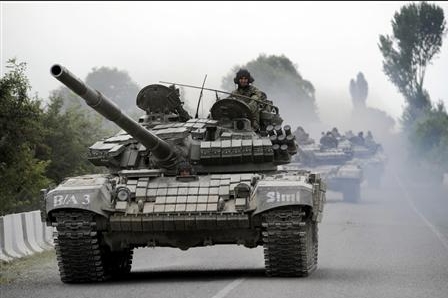
CNN’s “Russian Tanks Rolling into Georgian Breakaway” shows one thing: our old friend Vladimir Putin feels free to call the shots.

Twitter alerts can only get you so far, in following a crisis.  Check out these first attempts: this Twitter search or this one, or this Live News feed.  You can RSS any of these by the way.

I’m working on several Popfly-designed orchestrations of alerts and newsfeeds to keep me updated on the latest news from South Ossetia, incorporating crowd-sourced information as much as I can. 

Continue reading

CIA 2.0: The Agency’s CIO and Change

Fact: CIO magazine is running a big story on the CIA’s Chief Information Officer Al Tarasiuk and his IT operation, and their online site is breaking it up into a four-part series running this week.  Below I analyze the series.

Analysis: By the halfway mark in the series, the magazine’s reporter Thomas Wailgum had only accomplished a fairly rote recounting of what CIA is, what its CIO does, and how both those factors have changed since the good ol’ spy days amid the challenges of a post-9/11 world.

Part Onedescribed “a business-IT alignment project like few others,” although it mainly served to introduce CIO magazine’s broad readership to the unfamiliar world of a walled-off intelligence agency, waxing on about the hyper-security at Langley.  Part Two similarly was background on the bureaucratic culture of the agency and its relegation of IT to backwater status – until 9/11 came along.

Continue reading

Three Key Promotions in U.S. Intelligence

In the old days of Kremlinology, our side’s “Soviet analysts” (I was one as a kid, back in 1985-86) would pore over personnel lists and announcements of Politburo or Central Committee appointments, seeking clues to the direction of Party doctrine and intent. Military personnel promotions and reassignments were also studied closely to divine any insight into Soviet military policy.

There’s not a direct analogy to American military leadership promotions, but those lists are also studied intently, by peers and colleagues within the military branches, and also by experts throughout defense industry circles who can often decode Pentagon politics by watching who gets an extra star and who gets passed over.

Friday the U.S. Senate confirmed several key Army promotions, including three which I consider to be the most critical military intelligence positions in the nation. 

Continue reading

The Best of America, in Iraq

The fireworks (and sales) of the Fourth are over. Much has been written about this holiday, about which many in America are unnecessarily cynical. Both sides in the presidential campaign made much of patriotism this week. I just wanted to share something that I read in a back-of-the-paper page of the Washington Post today, a little interview which says more about the quiet ideals motivating American foreign policy at its best, and the undaunted courage of those who help to carry it out.

The interview (“The Doctor is In: To Iraq and Back“) is with dentist and retired-two-star general Ronald D. Silverman.  He practices in Alexandria, Virginia, and I may just see if I can get an appointment with him, because I’d like most of all to shake his hand and thank him for what he’s done.

Email this post to a friend

AddThis Social Bookmark Button

Pentagon’s New Program for Innovation, in Context

FACT: According to an article in today’s Washington Post, the Pentagon has announced “the selection of six university professors who will form the first class of the National Security Science and Engineering Faculty Fellows Program. The professors will receive grants of up to $600,000 per year for up to five years to engage in basic research — essentially a bet by the Pentagon that they will make a discovery that proves vital to maintaining the superiority of the U.S. military.”

ANALYSIS: This new program is an innovation from DoD’s Director of Defense Research and Engineering (DDR&E), and since tomorrow I’ll be at Ft. McNair for a two-day conference sponsored by DDR&E on Strategic Communications, I’ll congratulate John Young and his staff for the good idea.

But the Post article falls short in two ways: one immediate (it leaves out key information about next year’s program and the upcoming deadline!) and one longer-term (it ignores the overall context of federal support for R&D).  I’ll fill in the blanks below.

Continue reading

War is Virtual Hell

FACT: According to market research compiled by Microsoft, the global market for Modeling and Simulation (M&S) software/hardware platforms across all industries, including the defense industry, has hit $18 billion per year; the cumulative growth rate is estimated at 9.6% annually.

ANALYSIS:  The lovely wife and I have been lackadaisically house-hunting down in Virginia’s Northern Neck, the Athens of America and the cradle of our democracy. The Neck is the birthplace of George Washington, the Lee brothers (the revolutionary patriots about whom John Adams used the phrase, “This Band of Brothers,” among them Declaration of Independence signers Richard Henry Lee and Francis Lightfoot Lee, not to mention their later nephew Robert E. Lee), James Monroe, John Ballentine, etc. etc. 

Anyway, recently we toured the historic 1859 house at Braehead, an 18-acre estate actually located within the Civil War battlefield in Fredericksburg, Virginia. The house is for sale, and while it’s likely overpriced (like everything else on the market these days) [this observation has been energetically and somewhat persuasively disputed by the listing agent, who read the post], but we enjoyed the tour.  I’ve posted many (too many) photos of our little tour here.  My interest in the house is the historic angle: it’s actually where Robert E. Lee visited and took breakfast on the morning of the Battle of Fredericksburg in 1862, one of his successful efforts against U.S. forces.  Here’s an article about Braehead’s history and historic preservation.

It was in fact at Fredericksburg that Lee spoke the words which would sum up the entire war, nay all wars, as he witnessed thousands of Union soldiers falling in battle to Confederate guns on the hills above the Rappahannock River: “It is well that war is so terrible, lest we grow too fond of it.”  

Continue reading

How to Run a State-of-the-Art Technology Program – Quietly

FACT: In the new movie “Iron Man,” defense-contracting billionaire and engineering genius Tony Stark (played by Robert Downey Jr.) designs and builds a suit capable of individual flight (highly engineered control surfaces powered by an “arc-reactor” – it is Hollywood after all). During his first test flight, zooming straight up from Malibu and stressing the system to its max, he asks his onboard computer, “What’s the altitude record for the SR-71?” His computer responds back, “85,000 feet,” whereupon he zooms past that ceiling.

ANALYSIS: Funny moment, and excellent movie.  In its honor, below I’m going to give you access to a remarkable, recently declassified document describing one of America’s boldest Cold War technical achievements.  If you’ve ever run (or wanted to run) a high-tech company or program, like Tony Stark in the movie, you’ll appreciate the startling scope of the work – and if you’ve recently worked in DoD or the Intelligence Community you’ll marvel at how they did it “in the good old days.”

Continue reading

SecDef Blasts Air Force on ISR

FACT: U.S. military use of airborne drones (UAVs) dawned at the turn of the millenium, with nearly 100 vehicles in use before the Sept. 11 2001 attacks. By the end of that year the number had doubled, with the majority in use in Afghanistan. Today, according to a speech today by Sec. of Defense Bob Gates, “We now have more than 5,000 UAVs, a 25-fold increase since 2001.”

ANALYSIS: The Gates speech today, to an Air Force audience, is being covered mostly with a focus on his “harsh criticism” of that service. For example, CNN’s headline was “Defense Secretary Scolds Air Force for War Effort,” or Fox News “Gates Says Air Force Must Step Up Efforts in Iraq, Afghanistan.”  And there was plenty of raw material for the tough stories, including CNN’s inclusion of the Gates soundbite that getting the Air Force to send more surveillance and reconnaissance aircraft to Iraq and Afghanistan has been “like pulling teeth.”

Others (like a Reuters story) struck a less frenzied tone, including more depth about his proposals going forward, and the Defense Department’s actual plans for improved acquisition and use of Intelligence, surveillance, and reconnaissance, or ISR. I’d encourage you to read the full transcript (get it here).  (By the way, here’s some background on ISR and its variants.)

Continue reading