Spellcheck only goes so far…

fail owned pwned pictures

Technology is often only as good as the human using it 🙂

More funny “fail” pictures at FAIL Blog

Email this post to a friend

AddThis Social Bookmark Button

Pentagon’s New Program for Innovation, in Context

FACT: According to an article in today’s Washington Post, the Pentagon has announced “the selection of six university professors who will form the first class of the National Security Science and Engineering Faculty Fellows Program. The professors will receive grants of up to $600,000 per year for up to five years to engage in basic research — essentially a bet by the Pentagon that they will make a discovery that proves vital to maintaining the superiority of the U.S. military.”

ANALYSIS: This new program is an innovation from DoD’s Director of Defense Research and Engineering (DDR&E), and since tomorrow I’ll be at Ft. McNair for a two-day conference sponsored by DDR&E on Strategic Communications, I’ll congratulate John Young and his staff for the good idea.

But the Post article falls short in two ways: one immediate (it leaves out key information about next year’s program and the upcoming deadline!) and one longer-term (it ignores the overall context of federal support for R&D).  I’ll fill in the blanks below.

Continue reading

At Craigslist, “Traffic just keeps going up…”

Back in 1994-96 I was working for the Mayor of San Francisco (Frank Jordan, “the one before Willie Brown” as one friend persisted in calling him), and among other projects I was working on policies to nurture and promote the emerging  Internet economy, particularly the slowly burgeoning culture of Web startups – at times it seemed like the center of the universe was around South Park in the city’s South of Market neighborhood.  For the Mayor’s ’95 re-election campaign we put up one of the first political campaign websites, winning an award from “Campaigns & Elections” magazine. 

One of the cool people I worked with on innovative ideas for the nascent Web back then was Craig Newmark, founder of Craigslist. Like many people in San Francisco, I remember when using Craigslist was synonymous with “finding local S.F. stuff,” and have watched with delighted awe as the site (nonprofit empire!) has grown over the years.  The model absolutely rocks, in its simplicity, consistent innovation, and its universality.

Continue reading

How to Run a State-of-the-Art Technology Program – Quietly

FACT: In the new movie “Iron Man,” defense-contracting billionaire and engineering genius Tony Stark (played by Robert Downey Jr.) designs and builds a suit capable of individual flight (highly engineered control surfaces powered by an “arc-reactor” – it is Hollywood after all). During his first test flight, zooming straight up from Malibu and stressing the system to its max, he asks his onboard computer, “What’s the altitude record for the SR-71?” His computer responds back, “85,000 feet,” whereupon he zooms past that ceiling.

ANALYSIS: Funny moment, and excellent movie.  In its honor, below I’m going to give you access to a remarkable, recently declassified document describing one of America’s boldest Cold War technical achievements.  If you’ve ever run (or wanted to run) a high-tech company or program, like Tony Stark in the movie, you’ll appreciate the startling scope of the work – and if you’ve recently worked in DoD or the Intelligence Community you’ll marvel at how they did it “in the good old days.”

Continue reading

Spying on the A-12 OXCART

FACT: Today’s Tuscaloosa (Ala.) News has a great elegy for a pilot who died forty years ago: “Jack Weeks, University of Alabama graduate and Birmingham native, died in service to his country [on June 4, 1968]. Reports from his most famous mission wound up on the president’s desk during one of the flashpoints of the Cold War. His widow accepted his medal for valor shortly after his death. But for 40 years, nobody knew what he’d done. Only his wife knew he was a hero…. Weeks was a pilot in the Central Intelligence Agency flying the super-secret A-12 high-level surveillance aircraft from 1963 until his death in 1968. A couple of weeks before his death, he became the pilot who located the USS Pueblo, the American intelligence-gathering ship, after it was captured by North Korean patrol boats…. Next month, Weeks will finally get the public recognition he was denied for so long. Battleship Park, home of the USS Alabama, will commemorate the 40th anniversary of his death on June 4 with a ceremony that will include an Alabama Air National Guard fly-over.”

ANALYSIS: Friday I was over at CIA headquarters at Langley meeting with a friend, and once inside the compound I parked by the Agency’s newest historical exhibit. Situated on a new traffic island between two parking lots behind the original headquarters building, looming over rows of parked cars, is a massive, gorgeous, sleek black aircraft perched on shiny steel struts as if in flight, twenty feet off the ground.

Continue reading

Update on Facebook-in-Egypt

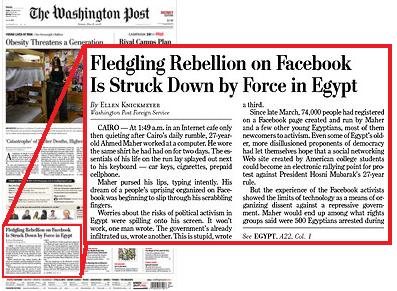
FACT: According to a Sunday Washington Post front-page story today recounting the events leading up to May 4, a “day of strike” called for by social-networkers as a protest against government policies, “By late afternoon, of the 74,000 people who had registered on the Facebook protest page, only 15 – three men and 12 women – were still eager to gather for a protest.”  [Note: the Facebook page had only been launched in late March.]

ANALYSIS: Last week I wrote about media coverage of Egypt’s Facebook affair, and noted that the Post and others had only covered it on media blogs, not in the actual newspaper.

This morning I picked up my Sunday-morning Post and saw the story, “Fledgling Rebellion on Facebook Is Struck Down by Force in Egypt,” right on the front page, which means that across Washington this morning, and other capital cities through clipping services, many in the foreign policy elite and punditocracy may be reading for the first time about the Web 2.0 facet of these events. 

Reporter Ellen Knickmeyer also posted today a related online “Field Notes” column about the challenges of covering the Facebook activists.

AddThis Social Bookmark Button 

Social Networking in Egypt Takes a Political Turn

FACT: In the past two days, reporters for the Los Angeles Times and the Washington Post have each written accounts of the ongoing confrontation in Egypt between the government and online activists – the “Facebook Revolution” as the Post reporter terms it, hyperbolically. One interesting aspect: the two accounts are not carried as actual news stories in the “newspaper” (real or virtual), but as blog posts by the reporters on dedicated foreign-correspondent blogs. The Washington Post account is on the “PostGlobal” uber-blogsite, under Jack Fairweather’s “Islam’s Advance” blog, while the L.A. Times account is on the “Babylon & Beyond” blog, which carries a sub-head of “Observations from Iraq, Iran, Israel, the Arab World and Beyond.”

ANALYSIS: Up to now there’s been little coverage in traditional American media outlets of the emerging political tenor of some social networks in Egypt over the past several months. Major newspapers and the cable-news channels have not explored the topic, but I just returned from some time in Egypt and I learned that of course it is a widely covered and discussed topic there.  One young woman in her 30s, an urban professional, told me “I’m on Facebook all day long!”

Every morning outside my hotel room I would find an English-language newspaper, and for many days in a row it was a different paper – often because they were weekly editions.  That gave me the opportunity to read a variety of opinions from a somewhat broad band, as measured in “distance to/from the government position.”  

Helpfully, on May 6 2008 the Egyptian Mail included a summary of the raging controversy over Facebook, noting that “In Egypt, Facebook is the stage for the latest twist in the generation gap, playing host to politically hungry young Egyptians eager to take on their ageing leader.”  Only at the end of the article did I notice that it was reprinted from a New-York-based Egyptian blogger, the respected Mona Eltahawwy.

Continue reading

Microsoft May Have a Killer Cloud App – Live Mesh

Microsoft Mesh LogoGot a technical briefing on Live Mesh today in Redmond, and I’m impressed – particularly by the demonstrated commitment to interoperability through adhering to web standards – and the very cool Live Desktop giving you remote access to all your files and folders from any device (work computer, home laptop, mobile phone) with  the new Microsoft Device Connectivity Service.

This is what will bring Cloud Computing down to earth.

Continue reading

SecDef Blasts Air Force on ISR

FACT: U.S. military use of airborne drones (UAVs) dawned at the turn of the millenium, with nearly 100 vehicles in use before the Sept. 11 2001 attacks. By the end of that year the number had doubled, with the majority in use in Afghanistan. Today, according to a speech today by Sec. of Defense Bob Gates, “We now have more than 5,000 UAVs, a 25-fold increase since 2001.”

ANALYSIS: The Gates speech today, to an Air Force audience, is being covered mostly with a focus on his “harsh criticism” of that service. For example, CNN’s headline was “Defense Secretary Scolds Air Force for War Effort,” or Fox News “Gates Says Air Force Must Step Up Efforts in Iraq, Afghanistan.”  And there was plenty of raw material for the tough stories, including CNN’s inclusion of the Gates soundbite that getting the Air Force to send more surveillance and reconnaissance aircraft to Iraq and Afghanistan has been “like pulling teeth.”

Others (like a Reuters story) struck a less frenzied tone, including more depth about his proposals going forward, and the Defense Department’s actual plans for improved acquisition and use of Intelligence, surveillance, and reconnaissance, or ISR. I’d encourage you to read the full transcript (get it here).  (By the way, here’s some background on ISR and its variants.)

Continue reading

Intriguing Politics – Social Media Discussion

FACT:  The second International Conference on Weblogs and Social Media (ICWSM) wrapped up yesterday in Seattle. It was organized again by the Association for the Advancement of Artificial Intelligence (or AAAI), with co-sponsorship by Microsoft, Google, and several universities and Web 2.0 companies. The papers are already being posted online here, which is great as there were some very interesting topics explored. 

ANALYSIS:   One really thought-provoking theme was proposed by Matthew Hurst, a scientist at Microsoft’s Live Labs (and co-creator of BlogPulse), who was a participant on the “Politics and Social Media” panel.  He’s summarized his points on his own blog, but it’s definitely worth pointing out the key distinction he posed:

Firstly, politics is about scaling social organization. A premier can’t talk to every citizen, so s/he has lieutenant’s. They have their own underlings, and so on in a typical hierarchical/departmental structure. Social media, however, is all about individuals – we read entries in weblogs, etc. So, if a politician wants to connect via social media, isn’t there some sort of fundamental mismatch? Obama may have 20, 000 followers on Twitter, but how many comments has he left on blog posts?

Secondly, there is the issue of social media amplifying the polarization (or homophily) found in any topical community. Thus, individuals look around at their neighbours in the social graph and see much of what they themselves are made of.

This bottom-down, top-up dichotomy has been discussed more generally about social media and social networks (often drawing a sharp distinction between “old-media” and “new-media,” or more colloquially if imprecisely as between “the media” and “the web.”)

Continue reading