Departure of the Pentagon CISO

I’ve had the good fortune to work with talented folks in my (short) time in Washington, since moving back East in 2002, particularly in the Intelligence Community and Department of Defense.  And one such fellow at DoD has been Bob Lentz, the outgoing deputy assistant secretary of Defense for information and identity assurance – the Chief Information Assurance Officer and equivalent to a private-sector CISO.

I gave an interview this afternoon to Federal News Radio (AM 1500 in the DC area, worldwide at www.FederalNewsRadio.com), on Bob’s tenure, and what will come next for DoD in the wake of his departure. You can read the news story about the interview here, or listen to the entire 15-minute interview as an mp3:

Shepherd interview on Federal News Radio, 10/13/2009

Continue reading

A few words about a few great Pentagon leaders

I was thinking about the Pentagon over the long weekend – appropos, given the Memorial Day celebration. But my thoughts were also sparked by viewing a 9/11 documentary, reviving all the memories of that dark day’s attacks on New York and Washington – which ultimately led to my joining the ranks of defense intelligence for a while.

Continue reading

Some say Obama has already chosen Cyber Czar

I’ll wade into the breach again, of analyzing (and trying to anticipate) some national-security appointments for the new Obama Administration.  Today I must admit that I’m taken with the latest reportage from the U.K. Spectator – a quite conservative publication not usually known for its closeness to the Obama inner circle.

Continue reading

Bob Gates and the future of defense thinking

Now that Bob Gates is officially going to stay on as Secretary of Defense in the Obama Administration, it’s worthwhile to refresh our understanding of his thinking. Continue reading

Google and Microsoft sign up for military duty

Fact: A September 2008 article in the Michigan Business Review holds that “An estimated 70 million people do have access to basic personal health records through their health insurers, with millions more scheduled to receive the service this year, according to health care benefit company Aetna.”  But that doesn’t mean they’re using a PHR.  Aetna also did a study just last year (2007) with the Financial Planning Association, according to the same article and found that “64 percent of respondents said they didn’t know what a personal health record was and of those who did, only 11 percent said they were currently using one.”

Analysis: In the battle to expand access to and use of PHRs, there’s great news on the way for a significant portion of the country: our millions of men and women in the military.

Continue reading

Walled-Garden Wikis and Candlepower

Fact: Last night the U.S. Joint Forces Command (JFCOM) announced it has “moved its C2Pedia Registry to the unclassified network enabling more potential users to access and edit the site, hoping it will ultimately improve the quality of data.”  C2Pedia is a MediaWiki-driven online knowledge base of information about Command and Control (C2), with specific information about more than 200 C2 systems used across the Department of Defense and the armed services.

Analysis: The profusion of wikis in official government circles is an interesting expression of the value of social media for enterprise knowledge management, but for the most part inside agency or network firewalls, denying access to the public at large and therefore incorporating only the wisdom of “the inside crowd.” The State Department’s Diplopedia sits on their intranet (ironically called “OpenNet”), as the New York Times pointed out in a story a few weeks ago (“An Internal Wiki that’s Not Classified“), implying a distinction (without a difference to my mind) between Diplopedia and the IC’s Intellipedia, which has an unclassified version as well – but it also sits on a firewalled network!

Jimmy Wales, founder of Wikipedia, testified to Congress recently about the value of wikis and social media within enterprises, and pointed out the distinction between “within-the-agency” verticalized information sharing, a la Diplopedia, and horizontal sharing across organizations as exemplified by the IC’s Intellipedia, which as I mentioned has a firewalled unclassified version as well as its classified-network versions, all accessible from any of the intelligence community’s sixteen agencies and beyond.

Continue reading

WIRED Cracks Cyber-Battle Code

Just a quick note between conflicting conference sessions in different locations around the DC Beltway, to note that WIRED’s premier national-security blogger Noah Schactman may have just cracked the code – or at least “a” code – on where the ongoing dispute over “control of cyber” is heading in national security circles, in his latest DangerRoom post (“Air Force Cyber Command Could Return, with Nukes“).

The dispute has been reported lightly, in places like the NextGov blog (“The Cyber Command Power Play?”), and usually boils down to a perceived battle between the U.S. Air Force and the nation’s Intelligence Community, over control of the increasingly central issue of cyber offense and cyber defense.

Continue reading

Armed Autonomy: Mechatronics plus Software plus Ammo

The Killer Robots are Coming!

Fact: According to a new story in LiveScience (“Will the U.S. Have a Droid Army“), “autonomous robots with the ability to open fire upon their own initiative are under development in other countries.”  Robotics researchers Doug Few and Bill Smart at Washington University in St. Louis are quoted with the assessment that “the U.S. military may be 30 percent robotic by the year 2020.” 

Analysis: I’ve been having some interesting discussions with DoD and their contractors about robotics lately, and the question of autonomous behavior comes up frequently, though infrequently about armed systems.  Among other reasons, Army’s Future Combat Systems (FCS) places great store in unarmed robotic systems coordinating with other command and control or combat systems. Continue reading

Click on My Head and You’re Classified 2.0

Fact: According to the latest McKinsey Global Survey report, “Building the Web 2.0 Enterprise,” many companies find themselves actually changing organizationally, both internally and externally, as a result of adopting Web 2.0 tools and practices. 

Continue reading

Using Web 2.0 to Track a Political Crisis

My gut tells me that the latest round in the Georgian-Russian crisis is going to get ugly.

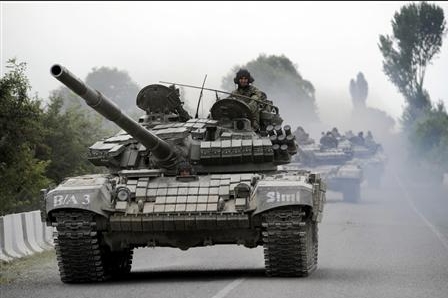
CNN’s “Russian Tanks Rolling into Georgian Breakaway” shows one thing: our old friend Vladimir Putin feels free to call the shots.

Twitter alerts can only get you so far, in following a crisis.  Check out these first attempts: this Twitter search or this one, or this Live News feed.  You can RSS any of these by the way.

I’m working on several Popfly-designed orchestrations of alerts and newsfeeds to keep me updated on the latest news from South Ossetia, incorporating crowd-sourced information as much as I can. 

Continue reading