A few words about a few great Pentagon leaders

I was thinking about the Pentagon over the long weekend – appropos, given the Memorial Day celebration. But my thoughts were also sparked by viewing a 9/11 documentary, reviving all the memories of that dark day’s attacks on New York and Washington – which ultimately led to my joining the ranks of defense intelligence for a while.

Continue reading

DNI Flags at Half-Mast

Only the second-ever Director of National Intelligence, Mike McConnell, resigned today effective immediately. As the Associated Press reported this afternoon in the wake of the announcement, “Lt. Gen. Ronald L. Burgess, Jr. is temporarily serving as acting national intelligence director… McConnell’s letter did not explain why he resigned before the Senate’s confirmation of his replacement. President Barack Obama has nominated retired Adm. Dennis Blair to be the next national intelligence director.” 
Analysis:  Given the impending Senate hearings on Denny Blair’s confirmation and the expected smooth sailing, most people I know were mildly surprised that McConnell jumped ship today, rather than waiting for a formal turnover to a confirmed Blair. McConnell has had a solid, successful track record of leading the IC in an era of long-needed reform, while contributing to a track record in his tenure of zero terrorist attacks on American soil.

odni-red-flagsBut then my inbox pinged with another notice from the Office of the DNI: release of “The 500-Day-Plan Update at Day 400” (download the PDF version here).  It contained a graphic depiction of the troubling challenges remaining – actually using graphic “red flags” to mark areas at risk.  More on the flags below.

Those who work in and with the intelligence community have been intimately familiar with the DNI’s 500-Day Plan.  When it was first drafted I was still in government and had my tiny slice of input into its composition through the interagency review process. Its release was hailed by some (“ODNI Earns Kudos for 500-Day Plan,” in Federal Computer Week) and greeted with a yawn in some sectors of the community itself. “Another reform plan? I’ll make room on the shelf.” Continue reading

Way Ahead and Far Behind

Today’s Washington Post has a story on its front page: “Staff Finds White House in the Technological Dark Ages.”

Two years after launching the most technologically savvy presidential campaign in history, Obama officials ran smack into the constraints of the federal bureaucracy yesterday, encountering a jumble of disconnected phone lines, old computer software, and security regulations forbidding outside e-mail accounts.”

“What does that mean in 21st-century terms? No Facebook to communicate with supporters. No outside e-mail log-ins. No instant messaging. Hard adjustments for a staff that helped sweep Obama to power through, among other things, relentless online social networking.”  -Washington Post

Some say that whoever has been responsible for information technology in the White House itself should be fired — but then perhaps the change of Administration just took care of that  🙂 

Overall, this situation is familiar to anyone who has worked in what I call “Big-G  IT” or the information technology of a federal government agency. I’ve argued about its challenges and sub-optimality before: see my previous pieces on “Roadmap for Innovation: From the Center to the Edge,” and more specifically “Puncturing Circles of Bureaucracy.”  In that latter piece back in March of 2008, I wrote about the “the defensive perimeters of overwhelming bureaucratic torpor,” and the frustrating reality within much of Big Government: “Federal employees have an entire complex of bizarrely-incented practices and career motivations, which make progress on technology innovation very difficult, not to mention general business-practice transformation as a whole.”

Here’s the truly frustrating, mind-bending part: it isn’t always true!  Other elements of the White House have cutting-edge, world-class technologies operating day in, day out.

Continue reading

2.0 View of President Obama’s Inaugural Speech

obama-inaugural-word-cloud

A word-cloud produced (quickly) by the Los Angeles Times.  Befiitting the social-media aspect, the paper published it on Twitter immediately; don’t know if it will even be published as a graphic in the day-old “newspaper” printed and distributed tomorrow.  The New York Times, meanwhile, has the same for every previous presidential inaugural address as well – interesting to scroll back and forth to notice trends in presidential intentions.

Which lines was I most struck by? Because of my national-security interests, I was taken by the strong, even muscular statement to terrorist foes: “You cannot outlast us and we will defeat you.”  That followed on his opening with a declarative statement that ““Our nation is at war against a far-reaching network of violence and hatred.”

Information Week has already this afternoon called it the “First Web 2.0 Inauguration,” arguing that “Web 2.0technologies offered plenty of new experiences and communications tools for those witnessing the historic event.”

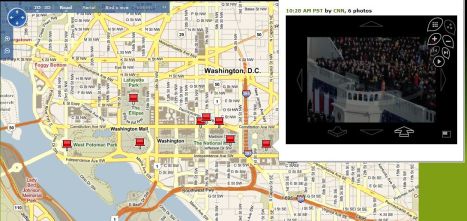
Some of the best set of mashups using cutting-edge technology, to my mind, are the photographs from media and members of the crowd on the Mall, being synthed into 3D Photosynth virtual models. Really cool!inaugural-photosynth


Twitter and other social-media services and channels appeared to hold up well under the crush of traffic. I was pleasantly surprised with the performance of Microsoft’s official streaming of the entire ceremony for the Presidential Inaugural Committee, using Silverlight (same technology was used really nicely for global streaming of the Summer Olympics last year).  In fact, the online streaming was markedly smoother than the ability of the TV networks to speak to reporters reliably down on the Mall – it appeared that network and cellular traffic was constantly cutting out on remote video and microphones.

A moving day, brought to more people than ever before through technology.

 Email this post to a friend

AddThis Social Bookmark Button

Swap Panetta and Blair: A Modest Proposal

First, a quick story from when I was working in government.

Not long after the initial establishment of a “Director of National Intelligence,” the DNI CIO held an inaugural “DNI Information Sharing Conference” in Denver in the summer of 2006. I was asked to sit on a panel about “Innovation across the Intelligence Community,” representing the Defense Intelligence Agency and sharing the stage with two counterparts, from the CIA and NSA.  Our panel chair was Mr. CJ Chapla, then the Chief Technology Officer (CTO) of the old Intelink Management Office, redubbed “Intelligence Community Enterprise Services,” an office now under the Office of the DNI (ODNI). CJ asked the three of us to describe briefly the goals and projects we were each working on, and in seriatim that’s what we did for 90 minutes or so.

When it was time for questions, the very first audience-member asked: “It seems that each of you are independently working on, and paying for, very similar kinds of technology projects. It would make sense to combine or rationalize the work, so why are you continuing to do it independently?” Continue reading

Some say Obama has already chosen Cyber Czar

I’ll wade into the breach again, of analyzing (and trying to anticipate) some national-security appointments for the new Obama Administration.  Today I must admit that I’m taken with the latest reportage from the U.K. Spectator – a quite conservative publication not usually known for its closeness to the Obama inner circle.

Continue reading

Elbowing for Obama influence between new CTO, new cyber czar

Today’s Friday – usually a big news day in Washington, whether by design (bury bad news late in a deep weekend news hole) or by human error (bureaucrats tried all week to get something done and slipped it in at the deadline).  There should be Obama cabinet announcements today, and meanwhile tech luminaries across the country are sitting by their phones, drumming their fingers and hoping for a call offering them the position of the nation’s first Chief Technology Officer. Norm Lorentz, who was OMB’s first-ever CTO, told C-SPAN this week that “If I were asked, I would serve in a heartbeat.”

Continue reading

Several new Microsoft advanced technologies

Fact: As reported in TechCrunch and other sites today, “Microsoft’s Live Labs has just released Thumbtack, a web clipping service that allows users to compile links, media, and text snippets into online storage bins for future reference. Users can also share their Thumbtack collections with their peers, allowing them to collaborate by adding new clips and notations… The service works fine on IE7 and Firefox, and isn’t OS dependent. Each of these clippings can be sorted into folders called ‘Collections’, which can be published to the web via RSS, embedded in blogs, opened to friends for collaboration, or kept private for safe keeping.”  [There’s also a good Ars Technica review of Thumbtack here.]

Continue reading

March of progress with human consequences

Fact: Today Cisco announced a new program with “learning solutions partners” to support China’s growing IT infrastructure by “Nurturing Talent in More Than 100 Training Centers Across 31 Cities in China” (Cisco Launches Talent Development Strategy for China“)

Analysis: One day last week an enterprising handyman in my little town of Montross, Virginia spied a large sinkhole in the long driveway leading up to our house. He offered to my wife that he’d fill and level the hole for $20.  Sold! Continue reading

Bob Gates and the future of defense thinking

Now that Bob Gates is officially going to stay on as Secretary of Defense in the Obama Administration, it’s worthwhile to refresh our understanding of his thinking. Continue reading