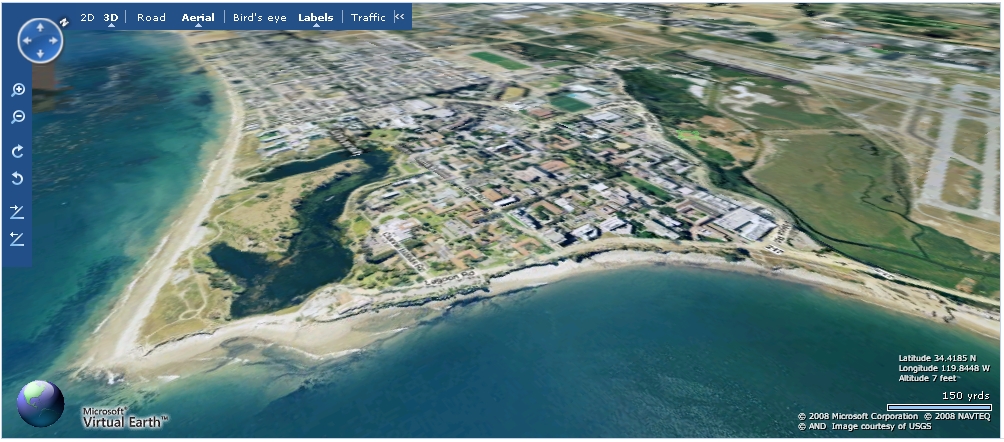
Higher Math on the Sands of Santa Barbara

UCSB

UCSB, looking NW

Spent Sunday afternoon with world-renowned mathematician Michael Freedman (short bio here) walking the beach and bluffs above, just northwest of UC Santa Barbara, talking about a number of absurd and not-so-absurd possibilities in the future applications of quantum computing.  Here’s an example of the kind of stuff I was trying, very hard and maybe somewhat successfully, to grasp while walking in the California sun and trying to ignore the nude sunbathers and hang-gliders.  If that’s unhelpful (as most of it is for me), here’s a straightforward description of some of his main work and its possible applications. 

Continue reading

Healthcare: It’s the Data, Stupid

Fact: Today’s L.A. Times has a startling report: “A stunning number of people who work in healthcare settings lack paid sick time — as many as 75% of all home health aides, for example… Federal data indicate that as many as 29% of all workers in the ‘healthcare and social assistance’ job sector lack paid sick days. Healthcare employees who work while ill may end up hurting the people they are hired to help….”

Analysis: Mark Twain said the only two sure things in life were death and taxes.  So it’s no surprise that the two presidential campaigns are focusing on healthcare and the economy, since people are universally affected in personal ways.  Forget taxes for today, I’m interested in technology’s role in healthcare, which is growing, and there’s no more potentially game-changing facet of that than the role of data. 

Continue reading

Innovation in Robotics: Government Uses?

Fact: Last week’s Automatica 2008, the big international robotics and automation trade-show, had “over 30,000 trade visitors from around 90 countries,” visiting 900 exhibitors’ booths, according to the conference wrap-up

Analysis: When I spoke recently at an IARPA conference in Orlando, and was asked to give a glimpse into Microsoft’s vision of R&D trends, one of the possibly surprising areas I highlighted was robotics.  We’re making a major push in that area, for reasons that might not be intuitive based on an old-fashioned impression of what Microsoft offers in the government realm.  More on the intelligence community’s potential use below.

Continue reading

The Nimitz Class Data Center?

Just an observation: We were discussing this week with a Navy 3-star the status of Microsoft’s work in mega-data-centers.  We brought up the combined-container strategy we’re using and how this provides a hyper-flexible platform for large data center scenarios, in obvious ways – lots of computational power available for web-scale hosting or anything smaller. 

Continue reading

How to Find Research: Here, There, Everywhere

FACT: The Washington Post today has a story in the Business section (“Intelligence Agency Joins U-Md. Research Center“) about the relationship between IARPA and the University of Maryland, the location of the planned new IARPA headquarters. 

ANALYSIS: UMd has a set of valuable relationships with the public- and private-sector national security community, and the IARPA startup is just the latest agency to benefit.   Proximity is key, for research and bureaucracy.  In Maryland’s case, IARPA Director Lisa Porter told an IEEE interviewer last month that “It’s nice not to be sitting right next to one particular agency. It’s also nice to be near a university because we’re sending a message that we want to bring in nontraditional partners: academia, industry. It sends a nice message that we’re embracing the broad community to help us solve these challenging problems.”

I lament sometimes that Charlottesville (home to my undergraduate alma mater) is a good two hours away from DC, as even that distance puts a frustrating limit on the amount of joint work that winds up being done with Virginia faculty and students. 

Continue reading

Pentagon’s New Program for Innovation, in Context

FACT: According to an article in today’s Washington Post, the Pentagon has announced “the selection of six university professors who will form the first class of the National Security Science and Engineering Faculty Fellows Program. The professors will receive grants of up to $600,000 per year for up to five years to engage in basic research — essentially a bet by the Pentagon that they will make a discovery that proves vital to maintaining the superiority of the U.S. military.”

ANALYSIS: This new program is an innovation from DoD’s Director of Defense Research and Engineering (DDR&E), and since tomorrow I’ll be at Ft. McNair for a two-day conference sponsored by DDR&E on Strategic Communications, I’ll congratulate John Young and his staff for the good idea.

But the Post article falls short in two ways: one immediate (it leaves out key information about next year’s program and the upcoming deadline!) and one longer-term (it ignores the overall context of federal support for R&D).  I’ll fill in the blanks below.

Continue reading

War is Virtual Hell

FACT: According to market research compiled by Microsoft, the global market for Modeling and Simulation (M&S) software/hardware platforms across all industries, including the defense industry, has hit $18 billion per year; the cumulative growth rate is estimated at 9.6% annually.

ANALYSIS:  The lovely wife and I have been lackadaisically house-hunting down in Virginia’s Northern Neck, the Athens of America and the cradle of our democracy. The Neck is the birthplace of George Washington, the Lee brothers (the revolutionary patriots about whom John Adams used the phrase, “This Band of Brothers,” among them Declaration of Independence signers Richard Henry Lee and Francis Lightfoot Lee, not to mention their later nephew Robert E. Lee), James Monroe, John Ballentine, etc. etc. 

Anyway, recently we toured the historic 1859 house at Braehead, an 18-acre estate actually located within the Civil War battlefield in Fredericksburg, Virginia. The house is for sale, and while it’s likely overpriced (like everything else on the market these days) [this observation has been energetically and somewhat persuasively disputed by the listing agent, who read the post], but we enjoyed the tour.  I’ve posted many (too many) photos of our little tour here.  My interest in the house is the historic angle: it’s actually where Robert E. Lee visited and took breakfast on the morning of the Battle of Fredericksburg in 1862, one of his successful efforts against U.S. forces.  Here’s an article about Braehead’s history and historic preservation.

It was in fact at Fredericksburg that Lee spoke the words which would sum up the entire war, nay all wars, as he witnessed thousands of Union soldiers falling in battle to Confederate guns on the hills above the Rappahannock River: “It is well that war is so terrible, lest we grow too fond of it.”  

Continue reading

How to Run a State-of-the-Art Technology Program – Quietly

FACT: In the new movie “Iron Man,” defense-contracting billionaire and engineering genius Tony Stark (played by Robert Downey Jr.) designs and builds a suit capable of individual flight (highly engineered control surfaces powered by an “arc-reactor” – it is Hollywood after all). During his first test flight, zooming straight up from Malibu and stressing the system to its max, he asks his onboard computer, “What’s the altitude record for the SR-71?” His computer responds back, “85,000 feet,” whereupon he zooms past that ceiling.

ANALYSIS: Funny moment, and excellent movie.  In its honor, below I’m going to give you access to a remarkable, recently declassified document describing one of America’s boldest Cold War technical achievements.  If you’ve ever run (or wanted to run) a high-tech company or program, like Tony Stark in the movie, you’ll appreciate the startling scope of the work – and if you’ve recently worked in DoD or the Intelligence Community you’ll marvel at how they did it “in the good old days.”

Continue reading

Quick – What’s Your Idea to Improve Homeland Security?

If you have a brilliant idea for protecting Homeland Security – and your idea can stand up to competitive scrutiny – have I got a proposal for you. The well-respected Christopher Columbus Fellowship Foundation has extended its deadline for entries for their $25,000 Homeland Security Award program, presented by AgustaWestland (the helicopter giant). Darlene Cavalier of the Foundation asked me today to remind my readers: “Super simple online nomination process: Here’s the Award entry site, and no fee to enter. However, the deadline is this Friday, May 30 at 5pm EST.”

Continue reading