MSR gets wired, WIRED gets MSR

MS Research in natural-user-interaction technologies
MSR natural-user-interaction immersive technologies

WIRED Magazine’s online site ran a great long profile of Microsoft Research late yesterday, with interviews and project features: “How Microsoft Researchers Might Invent a Holodeck.”

I have written about or mentioned all of the individual projects or technologies on my blog before, but the writing at WIRED is so much better than my own – and the photographs so cool – that I thought I should post a link to the story. Continue reading

The almighty ampersand linking R and D

According to Wikipedia, the lowly ampersand or “&” is a logogram representing the conjunction word “and” using “a ligature of the letters in et,” which is of course the Latin word for “and.”

In my line of work I most frequently encounter the ampersand in the common phrase “R&D” for research and development, although I notice that with texting and short-form social media the ampersand is making something of a comeback in frequency of use anyway.

Continue reading

Kinecting Communities

On April 16 I will be speaking at the Mobile Citizen Summit in Washington DC (registration still open), which brings together “practitioners across the  government, nonprofit, advocacy, and political spaces—the kinds of  people who develop the strategy and the tools to reach, engage, educate,  and enable citizens across the country and around the world.”

But I’m going to be talking about “mobile” in a different way than others still use the term, i.e. they focus on a handheld device, while I will be focusing on the mobile citizen. As I have said before I don’t believe our future involves experiencing “augmented reality” by always holding up little 3-inch plastic screens in front of our faces. Natural user interfaces and immersive computing offer much more to how we access computational resources – and how technology will help us interact with one another. Here’s an example, in a story from the past week.

Continue reading

Air Everything

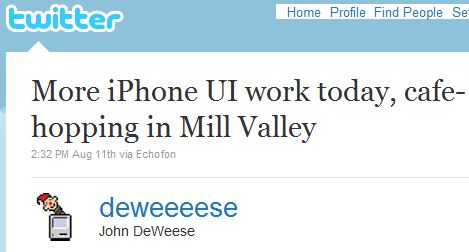
Like many people, I was very impressed by a video over the weekend of the Word Lens real-time translation app for iPhone.  It struck with a viral bang, and within a few days racked up over 2 million YouTube views. What particularly made me smile was digging backwards through the twitter stream of a key Word Lens developer whom I follow, John DeWeese, and finding this pearl of a tweet (right) from several months ago, as he was banging out the app out in my old stomping grounds of the San Francisco Bay Area. That’s a hacker mentality for you 🙂

But one thought I had in watching the video was, why do I need to be holding the little device in front of me, to get the benefit of its computational resources and display? I’ve seen the studies and predictions that “everything’s going mobile,” but I believe that’s taking too literally the device itself, the form-factor of a little handheld box of magic.

Continue reading

Playing with virtual data in spatial reality

For the past few months, when I’ve had visitors to Microsoft Research on the Redmond campus one of the things I’ve enjoyed demonstrating is the technology behind the new system for Xbox 360 – the controller-free gaming and immersive entertainment system that Microsoft is releasing for the holiday market in a month or so. In particular, I’ve enjoyed having Andy Wilson of MSR talk with visitors about some of the future implications in non-gaming scenarios, including general information work, and how immersive augmented-reality (AR) could transform our capabilities for working with information, virtual objects, and how we all share and use knowledge among ourselves.

We’re further along in this area than I thought we’d be five years ago, and I suspect we’ll be similarly surprised by 2015.

In particular, there is great interest (both in and out of the government circles I travel in) in the “device-less” or environmental potential of new AR technologies. Not everyone will have a fancy smartphone on them at all times, or want to stare at a wall-monitor while also wearing glasses or holding a cellphone in front of them in order to access other planes of information. The really exciting premise of these new approaches is the fully immersive aspect of  “spatial AR,” and the promise of controlling a live 3D environment of realtime data. Continue reading

Mix, Rip, Burn Your Research

You’ve done research; you’ve collected and sifted through mounds of links, papers, articles, notes and raw data. Shouldn’t there be a way to manage all that material that’s as easy and intuitive as, say, iTunes or Zune – helping you manage and share your snippets and research the way you share and enjoy your music?

Continue reading

Your choice, Dataviz as event or book

A friend wrote asking if I could make it to an event happening this week near DC. I can’t make it, but fortunately he also mentioned as consolation that he has a cool new book on the cusp of release – and I’ve now ordered my copy.

The Friend: legendary visualization and HCI guru Ben Shneiderman (Wikipedia entry). Ben is a computer-science professor at the University of Maryland and the founder of its well-known Human-Computer Interaction Laboratory (HCIL), as well as an ACM Fellow and AAAS Fellow.  He has done government a million favors over the years, consulting for agencies, including his recent work on the Recovery.gov site to help that platform of data – from hundreds of thousands of sources – organize, host, and visualize the data for millions of visitors.  I first got to know Ben through his support for better intelligence analysis – he helped invent a longtime intelligence analytics tool, Spotfire (see his article “Dynamic queries, starfield displays, and the path to Spotfire“).  Ben’s also well-known for his award-winning 2002 book Leonardo’s Laptop: Human Needs and the New Computing Technologies, which I enjoyed and still think about when brainstorming new techie toys.

Continue reading

Free Tools for the New Scientific Revolution

Blogs are great for supplementing real-life events, by giving space and time for specific examples and links which can’t be referenced at the time. I was invited to give a talk last week at the first-ever NASA Information Technology Summit in Washington DC, and the topic I chose was “Government and the Revolution in Scientific Computing.” That’s an area that Microsoft Research has been focusing on quite a bit lately, so below I’ll give some examples I didn’t use at my talk.

One groundrule was that invited private-sector speakers were not allowed to give anything resembling a “sales pitch” of their company’s wares. Fair enough – I’m no salesman.  The person who immediately preceded me, keynoter Vint Cerf, slightly bent the rules and talked a bit about his employer Google’s products, but gee whiz, that’s the prerogative of someone who is in large part responsible for the Internet we all use and love today.

I described in my talk the radical new class of super-powerful technologies enabling large-data research and computing on platforms of real-time and archival government data. That revolution is happening now, and I believe government could and should be playing a different and less passive role. I advocated for increased attention to the ongoing predicament of U.S. research and development funding.

Alex Howard at O’Reilly Radar covered the NASA Summit and today published a nice review of both Vint’s talk and mine.  Some excerpts: Continue reading

DARPA crowd guru gets a new lab

It’s been a little over two years since I came back to the tech private sector from my government service, and it’s great when we have other folks take the same path, for it improves the knowledge of each side about the other. Today we’re announcing that Peter Lee, currently the leader of the Defense Advanced Research Projects Activity’s innovative Transformational Convergence Technology Office (TCTO), is joining Microsoft to run the mighty flagship Redmond labs of Microsoft Research.

Continue reading

A Technical Computing revolution

Last week I enjoyed hosting a visit in Redmond from Chris Kemp, NASA’s new Chief Technology Officer for information technology. Our discussions were with folks from the Windows Azure cloud computing team, the high-performance computing and large-data folks, and our Extreme Computing Group. I smiled when Chris said he was a fan of the book Total Recall: How the E-Memory Revolution Will Change Everything, written by Microsoft’s Gordon Bell and colleague Jim Gemmell. (I wrote about their research projects in an earlier post, Total Recall for Public Servants.)

Continue reading