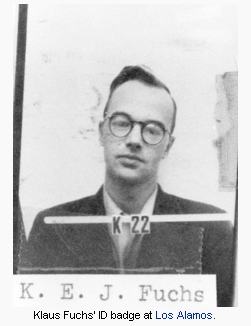
Theory of the Fireball, Supercomputing, and other Los Alamos Tidbits

Back in the early ’90s when I was first dating Kathryn, now the lovely bride, we went on some awesome roadtrips, including many cross-country – great way to get to know someone.  At the time my brother was an Air Force pilot, flying the F-117 stealth fighter, so we once paid him a visit at Holloman AFB on a 10-day drive through the Southwest.  I’ll have to find and upload to Flickr the pictures he took of each of us sitting in its classified cockpit – surely a massive security violation which I lay entirely at his feet (lucky for him he’s retired from the Air Force now and flying for Delta). 

Sadly, the F-117 Night Hawk has also now been officially retired, replaced by the F-22 Raptor.

As much as that was a thrill, though, the highlight of that particular roadtrip was driving up to the Los Alamos plateau and spending some time touring around the Lab, the Museum, and the interesting little town that’s grown up around all that PhD talent in the middle of the high desert.

That lab’s on my mind because I’ve been thinking about supercomputing and the revolution it could undergo thanks to quantum computing. I’m in Santa Barbara visiting the “Station Q” research program in quantum computing, and will write more about quantum computing soon, since I’m actually beginning to understand it.

But as an interesting artifact in my preparatory reading, Microsoft’s John Manferdelli sent me a link to a Federation of Atomic Scientists archive of declassified Los Alamos National Lab technical reports and publications, from “the good old days” at Los Alamos.

Continue reading

Latest NASA Launch: Viral Marketing

Fact: Aviation Week has a piece today (“Funding Biggest ISS Obstacle“) outlining the budgetary woes of the International Space Station program, noting that the five partnering national space agencies which jointly operate the ISS “say they are eager to use the facility as a stepping stone for lunar and Martian exploration, but they first must find a way to sustain operations beyond the present partnership agreement….The main question mark about extending operations is related to funding and not technical issues. No road map or timetable for prolonging the ISS lifetime can be established until these financial issues have been resolved.”

Analysis: I’m a fan of space research and travel, and I’d like to see more funding and attention go into the American space effort, and with it more American ability to collaborate on international space ventures.

Continue reading

Research and Intelligence … Research for Intelligence

I’ll be at Penn State University for the next couple of days, at the Research in American conference.  This particular conference, with the theme “Connecting Technology Thought Leaders with Government Officials,” is sponsored by the Office of the Director of National Intelligence, focusing on their Science and Technology area. 

Here’s the agenda for the conference, which has an excellent lineup of technologists presenting their approaches and progress. 

ODNI turned to the Intelligence and National Security Alliance (INSA) to host and run the conference.  Someone, somewhere in the chain, slipped up and invited me as the Keynote speaker for Tuesday – I’m planning to do the thing with no slides and to speak (in part) about the emerging possibilities of revolutionary research in a post Web 2.0 world.

For some sobering background information,  check out a recent tour of the research-funding horizon by Amy Ellis Nutt in the New Jersey Star-Ledger (“As research funds stagnate, science in state of crisis“).  Here’s a taste:

Once the world’s gold standard, American scientific enterprise is in free fall. Short of government funds and strapped for cash, researchers across the country are abandoning promising avenues of scientific investigation and, increasingly, the profession of science itself.” – Amy Ellis Nutt, The Star-Ledger

Do you share that pessimism?  Think it’s overstated?

I’ll give an update about the conference tomorrow.

Email this post to a friend

AddThis Social Bookmark Button

The “Rush to the Cloud” – Not So Fast…

Had a great time on Wednesday on a panel at the “Defense 2.0” conference, at the Arlington Ritz-Carlton.  I believe I learned as much from my fellow panelists from Cisco, IBM and so forth – about the importance of information security and assurance – as any conference in recent memory.  The story in Government Computer News (“Defense 2.0 a Work in Progress“) captures the views of most of the speakers. 

I had a gentle and gentlemanly disagreement with the keynote speaker, Mike Nelson.  Mike has a distinguished career, working with Internet-inventor Al Gore while he was VP, and later Director of Internet Technology and Strategy at IBM.  I offered that he was perhaps slightly overly enamored of the “rush to the Cloud” school of thinking.  I’ve written about that school of thought before, and the balance of where computing power is likely to reside in future, given Moore’s Law for the foreseeable future.  The GCN quotes capture my thinking in short form: there’ll be the cloud, along with increasingly powerful computing in local form factors (some desktops, more laptops, handhelds, mobiles, and embedded-computing forms of all sorts).

Continue reading

Healthcare: It’s the Data, Stupid

Fact: Today’s L.A. Times has a startling report: “A stunning number of people who work in healthcare settings lack paid sick time — as many as 75% of all home health aides, for example… Federal data indicate that as many as 29% of all workers in the ‘healthcare and social assistance’ job sector lack paid sick days. Healthcare employees who work while ill may end up hurting the people they are hired to help….”

Analysis: Mark Twain said the only two sure things in life were death and taxes.  So it’s no surprise that the two presidential campaigns are focusing on healthcare and the economy, since people are universally affected in personal ways.  Forget taxes for today, I’m interested in technology’s role in healthcare, which is growing, and there’s no more potentially game-changing facet of that than the role of data. 

Continue reading

So Long, Long Tail?

I’ve been known to disagree with Harvard eggheads before 🙂 


Chris Anderson's Long TailAnd now, perhaps, another opportunity. A new Harvard Business Review article (“Should You Invest in the Long Tail?” by HBS Professor Anita Elberse) throws water on Chris Anderson’s paradigm, arguing that “hit products” are still more valuable than the conglomerated also-rans in the tail; her research is mostly in retail products. Chris has responded on his blog, sparking many comments and debate, and today the Wall Street Journal covered the back-and-forth debate.

I’m interested in the debate mostly because of the interest in the Long Tail way of thinking in some circles of the intelligence community.  I’ve written about the approach and its relevance to some intelligence issues (see “Tradecraft in the Long Tail” and “IARPA and the Virtual Long Tail“).

I’m just not certain that even a total debunking of the retail-oriented paradigm would undercut its value as applied to intelligence analysis. 

For intelligence analysts, obscure “facts” and patterns hidden snugly within the low-scale noise are all important – whether or not they gain numerative bulk in any accumulative way.  The paradoxical “unknown unknowns” are what’s being sought by dogged collection and analysis, and I’m not sure that’s analogous to Elberse’s acknowledged findings. 

Your thoughts welcome, here or by email back to me.

 
Email this post to a friend

AddThis Social Bookmark Button
 

Early Bill Gates, and Bill’s Last Email

From Bill Gates’s final email today to “All at Microsoft”:


As Microsoft has grown, one of the most exciting and fulfilling things for me has been to watch new leaders develop. I am thrilled to have Ray and Craig playing key roles in guiding the company’s strategy… For over a decade I had hoped that we could convince Ray to join Microsoft — and in the three years he has been here, he has made a huge difference in helping us focus on the challenge and opportunity of software plus services. I have worked with Craig for more than 15 years. His ability to anticipate the future direction of technology is a key asset, as is his deep interest in and understanding of emerging markets.

Of course, I’ll continue to be involved in the work of the company as part-time Chairman. As part of this I will help with a handful of projects that Steve, Ray, and Craig select.”  

Continue reading

Prediction Markets: Research and Limits

Fact: A story in Science Daily this week, “Election Forecasters Preparing For Historic Election,” relates the publication this month of the “assembled insights of prominent election forecasters in a special issue of the International Journal of Forecasting.” 

Analysis:  The journal articles are available here for download.  One of them, “Prediction Market Accuracy in the Long Run” (by Joyce E. Berg, Forrest D. Nelson, and Thomas A. Reitz from the University of Iowa’s Tippie College of Business), compares the presidential election forecasts produced from the granddaddy of them all, the Iowa Electronic Market (IEM), to “forecasts from an exhaustive body of opinion polls.”  Science Daily says they find that the IEM is “usually more accurate than the polls.”

If we extrapolate out, these election markets are special cases of prediction markets, and I’m always interested in those.

Continue reading

How to Find Research: Here, There, Everywhere

FACT: The Washington Post today has a story in the Business section (“Intelligence Agency Joins U-Md. Research Center“) about the relationship between IARPA and the University of Maryland, the location of the planned new IARPA headquarters. 

ANALYSIS: UMd has a set of valuable relationships with the public- and private-sector national security community, and the IARPA startup is just the latest agency to benefit.   Proximity is key, for research and bureaucracy.  In Maryland’s case, IARPA Director Lisa Porter told an IEEE interviewer last month that “It’s nice not to be sitting right next to one particular agency. It’s also nice to be near a university because we’re sending a message that we want to bring in nontraditional partners: academia, industry. It sends a nice message that we’re embracing the broad community to help us solve these challenging problems.”

I lament sometimes that Charlottesville (home to my undergraduate alma mater) is a good two hours away from DC, as even that distance puts a frustrating limit on the amount of joint work that winds up being done with Virginia faculty and students. 

Continue reading