Google, Microsoft, and Medical Research

Fact: Two stark numbers are published today about Google co-founder Sergey Brin. First, the annual update of the “Forbes 400” wealthiest billionaires reports that Brin’s personal net worth is $15.9 billion (though that’s down some $2.7 billion from last year, due to the decline of Google’s stock price by 40% since last November).  More importantly, Brin himself wrote in his personal blog today that by having genetic research done on himself, “I learned something very important to me — I carry the G2019S mutation… it is clear that I have a markedly higher chance of developing Parkinson’s in my lifetime than the average person. In fact, it is somewhere between 20% to 80% depending on the study and how you measure.”

Analysis: Sergey Brin’s own blog account of his discovery is a remarkably personal and touching piece, dealing with his mother and her own belated diagnosis of Parkinson’s, and the scientific boundaries of current genetic research and the implications one can draw from this immature field of science.
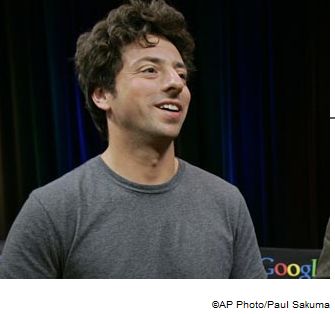
(c) AP Photo, Paul Sakuma

This was only the second post on Sergey’s new blog; the blog’s name is “Too” – and the first post merely stated the rationale for that name (“Welcome to my personal blog. While Google is a play on googol, too is a play on the much smaller number – two. It also means ‘in addition,’ as this blog reflects my life outside of work”). 

If his refreshing honesty and thoughtfulness today are going to be the calibre of his writing, I’m going to be a regular reader. 

His piece reminds me of Steve Jobs’ modern classic, his 2005 Stanford Commencement Address.  If you’ve never read that, then stop reading my words right now, and go read that. You’ll find yourself over the weekend thinking about your own approach to life.

But back to Brin and genetic research.  It will be interesting to watch what Google’s research arm is able to do in the area of medical and health research.  To make progress in bioengineering and genetics, “organizing the world’s information” is absolutely paramount and of course that’s Google’s mission statement.

Continue reading

Twitter Says LHC Fires Up, Earth Stubbornly Refuses to End

Fact: This morning’s press release from CERN: “Geneva, 10 September 2008. The first beam in the Large Hadron Collider at CERN was successfully steered around the full 27 kilometres of the world’s most powerful particle accelerator at 10h28 this morning. This historic event marks a key moment in the transition from over two decades of preparation to a new era of scientific discovery.” (LHC background here.)

Analysis: Early this morning, Twitter alerted me that the Earth was still spinning. Below I explain how.

Continue reading

Invisibility, Mind-Control, Great Coffee, and a New OS

Lots of interest and blogoshere commentary beginning about “The Mojave Experiment.”

The reaction is reminiscent of one of those Obama or McCain provocative ads posted online, generating far more attention and buzz than the attention they get on the natural by being broadcast.

Sure, it’s a sales pitch, and pretty narrowly geeky at that (thanks GoogleFight!).

But at least it’s an innovative one – as the Wall Street Journal puts it today, “Give Microsoft people credit: They did it with humor, and they weren’t afraid to air the negative stuff.”

Continue reading

Higher Math on the Sands of Santa Barbara

UCSB

UCSB, looking NW

Spent Sunday afternoon with world-renowned mathematician Michael Freedman (short bio here) walking the beach and bluffs above, just northwest of UC Santa Barbara, talking about a number of absurd and not-so-absurd possibilities in the future applications of quantum computing.  Here’s an example of the kind of stuff I was trying, very hard and maybe somewhat successfully, to grasp while walking in the California sun and trying to ignore the nude sunbathers and hang-gliders.  If that’s unhelpful (as most of it is for me), here’s a straightforward description of some of his main work and its possible applications. 

Continue reading

Latest NASA Launch: Viral Marketing

Fact: Aviation Week has a piece today (“Funding Biggest ISS Obstacle“) outlining the budgetary woes of the International Space Station program, noting that the five partnering national space agencies which jointly operate the ISS “say they are eager to use the facility as a stepping stone for lunar and Martian exploration, but they first must find a way to sustain operations beyond the present partnership agreement….The main question mark about extending operations is related to funding and not technical issues. No road map or timetable for prolonging the ISS lifetime can be established until these financial issues have been resolved.”

Analysis: I’m a fan of space research and travel, and I’d like to see more funding and attention go into the American space effort, and with it more American ability to collaborate on international space ventures.

Continue reading

Research and Intelligence … Research for Intelligence

I’ll be at Penn State University for the next couple of days, at the Research in American conference.  This particular conference, with the theme “Connecting Technology Thought Leaders with Government Officials,” is sponsored by the Office of the Director of National Intelligence, focusing on their Science and Technology area. 

Here’s the agenda for the conference, which has an excellent lineup of technologists presenting their approaches and progress. 

ODNI turned to the Intelligence and National Security Alliance (INSA) to host and run the conference.  Someone, somewhere in the chain, slipped up and invited me as the Keynote speaker for Tuesday – I’m planning to do the thing with no slides and to speak (in part) about the emerging possibilities of revolutionary research in a post Web 2.0 world.

For some sobering background information,  check out a recent tour of the research-funding horizon by Amy Ellis Nutt in the New Jersey Star-Ledger (“As research funds stagnate, science in state of crisis“).  Here’s a taste:

Once the world’s gold standard, American scientific enterprise is in free fall. Short of government funds and strapped for cash, researchers across the country are abandoning promising avenues of scientific investigation and, increasingly, the profession of science itself.” – Amy Ellis Nutt, The Star-Ledger

Do you share that pessimism?  Think it’s overstated?

I’ll give an update about the conference tomorrow.

Email this post to a friend

AddThis Social Bookmark Button

Test for Prediction Markets: They Say Obama, but Polls Say It’s Tied

Fact: According to the latest Rasmussen poll released Saturday July 12, and promptly headlined by the Drudge Report, “The race for the White House is tied. The Rasmussen Reports daily Presidential Tracking Poll for Saturday shows Barack Obama and John McCain each attract 43% of the vote.” Newsweek is reporting a similar result in its own poll, with Obama moving down and McCain up (“Obama, McCain in Statistical Dead Heat“), and other polls increasingly show a similarly close race.

Analysis: I’ve been tracking the growing divide between two quite different methods purporting to offer statistical predictive analysis for the November presidential election. Polls are saying one thing, but Prediction Markets are saying another. 

Continue reading

Up Late? Innovate.

Here’s some quick thought-provoking advice from Phil McKinney, who runs HP’s Innovation Program Office.  (Phil has his own blog as well, but the advice comes from an interview yesterday in the San Jose Mercury News.)

Q. One of your tips for innovation is to stay up late, because that’s when your filters are down. (The mental filters that rule out wild ideas, which might turn out to be good ones.) Do you still do that?

A. “Oh yeah, it drives my wife crazy. The idea really is to go back to things you’d do before you were successful, before you learned that you’ve always got to be on your guard.”

Man, do I swear by that!  Phil has some other points that I’m less enamored with, mostly because I don’t believe he’s thinking very radically.  His point that in the future we might be data-mining healthcare histories is undercut by the fact that we’re already doing it, as I blogged yesterday

Another less-than-startling prediction: We’ll still be using Second-Life style virtual worlds two decades from now?  Please!  I suppose we’ll also still be changing toner cartridges!!

Check out Phil’s blog, it reflects his innovative thinking better 🙂   But don’t read it till after midnight…

 
Email this post to a friend

AddThis Social Bookmark Button

How to Find Research: Here, There, Everywhere

FACT: The Washington Post today has a story in the Business section (“Intelligence Agency Joins U-Md. Research Center“) about the relationship between IARPA and the University of Maryland, the location of the planned new IARPA headquarters. 

ANALYSIS: UMd has a set of valuable relationships with the public- and private-sector national security community, and the IARPA startup is just the latest agency to benefit.   Proximity is key, for research and bureaucracy.  In Maryland’s case, IARPA Director Lisa Porter told an IEEE interviewer last month that “It’s nice not to be sitting right next to one particular agency. It’s also nice to be near a university because we’re sending a message that we want to bring in nontraditional partners: academia, industry. It sends a nice message that we’re embracing the broad community to help us solve these challenging problems.”

I lament sometimes that Charlottesville (home to my undergraduate alma mater) is a good two hours away from DC, as even that distance puts a frustrating limit on the amount of joint work that winds up being done with Virginia faculty and students. 

Continue reading