Pentagon’s New Program for Innovation, in Context

FACT: According to an article in today’s Washington Post, the Pentagon has announced “the selection of six university professors who will form the first class of the National Security Science and Engineering Faculty Fellows Program. The professors will receive grants of up to $600,000 per year for up to five years to engage in basic research — essentially a bet by the Pentagon that they will make a discovery that proves vital to maintaining the superiority of the U.S. military.”

ANALYSIS: This new program is an innovation from DoD’s Director of Defense Research and Engineering (DDR&E), and since tomorrow I’ll be at Ft. McNair for a two-day conference sponsored by DDR&E on Strategic Communications, I’ll congratulate John Young and his staff for the good idea.

But the Post article falls short in two ways: one immediate (it leaves out key information about next year’s program and the upcoming deadline!) and one longer-term (it ignores the overall context of federal support for R&D).  I’ll fill in the blanks below.

Continue reading

Is It Even Possible to Connect the Dots?

FACT: Among the inspired ideas of polymath Danny Hillis (pioneer of parallel computing) was establishing the Long Now Foundation, whose projects include the millennial Long-Now Clock (“the world’s slowest computer”) and the notion of “Long Bets.”  A Long Bet is an “accountable prediction,” meaning one that has a specified end-date and a testable, wagerable, proposition.  One of the early Long Bets posted wagers $2,000 that “By 2020, no one will have won a Nobel Prize for work on superstring theory, membrane theory, or some other unified theory describing all the forces of nature.”  That particular bet is one of many signs of scientific skepticism about string theory.

ANALYSIS: Even without the ease of hyperlinks, old-fashioned newspapers foster serendipitous connections between articles, particularly if you’re reading a Sunday morning paper with lots of sections. Sunday the Washington Post did me a service by placing in different sections a couple of articles which I connected, about intelligence “failures” and about stock-market prediction, leading me to some web-surfing about the questionable validity of string theory and some related observations about the difficulty of predicting human behavior.

In the Outlook section, the Post has an opinionated and thought-provoking op-ed piece by Mark Lowenthal, one of the most “intelligent” individuals in the recent history of the U.S. intelligence community (after all, he was the 1988 Jeopardy grand champion, as well as a former assistant director of CIA).

Continue reading

Update on Facebook-in-Egypt

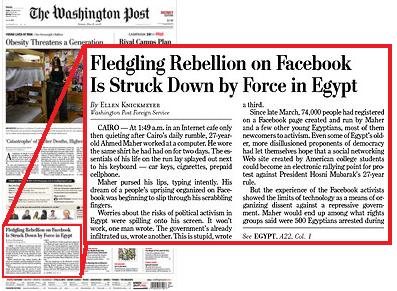
FACT: According to a Sunday Washington Post front-page story today recounting the events leading up to May 4, a “day of strike” called for by social-networkers as a protest against government policies, “By late afternoon, of the 74,000 people who had registered on the Facebook protest page, only 15 – three men and 12 women – were still eager to gather for a protest.”  [Note: the Facebook page had only been launched in late March.]

ANALYSIS: Last week I wrote about media coverage of Egypt’s Facebook affair, and noted that the Post and others had only covered it on media blogs, not in the actual newspaper.

This morning I picked up my Sunday-morning Post and saw the story, “Fledgling Rebellion on Facebook Is Struck Down by Force in Egypt,” right on the front page, which means that across Washington this morning, and other capital cities through clipping services, many in the foreign policy elite and punditocracy may be reading for the first time about the Web 2.0 facet of these events. 

Reporter Ellen Knickmeyer also posted today a related online “Field Notes” column about the challenges of covering the Facebook activists.

AddThis Social Bookmark Button 

Social Networking in Egypt Takes a Political Turn

FACT: In the past two days, reporters for the Los Angeles Times and the Washington Post have each written accounts of the ongoing confrontation in Egypt between the government and online activists – the “Facebook Revolution” as the Post reporter terms it, hyperbolically. One interesting aspect: the two accounts are not carried as actual news stories in the “newspaper” (real or virtual), but as blog posts by the reporters on dedicated foreign-correspondent blogs. The Washington Post account is on the “PostGlobal” uber-blogsite, under Jack Fairweather’s “Islam’s Advance” blog, while the L.A. Times account is on the “Babylon & Beyond” blog, which carries a sub-head of “Observations from Iraq, Iran, Israel, the Arab World and Beyond.”

ANALYSIS: Up to now there’s been little coverage in traditional American media outlets of the emerging political tenor of some social networks in Egypt over the past several months. Major newspapers and the cable-news channels have not explored the topic, but I just returned from some time in Egypt and I learned that of course it is a widely covered and discussed topic there.  One young woman in her 30s, an urban professional, told me “I’m on Facebook all day long!”

Every morning outside my hotel room I would find an English-language newspaper, and for many days in a row it was a different paper – often because they were weekly editions.  That gave me the opportunity to read a variety of opinions from a somewhat broad band, as measured in “distance to/from the government position.”  

Helpfully, on May 6 2008 the Egyptian Mail included a summary of the raging controversy over Facebook, noting that “In Egypt, Facebook is the stage for the latest twist in the generation gap, playing host to politically hungry young Egyptians eager to take on their ageing leader.”  Only at the end of the article did I notice that it was reprinted from a New-York-based Egyptian blogger, the respected Mona Eltahawwy.

Continue reading

“Legally Blonde 2.0” – SoCal Spook at Harvard

Shout out to Chris Rasmussen, a former colleague in the intell biz who emails that he’ll be speaking on uses of Web 2.0 approaches in the Intelligence Community at Harvard’s Kennedy School of Government in June…. as he put it in his email, “I’m pretty sure Danish dudes from southern California have been legallyblonde2.jpgblacklisted from Harvard for hundreds of years. Well the times are changing.”

Chris has been involved in social-networking and other 2.0 efforts in the IC, both at the enterprise level and in grass-roots form — accomplishing the latter and encouraging the former (strongly).  The Kennedy School program, “Web 2.0: Taking Action in Government”  is advertised as “examining the lessons learned from first movers in both business and government and distilling what actions government leaders must now take to harness the power of these new tools and business models.”  (more info here

I especially like that the conference is being organized with the help of Don Tapscott, co-author of  an excellent book: Wikinomics: How Mass Collaboration Changes Everything.

Continue reading

Microsoft May Have a Killer Cloud App – Live Mesh

Microsoft Mesh LogoGot a technical briefing on Live Mesh today in Redmond, and I’m impressed – particularly by the demonstrated commitment to interoperability through adhering to web standards – and the very cool Live Desktop giving you remote access to all your files and folders from any device (work computer, home laptop, mobile phone) with  the new Microsoft Device Connectivity Service.

This is what will bring Cloud Computing down to earth.

Continue reading

The Future of Enterprise Computing – and Social Computing

I wrote the other day about how highly ranked the University of Virginia’s undergrad business school is (a close second in BusinessWeek’s annual ranking), and mentioned that one reason is the creative research and programs they sponsor.

In fact, thanks to UVA’s McIntire School of Commerce, I enjoyed a great day recently exploring some of my favorite topics with leading experts.  I was an invited speaker at their one-day conference on The Future of Enterprise Computing on March 14th, presented by McIntire’s Center for the Management of Information Technology (CMIT).  It was a fascinating day….

Continue reading

Social (Network) Science

Fact: The social-networking site LinkedIn claims as users “17,000,000+ Professionals, 500,000+ Senior Executives, Executives from 498 Fortune 500 companies, [and] 65,000 new Professionals every week.”

Analysis: Since I hold the title of “chief technology officer” for my group at Microsoft, I regularly check the widely-read blog CTOvision, written by Bob Gourley, CTO of Crucial Point.

CollaborationlogosYesterday he posted a very solid summary of several social networking tools, including my preferred LinkedIn.  If you’re not up to speed on the genre it is a helpful cheatsheet and “buyer’s guide.”

The technology area deserves the attention. There are a dozen or more such sites for each that Gourley covers, and he chooses the ones that have shown growth and potential longevity; why invest any time adding personal data to a site just to watch it disappear? We’ve all had that happen. And yet hockey-stick growth has to be managed – LinkedIn for example has come in for some critical attention for some snafus along the way.

Let’s look at some efforts to understand more about the science behind the software….

Continue reading

Using Web 2.0 in a top-secret environment

Network World magazine has just posted a podcast interview which I recorded with editor Paul Desmond about a month ago, just after speaking at their “IT Roadmap” conference in December. The interview topic is “Using Web 2.0 tech in a top secret world,” and we discuss the DIA and Intelligence Community experience with social networks, wikis, and blogs.  We also discuss cloud computing, enterprise IT, SOA, IARPA, and the challenges of deploying secure software. Representative quote: “Intelligence analysts are much like ‘knowledge workers’ on Wall Street or in the media, they know what’s going on on the Internet, they know what they want, they know what they need, and it’s in the IT side’s interest to try and service them.”

At the end Paul was gracious enough to ask about my new role with Microsoft’s Institute for Advanced Technology in Governments. If your daily life has a 17-minute hole which you need to fill, then dim the lights, crank up the speakers, and mellow out to the Quiet Storm (I was using my NPR voice)….

Email this post to a friend


AddThis Social Bookmark Button