Is It Even Possible to Connect the Dots?

FACT: Among the inspired ideas of polymath Danny Hillis (pioneer of parallel computing) was establishing the Long Now Foundation, whose projects include the millennial Long-Now Clock (“the world’s slowest computer”) and the notion of “Long Bets.”  A Long Bet is an “accountable prediction,” meaning one that has a specified end-date and a testable, wagerable, proposition.  One of the early Long Bets posted wagers $2,000 that “By 2020, no one will have won a Nobel Prize for work on superstring theory, membrane theory, or some other unified theory describing all the forces of nature.”  That particular bet is one of many signs of scientific skepticism about string theory.

ANALYSIS: Even without the ease of hyperlinks, old-fashioned newspapers foster serendipitous connections between articles, particularly if you’re reading a Sunday morning paper with lots of sections. Sunday the Washington Post did me a service by placing in different sections a couple of articles which I connected, about intelligence “failures” and about stock-market prediction, leading me to some web-surfing about the questionable validity of string theory and some related observations about the difficulty of predicting human behavior.

In the Outlook section, the Post has an opinionated and thought-provoking op-ed piece by Mark Lowenthal, one of the most “intelligent” individuals in the recent history of the U.S. intelligence community (after all, he was the 1988 Jeopardy grand champion, as well as a former assistant director of CIA).

Continue reading

Update on Facebook-in-Egypt

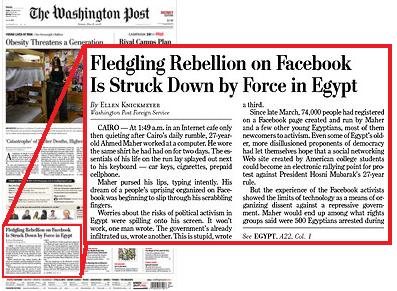
FACT: According to a Sunday Washington Post front-page story today recounting the events leading up to May 4, a “day of strike” called for by social-networkers as a protest against government policies, “By late afternoon, of the 74,000 people who had registered on the Facebook protest page, only 15 – three men and 12 women – were still eager to gather for a protest.”  [Note: the Facebook page had only been launched in late March.]

ANALYSIS: Last week I wrote about media coverage of Egypt’s Facebook affair, and noted that the Post and others had only covered it on media blogs, not in the actual newspaper.

This morning I picked up my Sunday-morning Post and saw the story, “Fledgling Rebellion on Facebook Is Struck Down by Force in Egypt,” right on the front page, which means that across Washington this morning, and other capital cities through clipping services, many in the foreign policy elite and punditocracy may be reading for the first time about the Web 2.0 facet of these events. 

Reporter Ellen Knickmeyer also posted today a related online “Field Notes” column about the challenges of covering the Facebook activists.

AddThis Social Bookmark Button 

Social Networking in Egypt Takes a Political Turn

FACT: In the past two days, reporters for the Los Angeles Times and the Washington Post have each written accounts of the ongoing confrontation in Egypt between the government and online activists – the “Facebook Revolution” as the Post reporter terms it, hyperbolically. One interesting aspect: the two accounts are not carried as actual news stories in the “newspaper” (real or virtual), but as blog posts by the reporters on dedicated foreign-correspondent blogs. The Washington Post account is on the “PostGlobal” uber-blogsite, under Jack Fairweather’s “Islam’s Advance” blog, while the L.A. Times account is on the “Babylon & Beyond” blog, which carries a sub-head of “Observations from Iraq, Iran, Israel, the Arab World and Beyond.”

ANALYSIS: Up to now there’s been little coverage in traditional American media outlets of the emerging political tenor of some social networks in Egypt over the past several months. Major newspapers and the cable-news channels have not explored the topic, but I just returned from some time in Egypt and I learned that of course it is a widely covered and discussed topic there.  One young woman in her 30s, an urban professional, told me “I’m on Facebook all day long!”

Every morning outside my hotel room I would find an English-language newspaper, and for many days in a row it was a different paper – often because they were weekly editions.  That gave me the opportunity to read a variety of opinions from a somewhat broad band, as measured in “distance to/from the government position.”  

Helpfully, on May 6 2008 the Egyptian Mail included a summary of the raging controversy over Facebook, noting that “In Egypt, Facebook is the stage for the latest twist in the generation gap, playing host to politically hungry young Egyptians eager to take on their ageing leader.”  Only at the end of the article did I notice that it was reprinted from a New-York-based Egyptian blogger, the respected Mona Eltahawwy.

Continue reading

IARPA and the Virtual Long Tail

FACT: This week, the Intelligence Advanced Research Projects Activity, an arm of the Director of National Intelligence (DNI), launched its new unclassified website.  What’s there is initially fairly minimal, but they’ll be adding to the public information posted there regularly.

ANALYSIS:  I spent the week in Orlando, as a Keynote speaker at the IARPA “Incisive Analysis Conference.”  I’ll be writing a little more about the conference in the near future, as I saw some great demo’s and spoke to the principal investigators on many excellent and far-sighted advanced research projects sponsored by IARPA.  It was great to be there and to see so many old friends from the intelligence community, the national labs (PNNL, Sandia, Oak Ridge, Livermore), DoD, and innovative commercial R&D outfits.  Also, as the first IARPA conference since the organization’s launch, it was an opportunity to hear new director Lisa Porter communicate her vision and principles, which she did well and I’ll discuss those soon as well.  (She also kidded me about my efforts to make her a cultural phenomenon, but I blamed it on WIRED magazine.)

Continue reading

Google Accelerates Hiring of Nobel Laureates

FACT:  Answering a question in this week’s Business Week about several recent high-profile departures of Google executives and engineers, CEO Eric Schmidt said: “What bothers me is that some people write: ‘So-and-so left the company.’ Well, they don’t also write that we hired 120 people that week, five of whom have Nobel prizes, three of whom have PhDs, and so on, who are beginning their career here now.”

ANALYSIS: There have only been some 700 Nobel Laureates awarded in the history of the program since 1901, according to the official Nobel site, and at least as of a 2001survey there were approximately 210 living Nobel prize-winners.

So, with some trepidation, I calculate that by Schmidt’s aggressive hiring of five Nobel laureates in a typical week, the entire roster of living prize-winners will be working for Google within a year.

Continue reading

“Legally Blonde 2.0” – SoCal Spook at Harvard

Shout out to Chris Rasmussen, a former colleague in the intell biz who emails that he’ll be speaking on uses of Web 2.0 approaches in the Intelligence Community at Harvard’s Kennedy School of Government in June…. as he put it in his email, “I’m pretty sure Danish dudes from southern California have been legallyblonde2.jpgblacklisted from Harvard for hundreds of years. Well the times are changing.”

Chris has been involved in social-networking and other 2.0 efforts in the IC, both at the enterprise level and in grass-roots form — accomplishing the latter and encouraging the former (strongly).  The Kennedy School program, “Web 2.0: Taking Action in Government”  is advertised as “examining the lessons learned from first movers in both business and government and distilling what actions government leaders must now take to harness the power of these new tools and business models.”  (more info here

I especially like that the conference is being organized with the help of Don Tapscott, co-author of  an excellent book: Wikinomics: How Mass Collaboration Changes Everything.

Continue reading

Friendships and Professional Relationships

FACT: The General Accounting Office has lifted a week-old ban imposed on IBM’s ability to win any new federal contracts (or work on new task orders for existing contracts).  But, according to ComputerWorld, “IBM still faces an investigation by the EPA as well as a federal grand jury probe over a bid for a contract at the agency in 2006.” The ban had been imposed because of significant problems in the process surrounding the $84 million Environmental Protection Agency contract, which the company lost last year. 

ANALYSIS: Now that the ban has been lifted, I am glad to relay the news — not only because I blogged about it when imposed but also because I admire IBM and its work for government. But the circumstances made me think about my own current set of relationships with former colleagues in the federal government.

According to the AP’s account of the agreement struck with IBM leading to the ban’s lifting, which I read in Enterprise Security Today, “Several IBM employees allegedly obtained protected information from an EPA employee, ‘which IBM officials knew was improperly acquired, and used the information during its negotiations to improve its chance of winning a contract,’ according to the agreement. Such an act violated federal procedures… IBM has placed five individuals on administrative leave pending its own internal investigation and any federal probe.”

I don’t have more to say about the issue per se, other than riffing on that human aspect of the affair to make a personal comment about my own experience since leaving the federal government’s payroll last December….

Continue reading

Do Voters Love the Candidates… or their Fonts?

FACT:  John McCain, Hillary Clinton, and Barack Obama have chosen distinctively different typeface fonts for their campaign posters, bumper stickers, and TV-ad logos. 

font-gotham-obama.jpgObama uses sans serif Gotham.  McCain uses sans serif Optima. Only Clinton uses a serif, New Baskerville.  According to the Los Angeles Times yesterday, many typographers are following the usage choices closely, and now some political analysts are finding message in the medium; Obama’s choice is “the hot font of 2008,” Clinton’s font flourishes “conjure trustworthiness,” while McCain’s communicates an “old-fashioned yet quirky vibe.”

ANALYSIS:  Anyone who remembers their first experience with a personal computer’s word-processing program recalls that initial thrill when the realization hit: I can choose any font? I can choose any font!!!

Billions of funky emails, resumes, and yard-sale posters later, we’re all perhaps jaded by the profusion of font styles, and tend to have built up biases and defenses regarding certain looks.

Continue reading

From Microsoft’s Cloud – PopFly

I mentioned PopFly in my last post – many Web users are now beginning to appreciate how it enables the fun and ease of innovation for non-technical people. Go to www.popfly.com/ and set up your own account (free of course), and you’ll be able to create usable, powerful “tools” out of the Cloud, or with your own data. 

Continue reading

The Future of Enterprise Computing – and Social Computing

I wrote the other day about how highly ranked the University of Virginia’s undergrad business school is (a close second in BusinessWeek’s annual ranking), and mentioned that one reason is the creative research and programs they sponsor.

In fact, thanks to UVA’s McIntire School of Commerce, I enjoyed a great day recently exploring some of my favorite topics with leading experts.  I was an invited speaker at their one-day conference on The Future of Enterprise Computing on March 14th, presented by McIntire’s Center for the Management of Information Technology (CMIT).  It was a fascinating day….

Continue reading