


Fact: According to a Houston Chronicle editorial urging increased funding for NASA, “The NASA budget approved by Congress is just over $17.3 billion. [A]dded funding is needed to shorten a dangerous 5-year gap between the decommissioning of the three aging space shuttles in 2010 and the first scheduled flight of Orion [the next generation U.S. manned spacecraft] in 2015.”
Analysis: NASA and its long-running race with the Russians is on my mind a bit, for two nifty reasons: first, NASA’s Dr. Lisa Porter is joining the intelligence community to lead advanced R&D (see my post last week), and I serendipitously found a stunning collection of vintage Soviet and European science-fiction images, oh-so-retro, and intend to redecorate my walls with them (or would if my wife would let me).
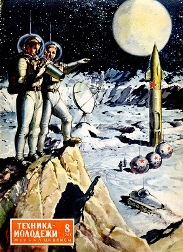 Does NASA need more money? The answer may depend on whether there actually is the potential of a new space race… and if so, toward what goal, and does the U.S. need to win that race. This week’s shot across our bow seems to indicate some Russians are eager for a race to Mars. Lev Zelyony, director of Russia’s prestigious Space Research Institute, was quoted as saying “We lost the race to the moon,” but that reaching the red planet by 2025 would bring “scientific and political prestige” and is “technically and economically achievable.” He added that they have “a head start” in the race, such as it is.
Filed under: Government, R&D, Society, Technology | Tagged: Apollo, NASA, Orion, R&D, Russia, science fiction art, scifi, Soviet, Soyuz, space, space flight, Space Shuttle, Zelyony | 2 Comments »

 Shepherd's Pi