Government Transparency circa 1837

A longtime government watcher told me recently that she’s becoming overwhelmed with the volume of information and self-echoing commentary on “government transparency,” in the  form of official blogs, citizen blogs, Twitter streams, conferences, and even in the pages of those quaint things called “books.”

Save some time. Here is the only piece you need to read about the subject of government openness, with all its implications for honest policy, court politics, and citizen empowerment.  And as you might expect, it’s a fairy tale.

“The Emperor’s New Clothes.” Go on, read it – you haven’t read it since childhood, have you? It’s short, so after you finish it take a moment, if you like, to comment back with your thoughts.

The full text follows, translated from Kejserens nye Klæder,  by Danish poet and author Hans Christian Andersen. There’s also an intellectually annotated version here at SurLaLune, by Information Science scholar Heidi Ann Heiner.

   ~   ~   ~  

Once upon a time there lived a vain Emperor whose only worry in life was to dress in elegant clothes. He changed clothes almost every hour and loved to show them off to his people.
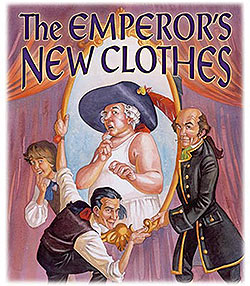
Emperors New ClothesWord of the Emperor’s refined habits spread over his kingdom and beyond. Two scoundrels who had heard of the Emperor’s vanity decided to take advantage of it. They introduced themselves at the gates of the palace with a scheme in mind. “We are two very good tailors and after many years of research we have invented an extraordinary method to weave a cloth so light and fine that it looks invisible. As a matter of fact it is invisible to anyone who is too stupid and incompetent to appreciate its quality.”

The chief of the guards heard the scoundrel’s strange story and sent for the court chamberlain. The chamberlain notified the prime minister, who ran to the Emperor and disclosed the incredible news. The Emperor’s curiosity got the better of him and he decided to see the two scoundrels. “Besides being invisible, your Highness, this cloth will be woven in colors and patterns created especially for you.” The emperor gave the two men a bag of gold coins in exchange for their promise to begin working on the fabric immediately. “Just tell us what you need to get started and we’ll give it to you.” The two scoundrels asked for a loom, silk, gold thread and then pretended to begin working.

The Emperor thought he had spent his money quite well: in addition to getting a new extraordinary suit, he would discover which of his subjects were ignorant and incompetent. A few days later, he called the old and wise prime minister, who was considered by everyone as a man with common sense. “Go and see how the work is proceeding,” the Emperor told him, “and come back to let me know.” The prime minister was welcomed by the two scoundrels. “We’re almost finished, but we need a lot more gold thread. Here, Excellency! Admire the colors, feel the softness!”

The old man bent over the loom and tried to see the fabric that was not there. He felt cold sweat on his forehead. “I can’t see anything,” he thought. “If I see nothing, that means I’m stupid, or worse, incompetent!” If the prime minister admitted that he didn’t see anything, he would be discharged from his office. “What a marvelous fabric, he said then. “I’ll certainly tell the Emperor.”

The two scoundrels rubbed their hands gleefully. They had almost made it. More thread was requested to finish the work. Finally, the Emperor received the announcement that the two tailors had come to take all the measurements needed to sew his new suit. “Come in,” the Emperor ordered. Even as they bowed, the two scoundrels pretended to be holding large roll of fabric. “Here it is your Highness, the result of our labor,” the scoundrels said. “We have worked night and day but, at last, the most beautiful fabric in the world is ready for you. Look at the colors and feel how fine it is.”

Of course the Emperor did not see any colors and could not feel any cloth between his fingers. He panicked and felt like fainting. But luckily the throne was right behind him and he sat down. But when he realized that no one could know that he did not see the fabric, he felt better.

Nobody could find out he was stupid and incompetent. And the Emperor didn’t know that everybody else around him thought and did the very same thing. The farce continued as the two scoundrels had foreseen it. Once they had taken the measurements, the two began cutting the air with scissors while sewing with their needles an invisible cloth. “Your Highness, you’ll have to take Emperors New Clothes 2off your clothes to try on your new ones.” The two scoundrels draped the new clothes on him and then held up a mirror. The Emperor was embarrassed but since none of his bystanders were, he felt relieved. “Yes, this is a beautiful suit and it looks very good on me,” the Emperor said trying to look comfortable. “You’ve done a fine job.”
“Your Majesty,” the prime minister said, “we have a request for you. The people have found out about this extraordinary fabric and they are anxious to see you in your new suit.” The Emperor was doubtful showing himself naked to the people, but then he abandoned his fears. After all, no one would know about it except the ignorant and the incompetent. “All right,” he said. “I will grant the people this privilege.” He summoned his carriage and the ceremonial parade was formed.

A group of dignitaries walked at the very front of the procession and anxiously scrutinized the faces of the people in the street. All the people had gathered in the main square, pushing and shoving to get a better look. Applause welcomed the regal procession. Everyone wanted to know how stupid or incompetent his or her neighbor was but, as the Emperor passed, a strange murmur rose from the crowd. Everyone said, loud enough for the others to hear: “Look at the Emperor’s new clothes. They’re beautiful!” “What a marvelous train!” “And the colors, the colors of that beautiful fabric, I have never seen anything like it in my life!”

They all tried to conceal their disappointment at not being able to see the clothes, and since nobody was willing to admit his own stupidity and incompetence, they all behaved as the two scoundrels had predicted.

A child, however, who had no important job and could only see things as his eyes showed them to him, went up to the carriage. “The Emperor is naked,” he said.

“Fool!” his father reprimanded, running after him. “Don’t talk nonsense!” He grabbed his child and took him away.

But the boy’s remark, which had been heard by the bystanders, was repeated over and over again until everyone cried: “The boy is right! The Emperor is naked! It’s true!”

The Emperor realized that the people were right but could not admit to that. He thought it better to continue the procession under the illusion that anyone who couldn’t see his clothes was either stupid or incompetent.

So he stood, stiffly on his carriage, while behind him a page held his imaginary mantle, carrying the train that wasn’t really there.

The End

Email this post to a friend

AddThis Social Bookmark Button

Place your bets on research

No reason to sugarcoat the Microsoft quarterly financial report issued this afternoon: it reflected the bad news in the overall economy.  Revenue down, earnings down, profits down. 

What I did find most interesting was the silver lining as Business Week points out in its coverage. Like most of Wall Street apparently (MSFT stock rose in after-hours trading), Business Week was impressed with some of the positive steps taken by the company:

Maybe the most striking news is Microsoft’s crisp cost-cutting. Who knew this Midas of the computer industry knew how to scale back so well? In the quarter, administrative costs fell by more than $1 billion, from $2.3 billion to $913 million. And the company completed its first ever general layoff, of 5,000 people. The company did not cut into its R&D budget, however. Spending there rose from $2 billion to $2.2 billion.”

It’s that last point that I’m focusing on, as it demonstrates that the company is living up to CEO Ballmer’s pledge to increase our annual R&D spending – amid this deep recession – from $8 billion a year to over $9 billion.

At a time when most budgets are hurting, that’s quite an investment.  If you’d like to know what we’re getting for that, check out http://research.microsoft.com, or for the most up-to-date reports, use Twitter to follow @MSFTResearch – this week, the Twitter feed has focused on papers and demonstrations we’re presenting at the 18th International World Wide Web Conference (WWW2009).

Email this post to a friend

AddThis Social Bookmark Button

Three cool new projects in Microsoft Research

[April Fool’s Edition]   I haven’t blogged in a little while – been a little busy – so I’ll make up for it with a burst of three cool new things coming out of the inventive lab work at Microsoft Research – improving Twitter, computer performance, and mobile phones.

MegaNano: New High-End Camera for Cellphones

Many people are dissatisfied with the fuzzy quality of photos taken with their built-in cellphone cameras. So Microsoft will be rolling out this summer the most advanced built-in mobile phone-cam on the market, based on a fantastic prototype now in final user testing at Microsoft Research’s Beijing lab.

MegaNanoDubbed the “MegaNano,” the sylish but diminutive camera boasts 72 megapixel resolution and a shutter-speed setting range from 0.003 seconds all the way up to seven hours.

The itty-bitty MegaNano will be launched simultaneously with the new Microsoft Mobile Apps Store, bundled with a nice selection of jackets and outerware with specially reinforced pouch-pockets and backpacks designed to hold the tiny device. 

I know you’ll want one. One beta-tester says, “It’s so small yet so powerful!  I have to remind myself sometimes that the weight on my shoulders is actually a tiny camera!”

Continue reading

Year of Data brings together Apple iPhone, Microsoft Surface, Google Android


Neat video below (Stimulant’s “XRay” project), but first, why I think it’s neat:

Every year is the year of data, I believe.

Continue reading

2.0 View of President Obama’s Inaugural Speech

obama-inaugural-word-cloud

A word-cloud produced (quickly) by the Los Angeles Times.  Befiitting the social-media aspect, the paper published it on Twitter immediately; don’t know if it will even be published as a graphic in the day-old “newspaper” printed and distributed tomorrow.  The New York Times, meanwhile, has the same for every previous presidential inaugural address as well – interesting to scroll back and forth to notice trends in presidential intentions.

Which lines was I most struck by? Because of my national-security interests, I was taken by the strong, even muscular statement to terrorist foes: “You cannot outlast us and we will defeat you.”  That followed on his opening with a declarative statement that ““Our nation is at war against a far-reaching network of violence and hatred.”

Information Week has already this afternoon called it the “First Web 2.0 Inauguration,” arguing that “Web 2.0technologies offered plenty of new experiences and communications tools for those witnessing the historic event.”

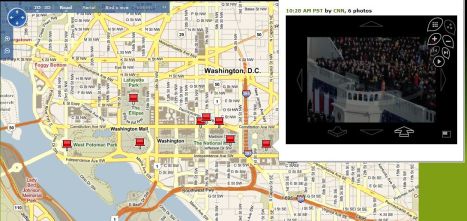
Some of the best set of mashups using cutting-edge technology, to my mind, are the photographs from media and members of the crowd on the Mall, being synthed into 3D Photosynth virtual models. Really cool!inaugural-photosynth


Twitter and other social-media services and channels appeared to hold up well under the crush of traffic. I was pleasantly surprised with the performance of Microsoft’s official streaming of the entire ceremony for the Presidential Inaugural Committee, using Silverlight (same technology was used really nicely for global streaming of the Summer Olympics last year).  In fact, the online streaming was markedly smoother than the ability of the TV networks to speak to reporters reliably down on the Mall – it appeared that network and cellular traffic was constantly cutting out on remote video and microphones.

A moving day, brought to more people than ever before through technology.

 Email this post to a friend

AddThis Social Bookmark Button

Swap Panetta and Blair: A Modest Proposal

First, a quick story from when I was working in government.

Not long after the initial establishment of a “Director of National Intelligence,” the DNI CIO held an inaugural “DNI Information Sharing Conference” in Denver in the summer of 2006. I was asked to sit on a panel about “Innovation across the Intelligence Community,” representing the Defense Intelligence Agency and sharing the stage with two counterparts, from the CIA and NSA.  Our panel chair was Mr. CJ Chapla, then the Chief Technology Officer (CTO) of the old Intelink Management Office, redubbed “Intelligence Community Enterprise Services,” an office now under the Office of the DNI (ODNI). CJ asked the three of us to describe briefly the goals and projects we were each working on, and in seriatim that’s what we did for 90 minutes or so.

When it was time for questions, the very first audience-member asked: “It seems that each of you are independently working on, and paying for, very similar kinds of technology projects. It would make sense to combine or rationalize the work, so why are you continuing to do it independently?” Continue reading

Stretching collaboration with Embodied Social Proxies

My wife and I are spending Christmas this year at home in Montross, and I’m sad that we’re not visiting with family in North Carolina or California.  But I’ve been looking at some new Microsoft research efforts on how to keep in touch with people in more natural ways, particularly valuable for teams working across geographic distances, which is how our Microsoft Institute works.

The question of how distributed teams can work collaboratively is only going to get more challenging, with out-sourcing and crowd-sourcing. Last week the Institute had a great visitor to our Reston digs: Tony Hey, Microsoft’s Corporate Vice President of External Research.  Tony’s bio on Wikipedia mentions his thirty years as a leading European academic (particle physics was his game), along with the excellent books he’s authored: Einstein’s Mirror, and Feynman and Computation.

Continue reading

Some say Obama has already chosen Cyber Czar

I’ll wade into the breach again, of analyzing (and trying to anticipate) some national-security appointments for the new Obama Administration.  Today I must admit that I’m taken with the latest reportage from the U.K. Spectator – a quite conservative publication not usually known for its closeness to the Obama inner circle.

Continue reading

Elbowing for Obama influence between new CTO, new cyber czar

Today’s Friday – usually a big news day in Washington, whether by design (bury bad news late in a deep weekend news hole) or by human error (bureaucrats tried all week to get something done and slipped it in at the deadline).  There should be Obama cabinet announcements today, and meanwhile tech luminaries across the country are sitting by their phones, drumming their fingers and hoping for a call offering them the position of the nation’s first Chief Technology Officer. Norm Lorentz, who was OMB’s first-ever CTO, told C-SPAN this week that “If I were asked, I would serve in a heartbeat.”

Continue reading

Libyan Strongman Ditches Government, Keeps Female Bodyguards

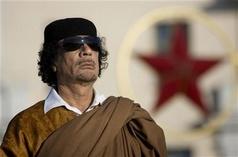
qaddafi-lion-of-the-desertWell, Muammar Qaddafi’s back in the news.  I know you were wondering what was up with him. After all, according to his Wikipedia bio the dashing desert prince is now the world’s longest-serving head of government (thanks, Fidel!).

The U.S. electorate may have just taken a turn to the left, with even George W. Bush sanctioning a massively larger role for government through the Wall Street bailout. But I was tipped today by an astute observer (she’s @krbstr on Twitter) that Qaddafi has announced a breathtakingly libertarian plan “to distribute the proceeds of oil wealth directly to the people and abolish government ministries,” according to a Financial Times story (“Qaddafi Debate Signals Change“). More below on the controversial proposal, but first a personal note.

Continue reading