Loopt Brings Apple, Microsoft Together

I don’t have an iPhone (I like my Windows Mobile 6.1 platform better, on a touch-screen Samsung i760) so I miss iPhone news sometimes.  I’m tardy in learning that, In the words of one of my colleagues at the Institute for Advanced Technology in Governments, “Loopt is launching their app on iPhone and is using Virtual Earth. How did Apple ever allow that to happen?”  🙂

Continue reading

Semantic Reality (Microsoft Acquires Powerset)

Fact: At last, the public announcement this afternoon of one of the most-rumored secrets in tech: Microsoft is acquiring Powerset, taking us one major step forward in semantic technologies. 

Analysis: There’ll be plenty of analysts looking at this, and I expect the acquisition will get a lot of buzz just as Powerset did originally when launched.  After all, Microsoft is buying a company which was called a “Google-Killer” by everyone from the New York Times to various esoteric search-technology blogs.  [Update: it’s already started on TechCrunch.]

If you haven’t used Powerset’s first announced product, semantic searching of Wikipedia, check it out on their site and you’ll begin to see why there’s been so much interest in their technical approach. I’ve known founder Barney Pell for a while now, and we’ve mused about the possibilities of adding Powerset’s strengths to Microsoft’s global scale.  The more I played with PowerLabs, before its full launch, the more I was convinced of its power.

When I was working at DIA, one of our dreams was a semantically enabled intelligence enterprise. IC analysts and advanced users within any other enterprise vertical are going to find some very interesting capabilities finally possible when Powerset technology is wedded to the FAST search software already being deployed at web scale. But that’s only the beginning.  Continue reading

Web Security and New Media in Politics

FACT: The Obama presidential campaign has been lauded for innovative uses of the Web and social media, particularly for fundraising and volunteer recruitment.  But as PC World has just reported, “Two months after their Web site was hacked, the organizers of Barack Obama’s presidential campaign are looking for a network security expert to help lock down their Web site…. Security experts said this is the first time they can remember seeing a Web security job advertised for a political campaign.”

ANALYSIS:  I wrote before about my experience in 1994-95 helping build one of the Internet’s first political campaign websites – I designed the content and wrote much of it, for Mayor Frank Jordan of San Francisco.  (The pages were literally built and posted by mayoral son Thomas Jordan, by the way, who was then a college student at UC-Berkeley; he went on to great things at Pixar.)   At the time, with such a simple site, we didn’t have to worry much about security – or so we thought, and luckily the worst scandal in those early years involved domain-squatting by certain rival campaigns.

As PC World points out, though, “Obama’s Web site, built by Facebook cofounder Chris Hughes, has been the model of Web 2.0 campaigning, using social-networking techniques to raise funds and build a broad base of active, Internet-savvy supporters. But security experts have long warned that powerful Web site features also open new avenues for attack.”

Continue reading

Update on Facebook-in-Egypt

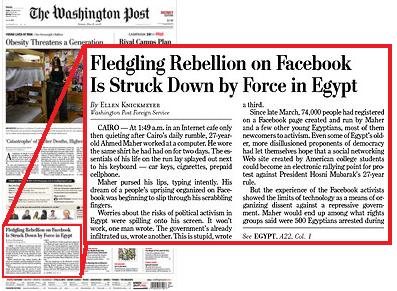
FACT: According to a Sunday Washington Post front-page story today recounting the events leading up to May 4, a “day of strike” called for by social-networkers as a protest against government policies, “By late afternoon, of the 74,000 people who had registered on the Facebook protest page, only 15 – three men and 12 women – were still eager to gather for a protest.”  [Note: the Facebook page had only been launched in late March.]

ANALYSIS: Last week I wrote about media coverage of Egypt’s Facebook affair, and noted that the Post and others had only covered it on media blogs, not in the actual newspaper.

This morning I picked up my Sunday-morning Post and saw the story, “Fledgling Rebellion on Facebook Is Struck Down by Force in Egypt,” right on the front page, which means that across Washington this morning, and other capital cities through clipping services, many in the foreign policy elite and punditocracy may be reading for the first time about the Web 2.0 facet of these events. 

Reporter Ellen Knickmeyer also posted today a related online “Field Notes” column about the challenges of covering the Facebook activists.

AddThis Social Bookmark Button 

Social Networking in Egypt Takes a Political Turn

FACT: In the past two days, reporters for the Los Angeles Times and the Washington Post have each written accounts of the ongoing confrontation in Egypt between the government and online activists – the “Facebook Revolution” as the Post reporter terms it, hyperbolically. One interesting aspect: the two accounts are not carried as actual news stories in the “newspaper” (real or virtual), but as blog posts by the reporters on dedicated foreign-correspondent blogs. The Washington Post account is on the “PostGlobal” uber-blogsite, under Jack Fairweather’s “Islam’s Advance” blog, while the L.A. Times account is on the “Babylon & Beyond” blog, which carries a sub-head of “Observations from Iraq, Iran, Israel, the Arab World and Beyond.”

ANALYSIS: Up to now there’s been little coverage in traditional American media outlets of the emerging political tenor of some social networks in Egypt over the past several months. Major newspapers and the cable-news channels have not explored the topic, but I just returned from some time in Egypt and I learned that of course it is a widely covered and discussed topic there.  One young woman in her 30s, an urban professional, told me “I’m on Facebook all day long!”

Every morning outside my hotel room I would find an English-language newspaper, and for many days in a row it was a different paper – often because they were weekly editions.  That gave me the opportunity to read a variety of opinions from a somewhat broad band, as measured in “distance to/from the government position.”  

Helpfully, on May 6 2008 the Egyptian Mail included a summary of the raging controversy over Facebook, noting that “In Egypt, Facebook is the stage for the latest twist in the generation gap, playing host to politically hungry young Egyptians eager to take on their ageing leader.”  Only at the end of the article did I notice that it was reprinted from a New-York-based Egyptian blogger, the respected Mona Eltahawwy.

Continue reading

“Legally Blonde 2.0” – SoCal Spook at Harvard

Shout out to Chris Rasmussen, a former colleague in the intell biz who emails that he’ll be speaking on uses of Web 2.0 approaches in the Intelligence Community at Harvard’s Kennedy School of Government in June…. as he put it in his email, “I’m pretty sure Danish dudes from southern California have been legallyblonde2.jpgblacklisted from Harvard for hundreds of years. Well the times are changing.”

Chris has been involved in social-networking and other 2.0 efforts in the IC, both at the enterprise level and in grass-roots form — accomplishing the latter and encouraging the former (strongly).  The Kennedy School program, “Web 2.0: Taking Action in Government”  is advertised as “examining the lessons learned from first movers in both business and government and distilling what actions government leaders must now take to harness the power of these new tools and business models.”  (more info here

I especially like that the conference is being organized with the help of Don Tapscott, co-author of  an excellent book: Wikinomics: How Mass Collaboration Changes Everything.

Continue reading

Microsoft May Have a Killer Cloud App – Live Mesh

Microsoft Mesh LogoGot a technical briefing on Live Mesh today in Redmond, and I’m impressed – particularly by the demonstrated commitment to interoperability through adhering to web standards – and the very cool Live Desktop giving you remote access to all your files and folders from any device (work computer, home laptop, mobile phone) with  the new Microsoft Device Connectivity Service.

This is what will bring Cloud Computing down to earth.

Continue reading

Intriguing Politics – Social Media Discussion

FACT:  The second International Conference on Weblogs and Social Media (ICWSM) wrapped up yesterday in Seattle. It was organized again by the Association for the Advancement of Artificial Intelligence (or AAAI), with co-sponsorship by Microsoft, Google, and several universities and Web 2.0 companies. The papers are already being posted online here, which is great as there were some very interesting topics explored. 

ANALYSIS:   One really thought-provoking theme was proposed by Matthew Hurst, a scientist at Microsoft’s Live Labs (and co-creator of BlogPulse), who was a participant on the “Politics and Social Media” panel.  He’s summarized his points on his own blog, but it’s definitely worth pointing out the key distinction he posed:

Firstly, politics is about scaling social organization. A premier can’t talk to every citizen, so s/he has lieutenant’s. They have their own underlings, and so on in a typical hierarchical/departmental structure. Social media, however, is all about individuals – we read entries in weblogs, etc. So, if a politician wants to connect via social media, isn’t there some sort of fundamental mismatch? Obama may have 20, 000 followers on Twitter, but how many comments has he left on blog posts?

Secondly, there is the issue of social media amplifying the polarization (or homophily) found in any topical community. Thus, individuals look around at their neighbours in the social graph and see much of what they themselves are made of.

This bottom-down, top-up dichotomy has been discussed more generally about social media and social networks (often drawing a sharp distinction between “old-media” and “new-media,” or more colloquially if imprecisely as between “the media” and “the web.”)

Continue reading

Google’s Argument to Enterprise IT: “Trust Us”

FACT:  Yesterday, Google’s Dave Girouard, VP of enterprise sales, gave a keynote speech on “The Evolution of Cloud Computing” at FOSE, a Washington trade-show focusing on federal government and military IT customers.  According to a Washington Post reporter’s blog account afterwards:

[Girouard said] “Google will have to do things differently” to work with defense and intelligence agencies, where data security and privacy are held to the tightest standards. But he argued that having information spread across hundreds of different servers is actually more secure than housing data on a few servers at a specific location. “Security is now more virtual than physical,” he said.

ANALYSIS:  The Google salesman (Girouard is VP of enterprise sales) was speaking at FOSE on the same day I made an April Fools blogpost featuring a lame “Cloud Computing” joke (see it here, come back when you stop laughing).  

This year I’m at FOSE as neither buyer nor speaker; the past couple of years I spoke at FOSE, as a DIA official, and I always enjoy walking the exhibit floor, plus I was curious about Girouard’s take on Google’s current move into the federal space.

To be honest I’ve met him before when he was with Virage and he’s a fine fellow, a good salesman.

The rhetoric of his main pitch, though, seems to be battling uphill, and I’m not sure he gets a nuanced distinction.

Continue reading