Microsoft Research Reclaims Value of Pi

pi-techFACT: Educators in the state of Alabama are chafing as the state celebrates a dubious anniversary: today marks ten years since the Alabama state legislature voted to change the value of the mathematical constant pi from 3.14159… to the “Biblical value” of 3.0.  Ramifications were felt across the state. 
Now, a team of Microsoft Research computer scientists have announced success in a groundbreaking effort to refactor the Biblical value, using modern high-performance computing hardware and machine-translation technologies on the original Old Testament texts.
  
ANALYSIS:  Looking back, an April 1998 issue of Science and Reason newsletter written by physicist Mark Boslough recounts the political and cultural battles which went behind the Alabama legislative change. The legislature of the “Yellowhammer State” justified the change by citing biblical injunction. As one supporter put it: “the Bible very clearly says in I Kings 7:23 that the altar font of Solomon’s Temple was ten cubits across and thirty cubits in diameter, and that it was round in compass.”

The use of “3.0” as the value of pi led to problems in schools, businesses, and local scientific pursuits, including a group of frustrated engineers at the NASA research facility in Huntsville.  According to NASA/Huntsville’s director of special projects “Dr.” Jim Simon (doctorate pending), “We had strayed from using our Microsoft software and instead had been trying to figure out how to use an advanced Google search platform, which was sold to us as a powerful Cloud Computing system.”

Unfortunately, that effort proved frustrating for the “rocket scientists” any time they used calculations involving pi, based on the Alabama-standard value of 3.0, mostly because they were under the mistaken impression that they were contractually barred from using Cloud Computing on any sunny days. Given the hospitable local weather that left them unable to use their computers for an average of 290 days each year.

Continue reading

From Microsoft’s Cloud – PopFly

I mentioned PopFly in my last post – many Web users are now beginning to appreciate how it enables the fun and ease of innovation for non-technical people. Go to www.popfly.com/ and set up your own account (free of course), and you’ll be able to create usable, powerful “tools” out of the Cloud, or with your own data. 

Continue reading

The Future of Enterprise Computing – and Social Computing

I wrote the other day about how highly ranked the University of Virginia’s undergrad business school is (a close second in BusinessWeek’s annual ranking), and mentioned that one reason is the creative research and programs they sponsor.

In fact, thanks to UVA’s McIntire School of Commerce, I enjoyed a great day recently exploring some of my favorite topics with leading experts.  I was an invited speaker at their one-day conference on The Future of Enterprise Computing on March 14th, presented by McIntire’s Center for the Management of Information Technology (CMIT).  It was a fascinating day….

Continue reading

How Not to Predict Stock Performance

Google hasn’t had a great week on the stock market so far, but it isn’t often that you get to use the words “Google stock” and “kick ’em while they’re down” in the same sentence, so…

I like my own little subtle “inside jokes” a bit too much sometimes. If you’re sharp-eyed you’ll have noticed that on the left-hand margin, down a ways, is an RSS feed featuring the latest news stories which include the phrase, “the next Google.” Yes, I use Google News itself to drive the RSS feed, ha ha.

Continue reading

Silverlight 2.0: It’s “1 better than 1.0”

Last week I was visiting an intelligence community facility which has been known for several years for housing some of the brightest and most innovative adopters of Web 2.0 approaches for classified systems. I could say who and where, but then I’d have to… well, not kill anyone, just apologize to all my other friends at other agencies who think they’re the cat’s meow on classified Web 2.0. (With any luck this anonymity now makes each of them think, “Wait, who’s more advanced than we are?  How can we catch up??!”)Well, it turns out they’re excited about something new & cool they would like to use.

Continue reading

Social (Network) Science

Fact: The social-networking site LinkedIn claims as users “17,000,000+ Professionals, 500,000+ Senior Executives, Executives from 498 Fortune 500 companies, [and] 65,000 new Professionals every week.”

Analysis: Since I hold the title of “chief technology officer” for my group at Microsoft, I regularly check the widely-read blog CTOvision, written by Bob Gourley, CTO of Crucial Point.

CollaborationlogosYesterday he posted a very solid summary of several social networking tools, including my preferred LinkedIn.  If you’re not up to speed on the genre it is a helpful cheatsheet and “buyer’s guide.”

The technology area deserves the attention. There are a dozen or more such sites for each that Gourley covers, and he chooses the ones that have shown growth and potential longevity; why invest any time adding personal data to a site just to watch it disappear? We’ve all had that happen. And yet hockey-stick growth has to be managed – LinkedIn for example has come in for some critical attention for some snafus along the way.

Let’s look at some efforts to understand more about the science behind the software….

Continue reading

Mashup Markoff

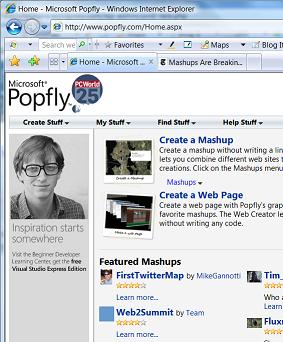
popfly.jpgJohn Markoff has a great story (that phrase belongs on a cut-n-paste clipboard) in today’s NY Times about PopFly, one of my favorite new Microsoft programs because it is so darned fun, and easy, and flexible – and potentially revolutionary.

I’m both a friend and fan of Markoff, but read his piece and you’ll see what I mean, as the examples he cites are pretty cool – or jump to the site itself.

PopFly is getting a lot of attention and coverage, landing on PCWorld’s list in December of “25 Most Innovative Products of the Year.”

Continue reading

Driving during the Super Bowl? Use a Mashup First

Fact: According to a report, “Taking Back the Airwaves” in the Buffalo News last month, “Listeners’ relationship with radio has changed in the last 25 years. Radio used to be the main source of music, … but now, like other industries, radio is fighting to reinvent itself in a digital age.”

Analysis: Let’s say you were an Air Force mission planner, and wanted to plan a particular flight over enemy territory.  Time-honored practices (and traditionally clunky but powerful software built custom for the purpose) allow you to overlay the enemy’s known radar-emitting sites, using circles or shapes to indicate the covered and non-covered areas, and to do the same with anti-aircraft missile ranges, allowing the precise planning of a safe flight route.

Now let’s look at a nifty adaptation, showing that there are much more fun and practical everyday uses of such an approach – and now new technologies make it much easier and faster to accomplish! Continue reading

Live may get (even more) personal

A welcome bit of news: Greg Linden, a very very smart pioneer in the personalization of information flow, has announced he is joining Microsoft, specifically Live Labs, the increasingly energetic dynamo at the heart of the company’s future online plans.  Gary Flake, who leads Live Labs, was one of the key people to convince me late last year to join Microsoft, and now Gary has convinced Linden to work on the Live team.  Linden was of course the founder of Findory.com, and before that was in on the early years of Amazon, writing its recommendation engine and leading the software team that developed Amazon’s personalization systems.  Excellent hire.

Email this post to a friend

AddThis Social Bookmark Button

A-Space: Top-secret social networking

Fact: As reported in InformationWeek recently, “In December, the DNI will launch A-Space, a portal that will eventually include everything from wikis, blogs, and social networking; built using SOA.”

Analysis: Our team at DIA got assigned by the Director of National Intelligence (DNI) to design and build A-Space, a brand new social-networking environment for the full intelligence community – “the MySpace for spies.” We’re talking a very high-walled Walled Garden.

I had to devote (not to say divert) some of our most talented people leading the all-important Alien program to this new effort, which really only began in September. Phase I of A-Space must go live by the end of the year; Phase II (with more advanced Web 2.0 capabilities) just a few months later.

Continue reading